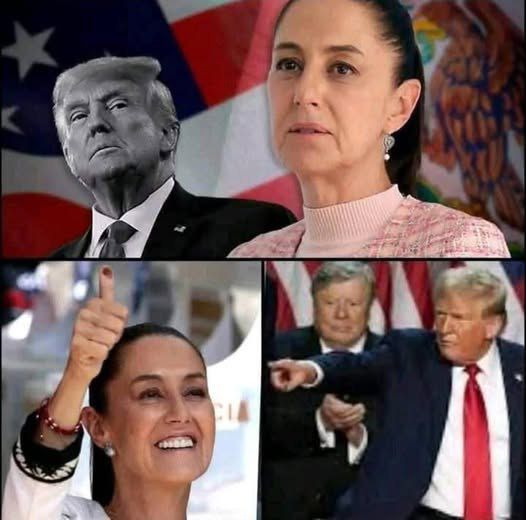
Recent remarks from Mexico’s president have drawn global attention after she addressed comments and proposals connected to U.S. President Donald Trump. The leader of Mexico, Claudia Sheinbaum, made it clear that her government does not accept the idea of U.S. military intervention in Mexico, stressing that the country’s sovereignty must be respected. Her statements come during a period of rising tensions and intense debate over how both nations should deal with drug cartels, migration, and security along the border.
Sheinbaum’s comments were largely a response to proposals from Trump suggesting stronger U.S. action against drug cartels that operate across the border. Some of those proposals included the possibility of using American military forces to target cartel groups inside Mexico. The suggestion sparked immediate controversy because it raises sensitive issues about national sovereignty and foreign military presence.
According to statements made by the Mexican president, she rejected the idea outright. She explained that while Mexico is willing to cooperate with the United States through intelligence sharing and joint strategies, it will not allow U.S. troops to operate inside Mexican territory. In public remarks, Sheinbaum emphasized that Mexico is a sovereign nation and must handle its internal security matters itself.
Her message was clear and direct: collaboration between the two countries is welcome, but intervention is not. She reportedly told Trump that Mexico could work together with the United States to fight organized crime, but any military operations must be carried out by Mexican authorities on Mexican soil.
This disagreement highlights the broader tensions that sometimes arise between the two neighboring countries. The United States and Mexico share one of the most complex and interconnected relationships in the world. Their economies are deeply linked through trade agreements, supply chains, and cross-border commerce. At the same time, issues such as migration, drug trafficking, and border security frequently lead to political disagreements.
Trump has long taken a hard-line approach to drug cartels and illegal immigration. His administration has described certain cartel groups as terrorist organizations, arguing that this designation allows the United States to use stronger legal and military tools against them. Some U.S. officials have suggested that such designations could justify cross-border operations targeting cartel infrastructure.
For Mexico, however, such proposals touch on deeply sensitive historical and political concerns. Mexico has a long-standing policy of defending its territorial sovereignty and avoiding foreign military involvement in domestic affairs. Many Mexican leaders, across different political parties and administrations, have insisted that security operations within Mexico must remain under Mexican control.
Sheinbaum’s response reflects that tradition. She has repeatedly said that cooperation between the two countries should focus on intelligence sharing, technology, and coordinated law enforcement efforts rather than foreign troops entering Mexico.
At the same time, she has acknowledged that cartel violence remains one of the most serious challenges facing her country. Drug trafficking organizations have become extremely powerful over the past several decades, operating across international borders and generating billions of dollars from illegal drugs, human trafficking, and other criminal activities.
Both governments agree that these criminal groups must be confronted, but they differ on the best way to do it. The United States tends to emphasize aggressive enforcement and the disruption of cartel networks, while Mexico often focuses on a broader strategy that includes social programs, economic development, and law enforcement reforms.
Despite these disagreements, diplomatic relations between the two countries continue. Mexico and the United States remain major trading partners, connected through the United States–Mexico–Canada Agreement, often called USMCA. Trade between the two nations reaches hundreds of billions of dollars every year, making cooperation essential for economic stability.
Political leaders on both sides of the border understand that maintaining a functional relationship is crucial. While disagreements over security policies may make headlines, the two countries also work together on many issues, including border infrastructure, anti-trafficking operations, and economic partnerships.
Sheinbaum has also tried to reassure the Mexican public that tensions with Washington do not necessarily mean a breakdown in relations. She has stated that dialogue remains open and that both governments continue to communicate regularly.
Analysts say the debate reflects broader questions about how nations cooperate in dealing with transnational crime. Drug cartels operate across borders, making it difficult for any one country to tackle the problem alone. However, allowing foreign military forces inside another country raises legal, political, and diplomatic challenges.
For many observers, the exchange between Trump and Sheinbaum illustrates how complicated international security cooperation can be. On one side is the urgency to stop powerful criminal networks; on the other is the need to respect national sovereignty and political independence.
As discussions continue, both governments are expected to keep negotiating ways to strengthen cooperation without crossing political red lines. Whether through intelligence sharing, coordinated policing, or economic measures aimed at weakening criminal organizations, the challenge remains enormous.
What is clear is that the issue of cartel violence and border security will continue to shape relations between the United States and Mexico for years to come. And as leaders like Donald Trump and Claudia Sheinbaum debate the best path forward, the world will be watching closely to see how these two neighboring nations balance cooperation with sovereignty