Teen Pallbearers Step In to Honor the Deceased with No Family
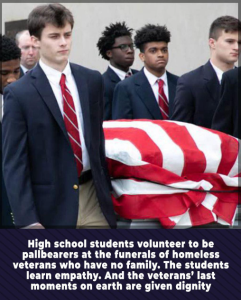
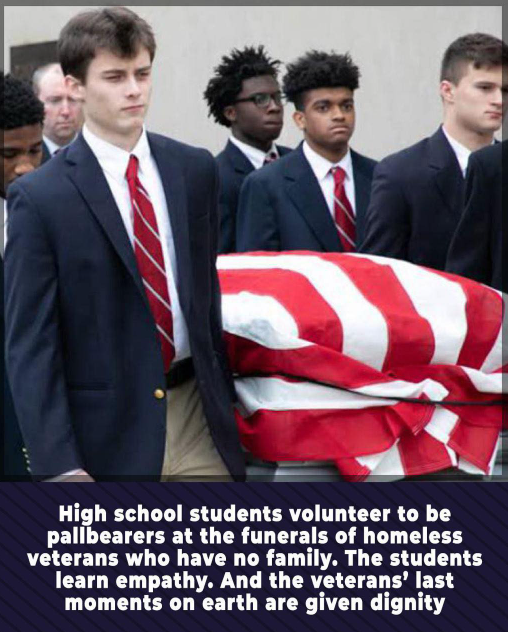
In a quiet town where everyone seemed to know everyone else, an extraordinary act of compassion unfolded one gray afternoon. The chapel was small, the pews mostly empty, and the air heavy with the kind of silence that only comes when grief has no one to sit beside it. At the front of the room lay a casket belonging to a man who had lived his final years alone. He had no known relatives, no close friends to speak his name aloud one last time. By all accounts, his life was modest and unnoticed. But on the day he was laid to rest, he was not alone. Six teenagers—students from the local high school—stepped forward to carry him, giving dignity where none was expected and presence where absence had ruled.
The story began with a call from the funeral director to the school’s guidance office. He explained that the deceased had no next of kin and that no one had come forward to serve as pallbearers. Traditionally, pallbearers are chosen from family or close friends—those who knew the person best. But in this case, there was no one to ask. The director didn’t want the man to be carried by strangers in silence or wheeled out without ceremony. He asked if the school might have volunteers who would be willing to honor a person they had never met.
When the guidance counselor shared the request with a group of seniors, the room went still. At first, no one spoke. The idea of carrying a stranger to his grave felt heavy—not just physically, but emotionally. Then one student raised his hand. “Someone should be there for him,” he said. Another nodded. Soon, six teens had volunteered, each motivated by a quiet sense of responsibility that went beyond extra credit or public recognition. They didn’t know his name, his past, or the life he had lived—but they knew that no one deserves to be forgotten.
On the morning of the funeral, the teenagers arrived early, dressed in dark suits borrowed from fathers and older brothers. Their shoes were freshly polished, their hair neatly combed. They stood awkwardly at first, hands folded in front of them, unsure where to look. The chapel was still nearly empty, with only the funeral director and a pastor present. No family. No flowers from loved ones. Just a simple casket and a few chairs.
Before the service began, the funeral director explained the role of pallbearers—the responsibility, the care, the quiet reverence. He showed them how to lift together, how to move in unison, how to keep their eyes forward. But more than the physical instructions, he spoke about the meaning behind the act. “You are the last people who will walk with him,” he told them. “That matters.”
As the organ music started, the teens took their places beside the casket. Their faces were solemn, but their posture was steady. When the time came, they lifted together, feeling the weight of the man they had never known. Each step down the aisle felt deliberate. The sound of their shoes on the floor echoed in the empty room, a reminder of how quiet this goodbye was. Yet in that quiet, there was something deeply human—an unspoken promise that even a life without witnesses would not end without respect.
During the short service, the pastor spoke not about achievements or family stories, but about the inherent value of every life. He said that dignity is not something you earn through popularity or success—it is something you are born with. The teenagers listened, some staring at the floor, others at the casket. One of them later said it was the first time he truly understood that death doesn’t care how many people you knew, only how you are treated at the end.
When it was time to leave the chapel, the teens again lifted the casket, carrying it outside to the waiting hearse. The sky was overcast, and a light drizzle had begun to fall. It felt fitting—nature offering its own kind of farewell. As they slid the casket into place, one of the boys quietly made the sign of the cross, though no one had asked him to. It was instinct, a final gesture of respect.
At the cemetery, the same six teens carried the casket to the gravesite. There were no mourners gathered around—just them, the pastor, and the funeral staff. As the casket was lowered into the ground, the students stood in a line, hats off, heads bowed. For a moment, the world seemed to pause. The man had no one else to remember him—but for those few minutes, he was not invisible.
Afterward, the teens didn’t talk much on the ride back to school. The usual laughter and music were absent. Instead, there was reflection. One student finally broke the silence. “I keep thinking…what if that was me someday?” No one answered right away, but everyone understood the question. It wasn’t about fear—it was about empathy.
Word of what they had done spread quickly through the community. Teachers, parents, and even strangers reached out to thank them. But the teens didn’t see themselves as heroes. To them, it felt like the bare minimum of human decency. One girl said, “He didn’t have anyone. So we were his anyone.”
In a world often driven by attention, likes, and public praise, their act stood out precisely because it wasn’t done for any of those reasons. There were no cameras in the chapel, no social media posts from the teens themselves. They simply showed up. And sometimes, showing up is the most powerful thing you can do.
The man they carried may never be remembered by name. His life may not make it into history books or headlines. But because six teenagers chose compassion over indifference, his final journey was marked by dignity. He was not alone at the end.