🦖⛰️ Can You See Two People Hugging or a Dinosaur in This Mountain? This Mind-Bending Optical Illusion Is Leaving Everyone Amazed!
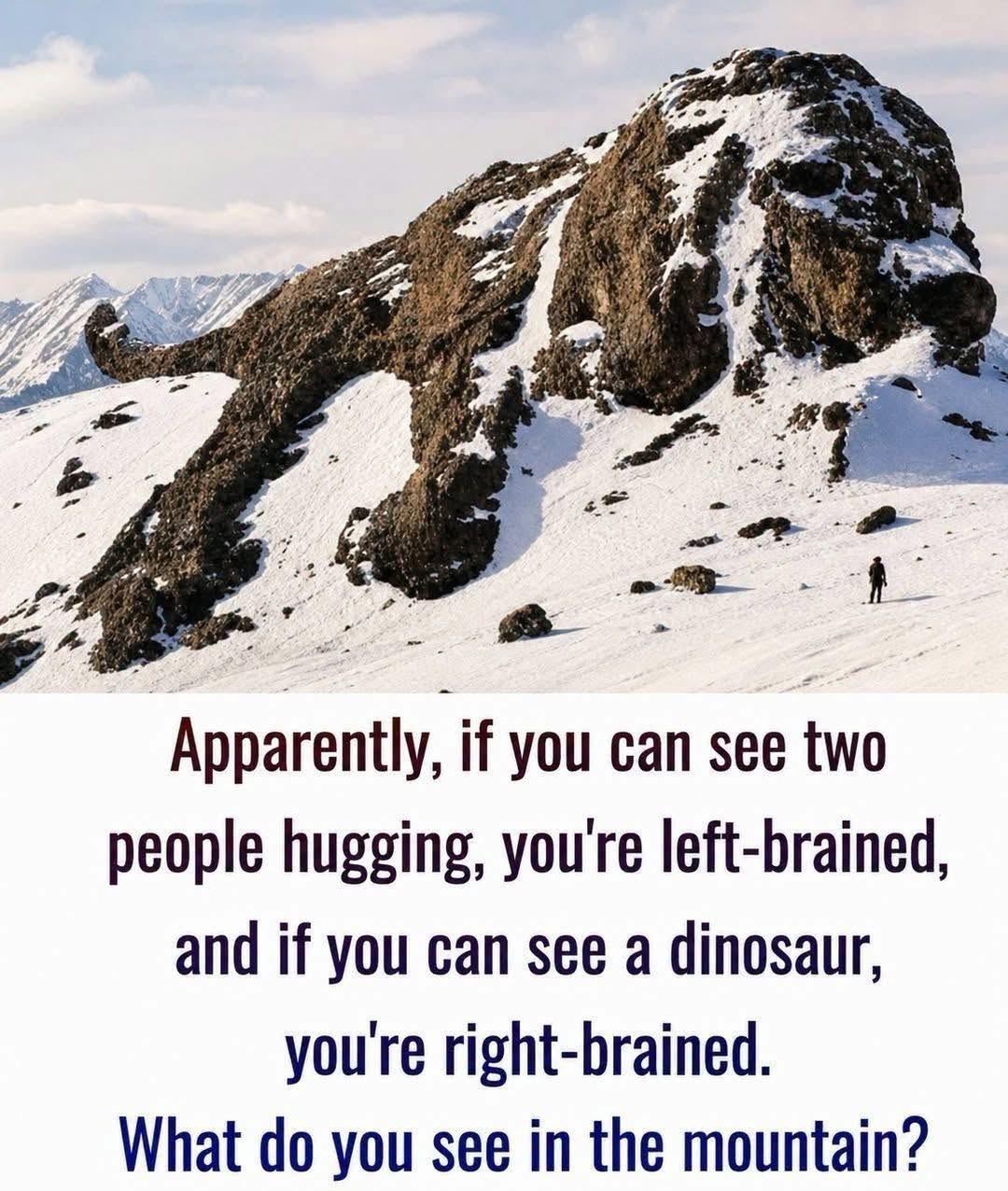
At first glance, it looks like an ordinary photograph of a snow-covered mountain. But look a little closer, and you might discover something extraordinary hidden in the rocks. Some people immediately see what appears to be a giant dinosaur standing on a snowy mountainside, while others notice something completely different: two people who seem to be embracing each other.
The fascinating question is simple: What do YOU see first? 🧐
This unusual photograph has captured the attention of people who enjoy visual puzzles, optical illusions, and brain teasers. It challenges the way we interpret shapes and patterns, reminding us that sometimes two people can look at exactly the same picture and see two entirely different things.
And the best part? There is no need to be an expert in psychology to enjoy the mystery.
🦖 The Dinosaur Hidden in the Mountain
For those who see a dinosaur, the mountain suddenly becomes something much more exciting than a collection of rocks and snow.
The enormous rock formation appears to have the shape of a prehistoric creature. Its large upper section resembles a head, while the uneven rocky surfaces create the impression of a massive body. One extended formation looks almost like a tail, and other sections seem to form legs or parts of the creature’s body.
The resemblance is particularly interesting because the surrounding snow helps highlight the dark outlines of the rocks.
Once someone points out the dinosaur, it can become difficult to look at the photograph without seeing it again. Your imagination begins connecting the shapes, creating an image of a giant creature frozen in the mountains.
Some viewers might even imagine a dinosaur from millions of years ago, standing proudly in a snowy prehistoric landscape.
Of course, the mountain is not actually a dinosaur. It is a natural rock formation, and the dinosaur is an interpretation created by the viewer’s visual perception.
Nevertheless, that is exactly what makes optical illusions so entertaining.
❤️ The Two People Hugging
Other viewers notice something entirely different.
Instead of a prehistoric animal, they see what appears to be two people embracing each other.
The arrangement of the rocks creates the impression of two figures facing one another, with their bodies close together and their arms appearing to wrap around each other.
It is a beautiful interpretation because it transforms a cold, rocky mountain into an image that suggests warmth, affection, and human connection.
For these viewers, the photograph is less about dinosaurs and more about the unexpected appearance of a touching human moment.
Imagine walking through a snowy mountain landscape and suddenly noticing what looks like two people sharing a hug. It is a reminder that our imagination can find familiar shapes in even the most unexpected places.
And once again, the mountain itself has not changed. Only the way we interpret it has changed.
🧠 Does What You See Reveal How Your Brain Works?
The text accompanying this photograph suggests that seeing two people hugging means you are left-brained, while seeing a dinosaur means you are right-brained.
It is an entertaining idea, but there is an important scientific detail worth understanding.
The human brain has two hemispheres, commonly called the left and right hemispheres. Both sides communicate continuously and work together to help us understand the world.
Certain functions show some degree of specialization. For example, language processing is more strongly associated with particular networks that are often left-dominant, while some aspects of spatial attention involve networks with important right-hemisphere contributions.
However, the popular idea that people are either completely left-brained or right-brained is an oversimplification.
Scientific research does not support the claim that choosing one interpretation of an optical illusion proves that someone has a particular personality or a dominant side of the brain.
Seeing a dinosaur does not mean you are automatically more creative, and seeing two people hugging does not mean you are necessarily more logical.
What you see may depend on several factors, including your attention, imagination, previous experiences, and the visual patterns your brain recognizes first.
That is what makes this photograph such an enjoyable conversation starter.
👀 Why Do Different People See Different Things?
Our brains are constantly working to interpret the enormous amount of information entering our eyes.
When we look at an unfamiliar object, our brains try to recognize patterns by comparing them with shapes and experiences we already know.
For example, a cloud might look like a rabbit to one person and a ship to another. A tree branch might resemble an animal, while a collection of stones might appear to form a human face.
This process is sometimes called pareidolia.
Pareidolia is the tendency to recognize familiar patterns, particularly faces and objects, in random or ambiguous visual information.
It explains why people sometimes see faces in clouds, animals in rock formations, and familiar figures in the shadows.
The mountain photograph is a perfect example of how this process can make an ordinary landscape seem extraordinary.
Your eyes collect the visual information, but your brain helps organize and interpret what you are seeing.
That interpretation is not always identical from one person to another.
❄️ Nature Is Full of Unexpected Shapes
One of the most wonderful things about nature is that it rarely produces perfectly organized patterns.
Mountains, rocks, clouds, rivers, and trees develop through natural processes that create unusual shapes and formations.
Wind, ice, rain, temperature changes, erosion, and geological activity can gradually transform landscapes over thousands or even millions of years.
Sometimes the resulting shapes look surprisingly familiar.
A rocky mountain might resemble a sleeping giant. A cliff might look like an enormous animal. A cloud might resemble a person waving from the sky.
These similarities are not necessarily intentional. They are simply examples of how the human imagination finds recognizable patterns in the natural world.
That is why photographers and nature enthusiasts often enjoy capturing unusual landscapes.
A single photograph can inspire dozens of different interpretations, depending on the person looking at it.
🤔 Try This Simple Optical Illusion Challenge
Here is a fun way to test your own visual perception.
First, look at the mountain photograph without reading the comments or asking anyone what they see.
Take a few seconds to examine the large rock formation.
Do you immediately recognize a dinosaur?
Can you identify what looks like its head, body, and tail?
Or do you see two people standing close together, seemingly sharing a hug?
If you cannot see either image immediately, try stepping away from the photograph for a moment and looking again.
Sometimes changing your focus helps you notice details you previously overlooked.
You can also ask a friend or family member to examine the picture without telling them what the two possible interpretations are.
Their first reaction might surprise you!
The most interesting part is comparing everyone’s answers. People may confidently describe completely different shapes even though they are looking at the same photograph.
🌍 Why Optical Illusions Are So Popular
Optical illusions have fascinated people for generations because they reveal just how interesting human perception can be.
They are simple, entertaining, and accessible to almost everyone.
You do not need special equipment, advanced knowledge, or complicated instructions. All you need is a picture and a little curiosity.
Some illusions involve colors that appear to change. Others use lines and geometric shapes to confuse our sense of distance or movement.
There are also hidden-object photographs that challenge viewers to find animals, faces, or everyday objects concealed within complicated backgrounds.
These puzzles are especially popular on social media because they encourage people to participate rather than simply scroll past an image.
Everyone wants to share what they see, compare answers, and discover whether their friends notice something different.
And sometimes the simplest photograph creates the biggest discussion.
❤️ The Real Beauty of Seeing Things Differently
Perhaps the most meaningful lesson from this mountain photograph has nothing to do with which side of the brain is dominant.
It reminds us that people can experience the same world in different ways.
One person sees a dinosaur. Another sees an embrace. Someone else might simply see a beautiful mountain covered in snow.
None of these interpretations needs to become an argument.
Our experiences, imagination, attention, and individual perspectives all influence how we understand the things around us.
Sometimes, looking at something from another perspective reveals a detail we would never have noticed on our own.
That is part of the beauty of human imagination.
The next time you look at a cloud, a mountain, or an unusual rock formation, take a moment to appreciate what your mind discovers.
You might find something surprising hiding in plain sight.
🔥 NOW IT’S YOUR TURN!
Look carefully at the photograph one more time.
Which image appeared in your mind first?
🦖 TEAM DINOSAUR: You see a giant prehistoric creature hidden in the mountain!
❤️ TEAM HUGGING: You see two people embracing each other!
🤔 TEAM BOTH: You can recognize both images depending on how you look at the photograph!
There are no wrong answers, and this fun visual challenge is not a scientific personality test.
Share this picture with your friends and family and ask them what they see first. You might be surprised by how differently everyone interprets the same mountain!
👇 Leave your answer in the comments: DINOSAUR 🦖 or TWO PEOPLE HUGGING ❤️?
Let’s see which interpretation wins!