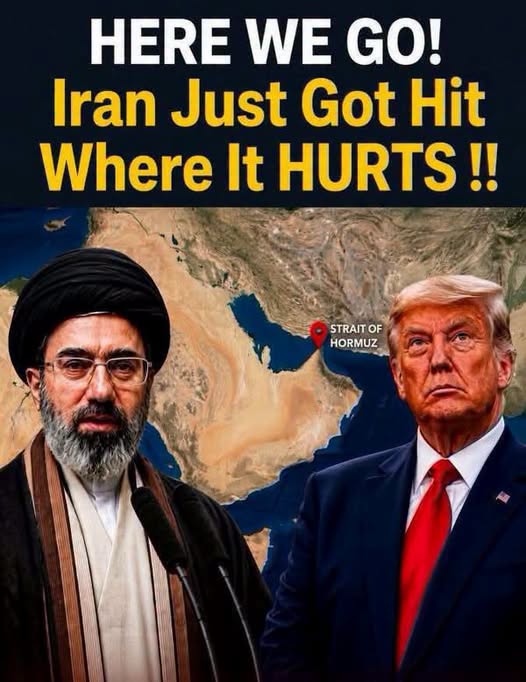
🚨 HERE WE GO! Iran Just Got Hit Where It HURTS! A Major New U.S. Move Sends Shockwaves Across the Middle East!
The situation involving Iran, the United States, and the wider Middle East has taken another dramatic turn. New developments reported on November 7 and 8 are drawing international attention as Washington expands its pressure campaign against Tehran.
This time, the focus is not only on military operations at sea. The United States is also moving to restrict the land routes and financial networks that Iran uses to move supplies, technology, and military-related equipment.
For Tehran, this represents another serious challenge at a moment when the country is already facing enormous economic and military pressure.
A NEW U.S. STRATEGY TARGETS IRAN’S SUPPLY NETWORKS
One of the most significant developments is the announcement of a new American initiative called Task Force Iron Gate.
According to reporting by Reuters, the initiative is designed to restrict Iran’s movement of advanced weapons, sanctioned goods, dual-use technology, and revenue through land borders and the Caspian Sea.
The operation expands an existing American naval blockade that has placed pressure on Iranian exports and shipping.
The U.S. military says the naval restrictions have prevented more than $25 billion in Iranian crude oil exports.
The new task force is expected to coordinate with several American government agencies, including departments responsible for financial enforcement, diplomacy, and law enforcement.
The objective is to make it more difficult for Iran to obtain materials that could support its military programs or generate revenue for the government.
This is a significant development because economic pressure can affect a country’s ability to maintain military operations over an extended period.
WHY THIS MOVE MATTERS TO IRAN
Iran has spent decades developing networks to obtain military equipment, technology, and other strategic materials despite international sanctions.
Restrictions on shipping alone may not be enough to stop those networks. Supplies can move through different countries, commercial intermediaries, and alternative transportation routes.
Washington’s new approach seeks to address that challenge by targeting land-based supply channels as well.
Reuters reported that Iran has continued importing military-related equipment through a network involving ships, trucks, and freight aircraft despite existing restrictions.
The new American initiative is intended to make those channels more difficult to use.
For Iran, the challenge is not simply military. It is also economic, diplomatic, and strategic.
TENSIONS IN THE GULF CONTINUE
Meanwhile, the waters surrounding Iran remain a major source of concern.
On November 7, U.S. Central Command said American forces had fired on and disabled a commercial vessel in the Gulf of Oman after its crew allegedly ignored repeated warnings and attempted to violate the naval blockade.
The incident demonstrates how dangerous maritime operations have become.
Commercial vessels, oil tankers, and military ships are operating in an increasingly tense environment.
Any misunderstanding could put civilian crews at risk and create additional pressure on governments already involved in the confrontation.
The Strait of Hormuz remains especially important because of its role in international energy transportation.
Disruptions in this waterway can affect oil markets, shipping insurance, and the cost of transporting goods around the world.
EXPLOSIONS AND REPORTS FROM IRAN
On November 8, Iranian media reported hearing explosions on Qeshm Island and in several locations, including Jask, Sirik, and Bandar Abbas.
These reports are attracting attention because of the strategic importance of the region.
However, the precise circumstances surrounding the reported explosions and their causes require further independent confirmation.
The developments come after President Donald Trump acknowledged limited American strikes targeting Iranian air-defense capabilities.
These events illustrate how quickly the military situation can change.
THE ECONOMIC CONSEQUENCES COULD BE ENORMOUS
Military confrontations are often discussed in terms of weapons, aircraft, ships, and battlefield victories.
But economic pressure can be equally important.
Iran’s economy has faced years of sanctions, financial restrictions, inflation, and difficulties attracting international investment.
Additional restrictions on exports and supply networks could create further challenges.
The consequences may affect businesses, industrial production, transportation, and ordinary households.
For families already struggling with rising prices, economic uncertainty can make daily life even more difficult.
At the same time, pressure on international oil transportation can affect consumers far beyond the Middle East.
That is why governments and financial markets are watching developments so closely.
RUSSIA AND OTHER COUNTRIES ARE WATCHING
Another important part of the story involves Iran’s international relationships.
Iran has maintained relationships with countries including Russia, which could become increasingly important as Tehran searches for diplomatic and economic alternatives.
Recent meetings between Iranian security officials and Russian President Vladimir Putin have included discussions about cooperation and regional developments.
However, Russia also has its own strategic interests and must consider the risks of becoming more deeply involved.
Other regional countries are also attempting to prevent the confrontation from spreading.
Diplomatic discussions involving Oman, Qatar, Pakistan, Saudi Arabia, and other governments demonstrate that there is still interest in finding a way to reduce tensions.
COULD THIS LEAD TO A BIGGER CONFRONTATION?
That remains one of the most important questions.
The United States wants to maintain pressure on Iran and restrict activities it considers threats to regional security.
Iran, meanwhile, has repeatedly warned against actions it views as violations of its sovereignty.
When both sides maintain strong positions, negotiations become difficult.
A mistake at sea, an unexpected military incident, or an attack on commercial infrastructure could create additional escalation.
That is why military communication and diplomatic negotiations remain essential.
THE WORLD IS WATCHING WHAT HAPPENS NEXT
The latest developments show that the confrontation is no longer limited to individual military incidents.
It involves shipping, oil exports, international trade, military supplies, financial networks, and diplomatic relationships.
Task Force Iron Gate represents a new dimension of American pressure, while continued incidents around the Strait of Hormuz demonstrate how fragile regional stability has become.
Whether these measures will force Tehran to change its position remains uncertain.
What is clear is that the decisions made in Washington and Tehran could have consequences far beyond their borders.
The biggest question now is whether the growing pressure will bring the countries closer to negotiations or push the region toward another dangerous escalation.
One thing is certain: the world will be watching every move.
And in a confrontation involving military power, international trade, and the global energy supply, the next development could matter to millions of people.
What do you think? Will increased economic and military pressure bring Iran to the negotiating table, or will tensions become even more dangerous?
Share your thoughts in the comments. 🇺🇸🌍