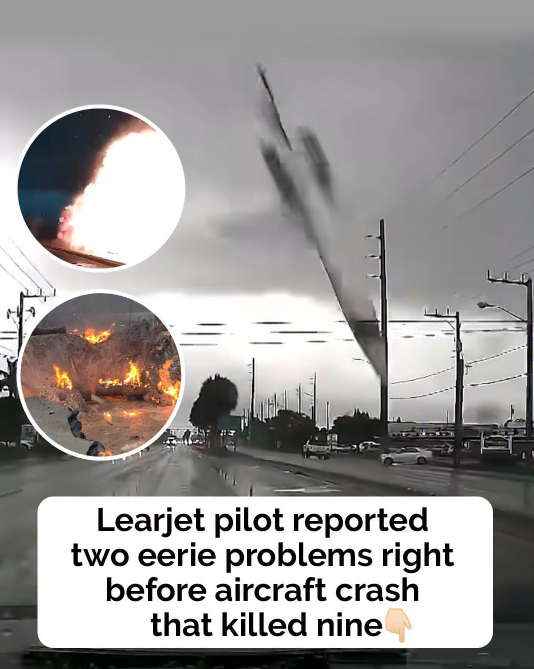
Learjet Pilot Reported Two Problems Before Crash That Killed Nine
A tragic aviation disaster in South Florida has left nine people dead and raised urgent questions about what happened during the final moments of a private Learjet flight.
On November 1, 2026, a Learjet 60 traveling from Austin, Texas, to the Bahamas crashed in a residential area of Greenacres, near West Palm Beach. Before the aircraft plunged toward the ground, the crew reported two serious problems: ice accumulating on the aircraft and moderate turbulence.
The distressing radio communications reveal how quickly the situation deteriorated. Investigators are now examining the aircraft, weather conditions, flight data, and communications to understand why a routine journey turned into a catastrophe.
A flight that turned into a nightmare
The Learjet departed Austin-Bergstrom International Airport on Sunday morning, carrying seven passengers and two crew members. Its destination was North Eleuthera in the Bahamas.
For much of the journey, the aircraft flew at approximately 35,000 feet. But as it approached South Florida, the crew began encountering increasingly difficult conditions.
According to information released by the National Transportation Safety Board (NTSB), the pilot reported light icing and moderate turbulence to air traffic controllers. The aircraft was also encountering precipitation.
At such high altitudes, icing can become a serious aviation hazard. Ice accumulating on aircraft surfaces can affect aerodynamic performance, increase drag, and interfere with the smooth flow of air over the wings and other control surfaces.
Turbulence can add another layer of danger, particularly when an aircraft encounters rapidly changing weather conditions.
Although the crew initially described the icing as manageable, the situation soon became much more alarming.
The final radio communications
The aircraft’s communications with air traffic control provide a chilling account of the emergency.
The crew requested permission to climb from 35,000 feet to 37,000 feet, apparently seeking a more favorable altitude as weather conditions worsened.
Controllers approved the request.
However, less than 30 seconds later, the aircraft began descending rapidly.
The pilot declared an emergency and reported an extraordinary rate of descent. Subsequent radio transmissions indicated that the aircraft was losing altitude at approximately 10,000 feet per minute, then at an even more alarming rate.
The crew also reported an overspeed condition, meaning the aircraft was exceeding its permitted speed range.
In one of the final transmissions, a pilot warned air traffic controllers that the aircraft was going to crash into the ground.
Moments later, the Learjet struck a roadway in Greenacres and erupted into flames.
The crash created a large crater and scattered debris across the surrounding area. Witnesses described a terrifying fireball and thick smoke rising into the sky.
Investigators discover evidence of structural failure
The investigation has taken an especially troubling turn after federal officials reported evidence that parts of the aircraft may have separated before impact.
On November 2, NTSB investigators said the aircraft appeared to have begun breaking apart while still in the air.
On November 3, investigators announced that they had located significant pieces of the aircraft’s left elevator, a component of the tail that helps control the aircraft’s pitch.
The pieces were found between approximately 1.3 and 3.8 miles from the crash site.
The discovery raises important questions about whether a structural failure contributed to the disaster or whether the aircraft’s extreme descent and speed caused components to separate.
Investigators have not yet established the sequence of events.
They are examining whether the aircraft lost critical control surfaces, whether weather conditions contributed to structural stress, and whether another mechanical problem occurred.
The victims and the families left behind
The crash killed all nine people aboard the aircraft, including two pilots and seven passengers.
Among the victims were Adam Robinson, his wife Helen Sharp, and their two young children, Emma, 4, and Charlie, 2.
The family’s loss has deeply affected relatives and friends, who described the couple as loving parents whose warmth and generosity touched many lives.
Another passenger, Rachael Reed, Charmi Fehr, and Anita Maria Cetina, were also identified by family members.
One of the pilots was identified as 20-year-old Nathalia Gadelha Filgueiras. She earned her pilot’s license in 2023 while still a high school student in Florida.
Her family is now grieving a young woman whose aviation career had only just begun.
The captain was identified as Jeff Gregory, a former employee of East Coast Jets. His former employer expressed condolences to his family and everyone affected by the tragedy.
Authorities are continuing the formal identification process for the victims.
A neighborhood caught in the disaster
The aircraft crashed in a residential area, placing people on the ground in immediate danger.
Residents described debris striking homes and roads, fires spreading around the impact site, and emergency crews rushing to the scene.
At least one person on the ground was injured.
Nearby residents were evacuated while investigators searched for wreckage and documented the crash site. Hundreds of people living in the surrounding mobile-home community faced temporary displacement as officials worked to make the area safe.
The disaster has affected not only the families aboard the aircraft but also an entire neighborhood that suddenly found itself confronting a devastating aviation accident.
What investigators are examining
The NTSB and Federal Aviation Administration are investigating several possible contributing factors.
-
Weather conditions: Investigators are reviewing the storm system, icing, turbulence, and precipitation encountered at cruising altitude.
-
Aircraft systems: They are examining the flight controls, engines, and other mechanical components.
-
Structural integrity: The discovery of separated tail components is a major focus of the investigation.
-
Flight data and communications: Investigators are seeking to reconstruct the aircraft’s final movements and determine what the crew experienced.
-
Cockpit voice recorder: Officials are working to recover the aircraft’s recorder, which could provide additional information about the emergency.
Importantly, investigators have not yet determined the cause of the crash. The reported icing and turbulence are significant clues, but they do not by themselves establish why the aircraft went down.
A tragedy that demands answers
The Learjet disaster is a heartbreaking reminder of how quickly conditions can change during flight and how much responsibility rests on aviation safety systems, aircraft maintenance, weather assessment, and emergency response.
The pilots were communicating with air traffic control and reporting the difficulties they encountered. Their transmissions now provide investigators with a crucial record of the final moments.
For the families who lost loved ones, however, no technical explanation can undo the devastation.
As investigators continue their work, the priority remains understanding exactly what happened, identifying any safety lessons that can prevent another tragedy, and giving the victims’ families the answers they deserve.