⚽ 1. Harry Kane: The Goal-Scoring Machine
Harry Kane has built his reputation as one of the most reliable strikers of his generation. His greatest strength is his ability to turn chances into goals, whether through powerful finishing, intelligent movement, accurate headers, or calm execution under pressure.
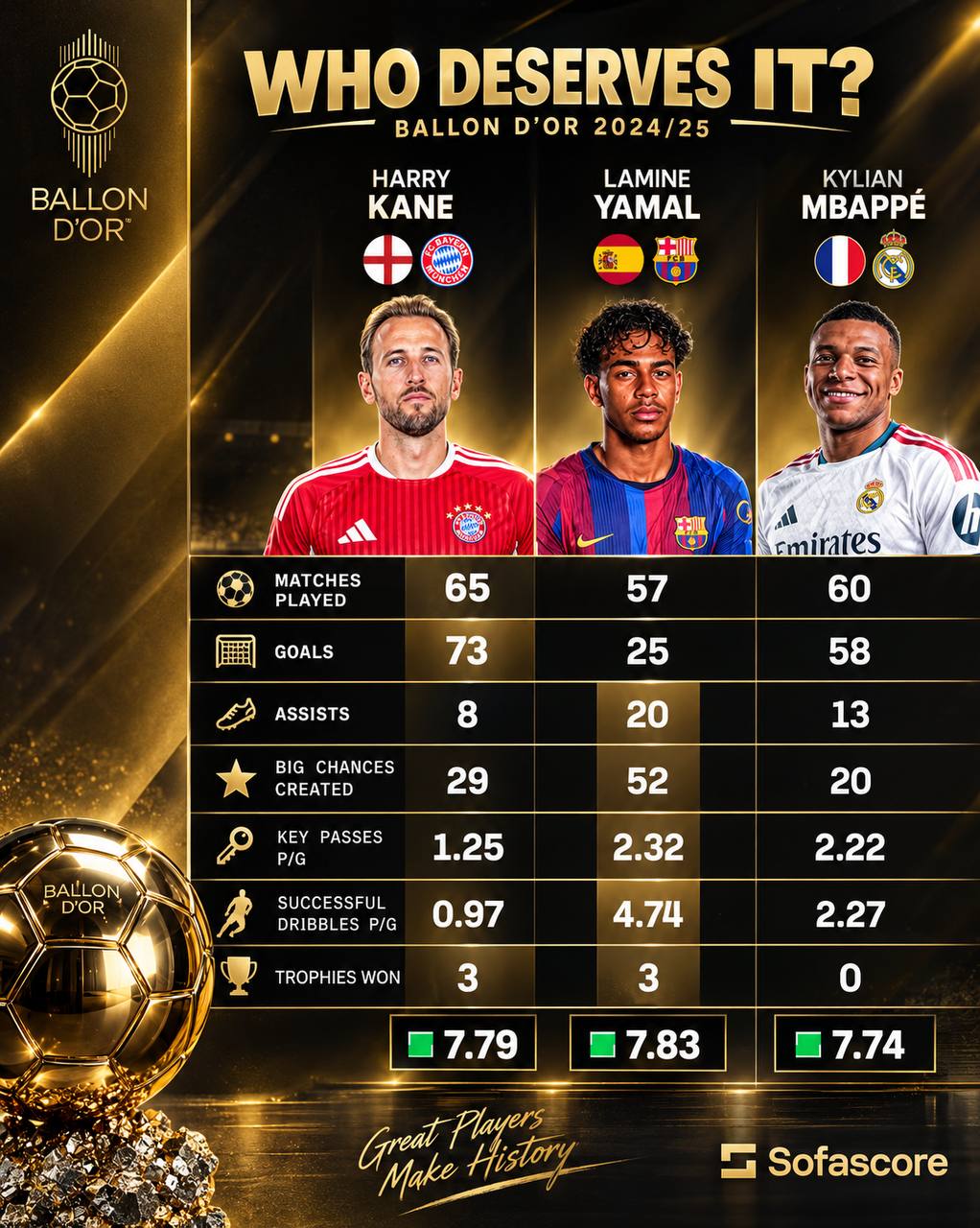
In the graphic, Kane is credited with 73 goals in 65 matches, alongside eight assists and three trophies. These are the figures shown in the image, not independently verified season statistics.
What makes Kane such a compelling candidate in any Ballon d’Or discussion is his combination of finishing ability, positioning, and football intelligence. He understands how to find space inside the penalty area, but he can also drop deeper to help build attacks and create opportunities for teammates.
His experience gives him another advantage. Kane has played at the highest level for club and country, carrying significant expectations in major competitions.
However, goals alone cannot determine the winner of the Ballon d’Or. Voters must consider the quality of opposition, the importance of performances, the player’s overall contribution, and the achievements of his team.
Kane’s supporters can argue that a prolific striker who consistently delivers decisive goals deserves serious consideration. The challenge is demonstrating that his overall season compares favorably with the achievements of other elite players.
🌟 2. Lamine Yamal: The Young Superstar Changing the Game
Lamine Yamal offers something different. While Kane is renowned for finishing, Yamal stands out for his creativity, dribbling, vision, and ability to unsettle defenders.
The graphic credits Yamal with 25 goals, 20 assists, 52 big chances created, and three trophies. Again, those figures should be treated as the graphic’s claims rather than verified totals.
His style of play makes him particularly exciting to watch. Yamal can receive the ball out wide, take on defenders, move into dangerous positions, and create opportunities that other players might not see.
His confidence is remarkable, especially considering his age. Rather than simply passing the ball backward when confronted by a defender, he often attempts to create an advantage through skill and movement.
Barcelona benefited from his creativity during the 2024–25 season, when the club won La Liga, the Copa del Rey, and the Spanish Super Cup. His performances helped establish him as one of the most influential young footballers in the world.
Yamal also finished second in the 2025 men’s Ballon d’Or voting and won the Kopa Trophy for the second consecutive year. These are confirmed achievements, making his place in the conversation about football’s brightest young stars undeniable.
His case demonstrates that football greatness is not measured exclusively by goals. Creating chances, controlling the rhythm of attacks, and consistently troubling opposing defenses can be just as important.
🚀 3. Kylian Mbappé: Speed, Power, and Finishing
Kylian Mbappé is another player whose attacking qualities make him a constant threat.
His pace can force defenders to retreat, creating space for teammates. When he receives the ball in dangerous areas, his acceleration and finishing ability can transform a promising attack into a goal within seconds.
The graphic credits Mbappé with 58 goals, 13 assists, and 60 appearances. These numbers are presented as shown and should not be mistaken for verified statistics covering a clearly defined competition or period.
Mbappé’s individual quality is not in question. His record at the highest level, including his performances for France and his previous achievements with Paris Saint-Germain, demonstrates why he regularly attracts attention in major individual-award discussions.
His first season with Real Madrid in 2024–25 also brought considerable expectations. Supporters hoped his arrival would help the club maintain its position among Europe’s leading teams.
Nevertheless, individual awards consider more than reputation and talent. Team success, consistency, decisive performances, and the overall balance of a season all influence the discussion.
Mbappé finished seventh in the official 2025 Ballon d’Or voting. That result illustrates the difference between being an exceptional footballer and having the strongest overall case for a particular season’s award.
📊 What Do the Statistics Really Tell Us?
The image compares several categories, including goals, assists, big chances created, key passes, successful dribbles, and trophies.
Each category reveals a different part of a player’s contribution.
Goals measure finishing output. Assists highlight the ability to help teammates score. Chances created and key passes indicate creative influence, while successful dribbles demonstrate a player’s ability to beat opponents and advance attacks.
Trophies provide another perspective because football is a team sport. A player’s individual achievements can be impressive even when their club falls short of its major objectives, but collective success remains relevant to the Ballon d’Or.
The important question is how these measurements fit together.
A striker might lead the scoring charts while another player creates more opportunities and contributes more extensively to the team’s overall play. A third player might deliver decisive performances in the biggest matches.
There is no single statistic that captures every aspect of football excellence.
It is also important to compare like with like. Figures should cover the same dates and competitions, distinguish club performances from international matches, and use consistent definitions. Otherwise, a graphic can make comparisons appear more conclusive than they really are.
🏆 What Actually Determines the Ballon d’Or?
The Ballon d’Or is awarded through voting by an international jury of specialized football journalists.
The official criteria emphasize three areas:
- Individual performances, including decisive and impressive contributions.
- Team performances and the trophies won.
- Class and fair play.
These criteria explain why the discussion goes beyond counting goals or comparing statistical ratings.
A player’s performance in an important match may carry considerable weight in the overall assessment. Consistency throughout the season matters, as does the ability to contribute to a successful team.
Ultimately, the award reflects the judgment of the voting panel rather than a mathematical formula based on the statistics displayed in a social media graphic.
🥇 The Important Truth About the 2025 Award
There is one crucial distinction: the image asks who deserves the Ballon d’Or for 2024–25, but that award has already been decided.
Ousmane Dembélé won the men’s 2025 Ballon d’Or on September 22, 2025, after a remarkable season with Paris Saint-Germain. Lamine Yamal finished second, while Mbappé finished seventh. Kane was not among the top three. These results are documented in the official award coverage from UEFA.
That does not prevent fans from debating which player they personally rate most highly. It simply means that an article should distinguish a fan poll or hypothetical comparison from the actual award result.
💬 So, Who Deserves It?
Kane’s strongest argument is his goal-scoring ability. Yamal’s case rests on creativity, influence, and his outstanding contribution at a remarkably young age. Mbappé brings pace, finishing, and proven quality at the highest level.
Each player offers something different, and supporters will naturally value those qualities differently.
But when discussing the completed 2024–25 Ballon d’Or, the official answer is Dembélé. The debate between Kane, Yamal, and Mbappé is best understood as a comparison of their individual qualities rather than a claim that one of them won the award.
Now it’s your turn, football fans! ⚽
Which quality matters most when judging the world’s best player: goals, assists, creativity, consistency, or trophies?
And if you could choose one player to build your team around, would you pick Harry Kane, Lamine Yamal, or Kylian Mbappé?
Share your choice in the comments and explain why. Let the football debate begin! 🏆🔥