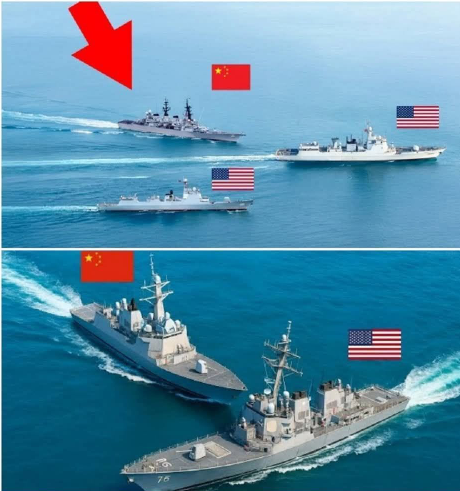
A tense maritime encounter between China and the United States has drawn renewed attention to one of the world’s most strategically important waterways. Chinese military forces reportedly tracked and monitored the U.S. Navy’s USS Charleston near the disputed Sabina Shoal in the South China Sea, intensifying an already delicate regional standoff. The incident was reported on October 20, 2026, and further analysis appeared on October 22.
Although the headline may sound like the beginning of a major military confrontation, there have been no verified reports in these sources of an exchange of fire between Chinese and American forces during this encounter. The reported confrontation centered on competing maritime claims, naval monitoring, and disagreement over the right to operate in the area.
For Washington, Beijing, and neighboring countries, the incident highlights how quickly routine naval movements can become politically sensitive.
⚓ What happened near Sabina Shoal?
According to Reuters, the encounter occurred early Tuesday, October 20, when China’s military said it had dispatched forces to track the USS Charleston, a U.S. Navy littoral combat ship operating near Sabina Shoal in the Spratly Islands. China accused the American vessel of entering the area without permission.
The United States rejected China’s interpretation of the incident.
A spokesperson for the U.S. Navy’s 7th Fleet said the Charleston was conducting routine operations in international waters consistent with international law. The U.S. position is that nations have the right to navigate and operate lawfully in these waters without requiring China’s approval.
The disagreement is significant because it reflects a larger struggle over maritime rights, regional influence, and military presence in the Indo-Pacific.
🇨🇳 Why China objected to the American warship
China claims extensive areas of the South China Sea, including waters and maritime features disputed by several neighboring countries.
Beijing argues that foreign military activity in areas it considers its territory threatens its sovereignty and security. Chinese military officials have repeatedly warned Washington against operations they believe challenge those claims.
The USS Charleston’s reported presence near Sabina Shoal therefore became more than a routine naval movement. It provided another example of the competing positions held by the two governments.
China said its forces monitored the American vessel and demanded that the United States stop such activities. However, the available reports do not establish that Chinese forces attacked the Charleston or that the two navies exchanged gunfire.
🇺🇸 Why the United States continues operating there
The South China Sea is an important international shipping route, connecting major Asian economies with markets around the world.
The United States maintains that lawful navigation and access to international waters should not be restricted by excessive maritime claims. American naval vessels regularly operate in the broader region, and the U.S. works with regional partners on maritime security.
The Philippines also disputed China’s accusation that the American vessel had trespassed into Chinese territory. A Philippine military spokesperson stated that no single country could demand prior permission for lawful transit through international waters.
This disagreement reflects two fundamentally different approaches: China emphasizes its sovereignty claims, while the United States emphasizes freedom of navigation under international law.
The legal details depend on the precise location of a vessel and the maritime rights applicable to those waters. Merely declaring an area sovereign does not automatically settle every competing international claim.
🌏 Why the Philippines is watching closely
The encounter occurred amid heightened tensions between China and the Philippines.
Sabina Shoal has been a flashpoint in the dispute between Beijing and Manila. In September, a Chinese Coast Guard vessel collided with a Philippine boat near the shoal, according to the Philippine Coast Guard. China disputed responsibility for that incident.
Because the Philippines has a mutual defense treaty with the United States, developments in the region carry implications beyond the two countries directly involved in the latest naval encounter.
Manila must balance its territorial claims and maritime interests against the risk of further confrontation. Washington, meanwhile, must consider its treaty commitments, regional partnerships, and broader strategic interests.
For neighboring countries, the central concern is whether competing claims can be managed peacefully without putting sailors, coast guard personnel, or commercial shipping at risk.
⚠️ Could this lead to war?
The encounter underscores a genuine security concern, but it does not mean that war has begun or that a military clash is inevitable.
Naval forces operating in close proximity must make rapid decisions. Miscommunication, a collision, or an incorrectly interpreted maneuver could turn a tense encounter into a more serious incident.
At the same time, both governments have reasons to avoid a direct military conflict. Such a conflict could endanger military personnel, disrupt trade, damage regional economies, and create consequences extending far beyond the South China Sea.
Diplomatic communication, clear operational procedures, and restraint at sea can help reduce those risks.
The most important question is not simply which country sends more ships into the region. It is whether the competing powers can manage their disagreements without allowing a confrontation to escalate.
🚨 What happens next?
The reported encounter will likely remain part of the wider debate over China’s maritime claims and the U.S. military presence in the Indo-Pacific.
Observers will be watching for further official statements, additional naval activity, and developments involving the Philippines and other countries with competing claims.
For now, the established facts are that China reported monitoring the USS Charleston near Sabina Shoal, the United States defended its operations as lawful, and the Philippines rejected the suggestion that the American vessel had trespassed into Chinese territory. No exchange of fire was reported in the sources reviewed.
🇺🇸🇨🇳 The bottom line: China has challenged the U.S. Navy’s presence near disputed waters, but the reported incident is a maritime and diplomatic confrontation—not evidence that a war between the two powers has started.
The world will be watching closely to see whether both sides choose restraint and diplomacy over further escalation.
What do you think? Should the United States continue its naval operations to defend freedom of navigation, or should Washington and Beijing pursue a different approach to reduce tensions in the South China Sea?