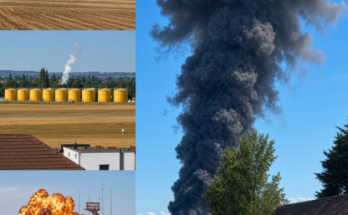

🚨 RIGHT NOW: PLANE WITH MORE THAN 244 ONBOARD JUST CRASH… SEE MORE ✈️💔
A frightening headline is spreading rapidly across social media, claiming that a passenger plane carrying more than 244 people has just crashed.
The wording is alarming.
“RIGHT NOW.”
“MORE THAN 244 ONBOARD.”
“JUST CRASH.”
For anyone seeing those words while scrolling through Facebook or another social-media platform, the natural reaction is shock and concern.
But there is an important detail that should not be overlooked:
There is currently no reliable confirmation that a new plane carrying more than 244 people has crashed right now.
The headline appears to be a recycled version of a story connected to the devastating Air India Flight AI171 crash of June 12, 2025, rather than evidence of a brand-new aviation disaster. Multiple websites have republished essentially the same headline during 2026, sometimes without making the original date clear.
The tragedy behind the headline
Air India Flight AI171 was a Boeing 787-8 Dreamliner traveling from Ahmedabad, India, to London Gatwick.
On June 12, 2025, the aircraft crashed shortly after takeoff from Ahmedabad.
There were 244 people aboard, including passengers and crew. The aircraft came down in a populated area, making an already devastating aviation accident even more tragic because people on the ground were also affected.
The news shocked India and people around the world.
Within minutes, images and videos from the crash area began circulating. Huge amounts of smoke could be seen rising into the sky, while emergency crews rushed toward the wreckage.
Firefighters, police officers, medical personnel, rescue workers, and other emergency responders faced an extraordinarily difficult situation.
For families waiting to learn what had happened to their loved ones, those moments were filled with fear and uncertainty.
Why the headline is confusing
The biggest problem with the viral headline is the phrase “right now.”
That wording makes an older event sound like something happening today.
A post can be uploaded months after an event while still using words such as:
“BREAKING.”
“JUST NOW.”
“RIGHT NOW.”
“URGENT.”
When thousands of people encounter the post without seeing the original publication date, they may naturally assume a new disaster has occurred.
That is exactly why dates matter.
The Air India tragedy happened in 2025, not today. The repeated versions of the headline appearing online in 2026 are not, by themselves, evidence of another crash.
The aircraft involved
The aircraft was a Boeing 787-8 Dreamliner, a modern wide-body aircraft commonly used for long-distance international flights.
Its route was supposed to take passengers from Ahmedabad to London.
Instead, the flight ended in catastrophe shortly after departure.
The accident immediately raised major questions about what had happened during the aircraft’s first moments in the air.
Aviation investigators began examining the aircraft, its systems, flight data, cockpit recordings, maintenance history, operational procedures, and other evidence.
That process is complicated and cannot responsibly be reduced to a single explanation based on social-media videos or early speculation.
One survivor became a symbol of hope
Among the heartbreaking details of the disaster was the survival of one passenger.
Vishwashkumar Ramesh survived the crash and was taken for medical treatment.
His survival attracted worldwide attention because of the scale of the destruction around him.
But his story also highlighted something important about major disasters: behind every statistic is an individual human being.
Passengers were not simply numbers on a manifest.
They were parents, children, siblings, spouses, friends, coworkers, and loved ones.
Each person had a destination and a reason for traveling.
For families affected by the crash, the event was not an internet headline.
It was a permanent change to their lives.
The emergency response
After a major aircraft accident, emergency services must work under extraordinarily difficult conditions.
Fire crews have to control fires.
Medical teams search for survivors and treat the injured.
Police secure the area.
Investigators preserve evidence.
Authorities work to identify victims and notify families.
At the same time, airports and government agencies must manage the enormous flow of information coming from worried relatives and members of the public.
The response to a disaster of this magnitude requires coordination between many organizations.
It also requires patience because investigators cannot immediately answer every question.
Why aviation investigations take time
When an aircraft crashes, people often want an explanation immediately.
What failed?
Was there a mechanical problem?
Was there a problem with the engines?
What did the pilots see?
What did the aircraft’s computers record?
Was the aircraft configured correctly for takeoff?
Were weather conditions involved?
These are serious questions, but answering them requires evidence.
Investigators examine flight recorders, aircraft components, maintenance records, air-traffic-control information, weather data, witness statements, and many other sources.
Premature conclusions can be dangerous.
Aviation safety depends on getting the facts right.
Why these viral posts spread
Plane-crash headlines naturally attract attention because aviation disasters are emotionally powerful.
A headline claiming that more than 244 people are involved immediately creates fear.
Adding phrases such as “RIGHT NOW” increases the sense of urgency.
And the familiar “See more” wording encourages people to click.
Once a post begins spreading, other pages may copy the same headline without checking the original story.
Eventually, an event that happened in one year can appear to be happening again.
That is why social-media users should always check the date and source before sharing.
What should you do when you see this headline?
If you encounter a post saying a plane with more than 244 people has just crashed, don’t immediately assume it is true.
Instead, ask a few simple questions:
When was the original event?
Where did it happen?
Which airline was involved?
What was the flight number?
Has the airline issued a statement?
Have aviation authorities confirmed the incident?
Are major established news organizations reporting the same event?
If those details are missing, the headline deserves caution.
A genuine major commercial-airliner disaster would normally generate confirmation from multiple authoritative sources.
Remembering the real tragedy
The fact that the viral headline may be recycled does not make the underlying tragedy any less serious.
The Air India AI171 disaster remains a deeply painful event for the families, passengers, crew members, and communities affected.
It should be remembered accurately and respectfully.
Using an old tragedy to create the impression that another crash has just occurred can cause unnecessary fear, especially for people with family members traveling by air.
The important message
The headline “RIGHT NOW, PLANE WITH MORE THAN 244 ONBOARD JUST CRASH…” should not currently be treated as confirmation of a new crash.
The available information connects the wording to the tragic Air India Flight AI171 disaster of June 12, 2025.
That distinction is extremely important.
In today’s fast-moving social-media environment, a dramatic headline can travel around the world in minutes.
But fast does not always mean current, and viral does not always mean verified.
Before sharing frightening breaking-news claims, take a moment to check the date, identify the original source, and look for independent confirmation.
For the families affected by real aviation disasters, accuracy matters.
For everyone else, taking a few seconds to verify a headline can prevent an old tragedy from being mistaken for a new emergency.
✈️ If you see this headline circulating, remember: check the date, check the source, and verify before you share.
SEE MORE BELOW 👇