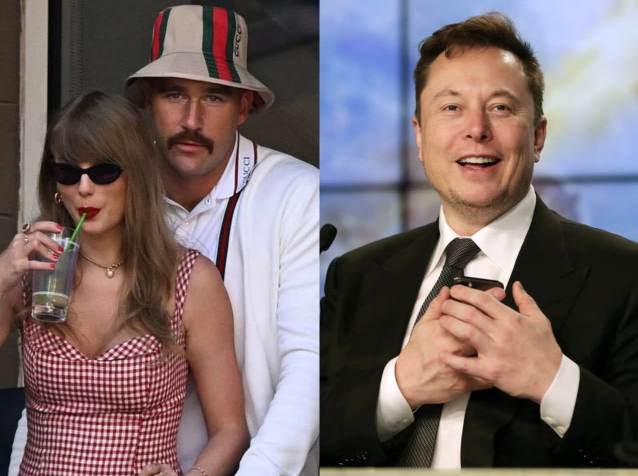
BREAKING NEWS: Travis Kelce and Elon Musk’s X app — the viral claim that sent social media into a frenzy
A dramatic headline has been circulating online claiming that Kansas City Chiefs star Travis Kelce announced he was leaving Elon Musk’s X platform and described it as a “toxic dumping ground” following harsh comments involving his wife, Taylor Swift.
The headline sounds explosive.
It sounds like the kind of celebrity confrontation that could instantly dominate social media.
But there is an important problem: the claim is not supported by credible evidence.
Fact-checkers investigated the story after it began circulating on Facebook in November 2024. PolitiFact reported that there was no evidence Kelce had made the alleged announcement or used the quoted description of X. His account remained active at the time.
Lead Stories reached the same conclusion, reporting that searches of Kelce’s X activity and credible news coverage did not produce evidence that he had announced an exit from the platform or described it using the alleged language.
So how did such a story become believable to so many people?
The perfect ingredients for a viral headline
The story combines several names that naturally attract enormous attention.
There is Travis Kelce, one of the NFL’s most recognizable players.
There is Taylor Swift, one of the world’s most famous entertainers.
And there is Elon Musk, the owner of X and another globally recognizable public figure.
Put those names together in one headline, add an alleged argument, and the result is almost guaranteed to attract clicks.
That does not make the story true.
In fact, sensational headlines often rely on exactly this formula: take recognizable people, introduce conflict, add an emotional quotation, and encourage readers to click before checking the original source.
What fact-checkers actually found
The claim was not merely overlooked by journalists.
It was specifically investigated.
PolitiFact reported that the Facebook post claimed Kelce was leaving X and called the platform a “toxic waste dump.” Investigators looked for supporting evidence, including public statements and credible news reports, but found none.
Lead Stories likewise reported that there was no credible evidence supporting the supposed announcement. Its investigation found that Kelce’s account remained on X and that searches did not uncover a statement from him matching the viral claim.
Another fact-check published by Check Your Fact also concluded that there was no evidence Kelce had announced his departure from X.
That distinction matters.
There is a huge difference between “people online are claiming Travis Kelce said this” and “Travis Kelce actually said this.”
The first can be documented.
The second requires evidence.
Why Taylor Swift became part of the story
The rumor also appears to have gained attention because of Elon Musk’s past interactions involving Taylor Swift.
In September 2024, Musk posted a controversial message directed toward Swift after she publicly endorsed Kamala Harris. A fabricated screenshot subsequently circulated online that appeared to show Kelce responding to Musk.
Reuters investigated that separate screenshot and found that it was not an authentic post from Kelce.
This is an important example of how one piece of misinformation can create an environment where another fabricated story seems believable.
Once people have seen a fake screenshot involving two celebrities, they may be more likely to believe a later headline claiming that the celebrities have entered a public feud.
Social media makes the cycle faster
The internet has changed the way celebrity stories spread.
A traditional news report usually contains a source, date, quotation, and context.
A viral social-media post may contain only a photograph and a few dramatic sentences.
Sometimes there is no link to an original interview.
There may be no video.
There may be no statement from the person involved.
And yet thousands of people can share the post before anyone checks whether the underlying claim is real.
That is why readers should be particularly cautious with headlines containing phrases such as “BREAKING,” “just announced,” “finally speaks out,” or “breaks silence.”
Those phrases are not proof.
What Travis Kelce is actually doing
The verified recent record provides a very different picture of Kelce’s public life.
In 2026, Kelce returned to the Kansas City Chiefs for his 14th NFL season. The Chiefs’ official roster currently lists him as a 36-year-old tight end wearing No. 87.
He has also continued playing at a high level. In the Chiefs’ September 20, 2026 game against the Indianapolis Colts, he recorded nine receptions for 101 yards and a touchdown.
Recent reporting has also focused on his football career, his future in the NFL, his marriage to Taylor Swift, and other aspects of his public life—not on a verified announcement that he was abandoning X because of Musk.
That does not prove what Kelce may or may not do with social media in the future.
It simply means the specific viral announcement described in this headline is not supported by the evidence available.
Why checking the source matters
Before sharing a dramatic celebrity story, ask a few simple questions:
Where did the quote originate?
Is there a video of the person saying it?
Did the person’s verified account publish it?
Are reputable news organizations reporting the same thing?
Is the headline based on an actual interview or merely another social-media post?
These questions take less than a minute to consider but can prevent misinformation from spreading to hundreds or thousands of other people.
The bigger lesson
The Travis Kelce story is a useful reminder that viral does not mean verified.
A headline can be professionally written.
A photograph can look completely authentic.
A quotation can sound exactly like something a celebrity might say.
None of those things proves that the statement happened.
In this case, multiple fact-checking organizations investigated the claim and found no evidence that Kelce made the supposed announcement about leaving X or calling the platform a “toxic waste dump.”
So if this headline appears in your Facebook feed, the safest interpretation is not that Travis Kelce has suddenly launched a war against Elon Musk.
Instead, recognize it as a previously debunked viral claim that has circulated online.
And that is perhaps the most important part of the story.
In an era when one sensational sentence can travel around the world in minutes, checking the evidence before sharing is more valuable than ever.
A dramatic headline may get your attention—but the source tells you whether it deserves your trust.