BREAKING: “RUSSIAN SU-57 PILOT DESTROYS U.S. AIRCRAFT CARRIER CARRYING 700…” — SEE MORE 🚨
A dramatic military headline is spreading rapidly across social media, claiming that a Russian Su-57 pilot has destroyed a U.S. aircraft carrier supposedly carrying 700 tanks.
The wording is designed to sound like an extraordinary breaking-news event.
It mentions a Russian fighter.
It mentions a massive American warship.
It claims hundreds of tanks were aboard.
And it suggests the event happened only minutes ago.
But there is a major problem with the story:
There is no credible confirmation that this attack actually happened.
Searches for the exact claim lead primarily to websites and social-media posts repeating the same sensational story rather than confirmation from the U.S. Navy, Russian authorities or major international news organizations. One website publishing the story explicitly identifies it as fictional.
That distinction is extremely important.
✈️ THE SU-57 IS REAL
The story sounds believable partly because the aircraft mentioned in it is real.
Russia’s Su-57 is a real advanced fighter aircraft and an important part of the country’s modern military aviation program.
But the existence of the aircraft does not prove that a particular Su-57 pilot carried out the attack described in the viral headline.
This is one of the easiest ways misinformation can appear convincing.
A real aircraft can be placed inside a fictional scenario.
A genuine photograph can be paired with an unrelated story.
A computer-generated image can be presented as a photograph.
And video-game footage can be edited to look like battlefield footage.
That appears particularly relevant here.
🎮 THE VIDEO CLUE
A video circulating with essentially the same headline has been identified as ARMA 3 gameplay, meaning it is a virtual military simulation rather than authentic footage of a Russian fighter attacking an American aircraft carrier.
That doesn’t mean the video isn’t visually impressive.
Modern military simulation games can look remarkably realistic.
Aircraft can fly across detailed landscapes.
Ships can explode.
Missiles can strike targets.
Smoke and fire can fill the screen.
For someone encountering the footage without context, it may look like genuine combat.
But a realistic-looking simulation remains a simulation.
And that is why viewers should never assume that dramatic military footage is authentic simply because it looks convincing.
🚢 WHAT ABOUT THE “700 TANKS”?
Another striking part of the headline is the claim that the U.S. aircraft carrier was carrying 700 tanks.
That detail deserves particular scrutiny.
Aircraft carriers are primarily designed to operate aircraft.
They are floating aviation bases rather than giant tank-transport ships.
A U.S. carrier’s primary function involves launching, recovering and supporting aircraft while operating as part of a larger carrier strike group.
The viral claim therefore combines several dramatic elements into one story: a Russian fighter, an American aircraft carrier, a massive attack and hundreds of tanks.
That combination makes the headline extremely effective at grabbing attention.
But dramatic details require evidence.
And evidence is precisely what is missing.
🌊 WHY A REAL CARRIER ATTACK WOULD BE ENORMOUS NEWS
Imagine for a moment that a U.S. aircraft carrier really had been destroyed by a Russian fighter.
That would not be an ordinary military story.
It would be an extraordinary international event.
The United States and Russia are major military powers, and a confirmed direct attack involving their forces would immediately attract enormous attention from governments, defense officials and news organizations around the world.
There would be questions about the carrier’s identity.
Where was it?
When was it attacked?
How was the attack detected?
Were there casualties?
What happened to the crew?
Was the ship sunk or damaged?
What weapons were involved?
Did the U.S. military respond?
Did Russian authorities acknowledge the incident?
Were satellite images available?
Were independent journalists reporting from the region?
Those questions are important because extraordinary military claims require extraordinary evidence.
The viral headline does not provide that evidence.
📱 WHY “30 MINUTES AGO” IS IMPORTANT
Another feature of the headline is its urgency.
“BREAKING.”
“30 minutes ago.”
“DESTROYS.”
These phrases are designed to create a feeling that readers must react immediately.
That can be extremely effective on social media.
People see the headline.
They become shocked.
They click.
They comment.
They share.
Then another account copies the same headline.
Soon, dozens of pages may appear to be reporting the same event.
But dozens of copies do not necessarily represent dozens of independent sources.
They may all trace back to the same original post.
That is why the number of websites repeating a claim should never be confused with the number of independent confirmations.
🌍 THE REAL DANGER OF FALSE MILITARY REPORTS
False military stories are more than harmless clickbait.
During periods of international tension, a fabricated report claiming that one major military power has attacked another can create unnecessary fear.
People may believe a much larger conflict has begun.
They may assume governments are preparing for war.
They may share the story with friends and family.
And within hours, an unsupported rumor can become accepted as fact by people who encountered it repeatedly.
That is why responsible reporting uses words such as “confirmed,” “reported,” “claimed,” and “unverified” carefully.
Those words are not interchangeable.
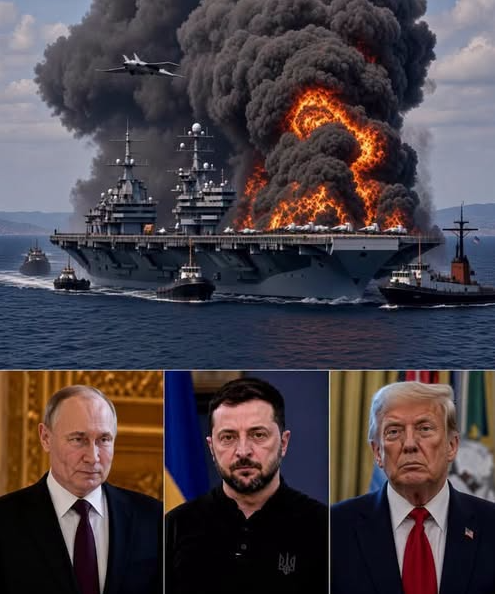
🔥 THE IMAGE DOESN’T PROVE THE STORY
The dramatic image associated with the claim is another reason people may believe it.
A burning aircraft carrier surrounded by smoke is visually powerful.
But an image alone does not establish when or where it was taken.
It could be old.
It could be digitally altered.
It could come from a movie or simulation.
It could depict an entirely unrelated accident or military exercise.
A photograph needs context.
And in this case, the available evidence does not establish that the image documents an actual Russian attack on a U.S. carrier.
🇺🇸🇷🇺 REAL MILITARY TECHNOLOGY, FICTIONAL SCENARIO
There is an important distinction between the technology and the story.
The Su-57 is real.
U.S. aircraft carriers are real.
Russia and the United States possess sophisticated military capabilities.
Their aircraft, ships, weapons and defensive systems are genuine subjects of military analysis.
But that does not mean every story combining those real-world elements is genuine.
Hollywood does exactly the same thing.
A real airplane can be placed into a fictional battle.
A real ship can appear in a fictional movie.
A real country can become part of an imaginary military scenario.
The same principle applies to online videos and social-media posts.
🔎 HOW TO CHECK A CLAIM LIKE THIS
Before sharing a story like this, ask a few basic questions:
Who reported it first?
Is the U.S. Navy confirming it?
Is Russia confirming it?
Where exactly did the attack supposedly occur?
What is the name of the carrier?
Are independent news organizations reporting the same event?
Is the video authentic?
Does the footage contain signs that it came from a simulation or video game?
Those questions can quickly reveal whether a “breaking news” story has substance.
In this case, the evidence points in the opposite direction.
🚨 THE BOTTOM LINE
The viral headline claiming that a Russian Su-57 pilot destroyed a U.S. aircraft carrier carrying 700 tanks is not confirmed as a real event.
The exact headline has circulated repeatedly, and at least one version explicitly describes the scenario as fictional. Related video material has also been identified as military simulation gameplay.
That means the dramatic story should not be presented as confirmed breaking news.
The Su-57 is real.
American aircraft carriers are real.
Military tensions between major powers are real.
But this particular attack is not supported by credible evidence.
So if this headline appears in your feed, take a moment before pressing “share.”
A realistic video isn’t necessarily real.
A dramatic photograph isn’t necessarily current.
And a headline saying “30 minutes ago” isn’t proof that something happened 30 minutes ago.
In the age of viral misinformation, sometimes the most important part of a breaking-news story is not what the headline says.
It’s what the evidence actually shows.
🚨 VERIFY BEFORE YOU SHARE.
Because when a headline claims that a Russian fighter has destroyed an American aircraft carrier, the world deserves facts — not fiction disguised as breaking news.