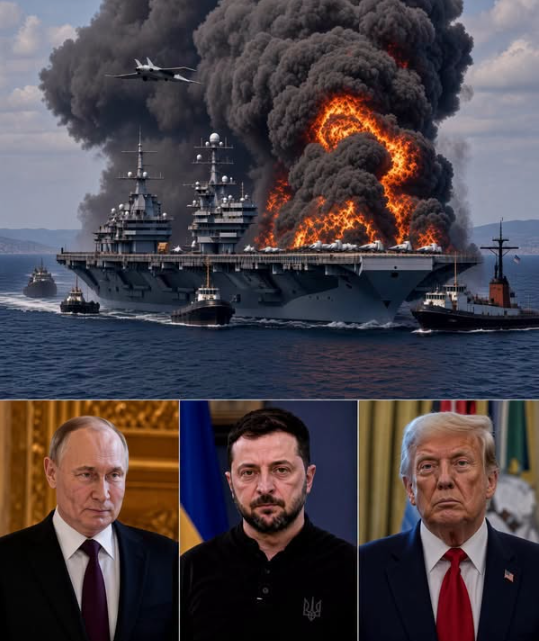
🚨✈️ BREAKING — 30 MINUTES AGO: RUSSIAN SU-57 PILOT DESTROYS U.S. AIRCRAFT CARRIER CARRYING 700… SEE MORE 🇷🇺🇺🇸
A dramatic military headline is spreading rapidly across social media, claiming that a Russian Su-57 pilot has destroyed a U.S. aircraft carrier reportedly carrying 700 tanks.
The wording is designed to sound like an extraordinary breaking-news event.
“30 minutes ago.”
“Destroyed.”
“U.S. aircraft carrier.”
“700 tanks.”
Each detail makes the story sound more urgent and more shocking.
But there is an important fact readers should know before sharing the post:
There is currently no credible confirmation that this attack actually happened.
Versions of the same headline have appeared repeatedly online throughout 2026. Searches for the claim lead primarily to sensational websites, social-media posts and videos rather than confirmation from major international news organizations or official military authorities.
Even more importantly, videos circulating with essentially the same headline have been identified as virtual military simulations created using ARMA 3, meaning they are computer-generated gameplay rather than footage of a real Russian attack on an American carrier.
🚨 THE HEADLINE SOUNDS REAL
Imagine seeing the words on your phone:
“30 MINUTES AGO: RUSSIAN SU-57 PILOT DESTROYS U.S. AIRCRAFT CARRIER…”
For many people, the first reaction would be immediate shock.
A U.S. aircraft carrier is one of the most recognizable symbols of American military power. The Su-57, meanwhile, is a real Russian advanced fighter aircraft.
Put the two together in one headline, add an enormous explosion, and the result sounds like the beginning of a major international crisis.
But a real aircraft plus a real military ship does not automatically make the story real.
A genuine piece of military equipment can be placed inside a fictional scenario.
A video game can be edited to look like news footage.
An old photograph can be presented as though it was taken moments ago.
And an unverified claim can be reposted so many times that people begin assuming it must have been confirmed.
That appears to be what is happening with this story.
✈️ THE SU-57 IS REAL
The Su-57 itself is not fictional.
It is a Russian fifth-generation fighter aircraft and is one of the most advanced aircraft associated with Russia’s military aviation program.
That fact makes the viral story sound believable.
But the existence of the Su-57 does not prove that a particular pilot carried out the attack described in the headline.
This distinction is extremely important.
The question is not:
“Does Russia have Su-57 aircraft?”
Yes.
The question is:
“Did a Su-57 just destroy a U.S. aircraft carrier carrying 700 tanks?”
There is currently no reliable evidence establishing that this happened.
🎮 THE VIDEO CLIP IS A MAJOR CLUE
One of the strongest clues comes from the video material accompanying versions of the headline.
A YouTube video using essentially the same wording identifies itself as a virtual game simulation. Its description specifically says that the footage is an ARMA 3 combat simulation and that simulations may differ from real events.
Another video carrying the same claim also identifies itself as a virtual game rather than real-life combat footage.
That means anyone watching explosions, aircraft and ships in these clips should not automatically assume they are seeing an actual battlefield.
Modern military video games can look remarkably realistic.
They can include fighter aircraft, warships, missiles, explosions, smoke and highly detailed environments.
When a short clip is removed from its original context and placed beneath a dramatic headline, it can easily be mistaken for genuine news footage.
⚠️ WHAT ABOUT THE “700 TANKS”?
The claim that the carrier was carrying 700 tanks is another reason to question the story.
Aircraft carriers are primarily designed as floating aviation bases.
Their central purpose is to operate aircraft at sea.
They are not giant floating tank-storage facilities.
A carrier can support enormous military operations, and naval forces can work alongside amphibious and logistics vessels carrying ground equipment, but the specific image created by the headline — one American aircraft carrier transporting 700 tanks — deserves serious scrutiny.
The number itself appears to be part of the sensational presentation rather than a detail supported by credible reporting.
And that is an important lesson about viral military headlines:
The most dramatic number is not necessarily the most accurate number.
🌎 WHAT WOULD HAPPEN IF A U.S. CARRIER WERE REALLY DESTROYED?
This question helps put the claim into perspective.
If a Russian fighter actually destroyed a U.S. aircraft carrier, the event would be extraordinarily significant.
It would not simply appear as an isolated social-media post.
Governments would be under enormous pressure to respond.
Military officials would investigate.
News organizations around the world would report on the incident.
Analysts would examine satellite imagery, photographs, ship movements, aircraft activity and other available evidence.
Questions would immediately arise about the carrier’s identity, location, crew, casualties, cause of the attack and the response of the United States and its allies.
Yet the viral story does not provide the kind of independently verified information that would normally accompany an event of this magnitude.
Instead, versions of the claim continue to circulate with dramatic images and simulation footage.
📱 WHY DOES “30 MINUTES AGO” MATTER?
The phrase “30 minutes ago” is powerful because it creates urgency.
It tells readers that they may be witnessing history as it happens.
People become less likely to stop and verify the information because they fear that waiting means missing the latest development.
That is exactly why timestamps in viral posts should be treated carefully.
A website can publish an article today using the words “30 minutes ago” even when the underlying video or story has been circulating for weeks or months.
In fact, versions of this exact Su-57/carrier headline appeared online well before the current September 2026 circulation.
So the timestamp in the headline should never be considered proof of when the alleged event actually happened.
🔎 HOW TO CHECK A CLAIM LIKE THIS
Before sharing a major military story, ask a few simple questions.
What is the name of the aircraft carrier?
Where did the alleged attack happen?
When exactly did it happen?
Which official authority confirmed it?
Is the U.S. Navy reporting it?
Is the Russian government reporting it?
Are major international news organizations independently reporting it?
Is the video genuine footage or a simulation?
These questions can often reveal the truth very quickly.
In this case, one of the most important answers is already available: related footage has been identified as an ARMA 3 simulation.
🌐 THE DANGER OF MILITARY MISINFORMATION
False military stories are not harmless entertainment for everyone.
A fake report about an attack between Russia and the United States can create unnecessary fear.
People may believe a major war has started.
Families may become frightened.
Readers may share the claim with friends and relatives believing they are warning them about an emergency.
And once misinformation spreads, correcting it can be much harder than creating it.
That is why dramatic military claims deserve especially careful treatment.
🚨 THE BOTTOM LINE
The viral headline claiming that a Russian Su-57 pilot has just destroyed a U.S. aircraft carrier carrying 700 tanks has not been confirmed by credible evidence.
The Su-57 is real.
U.S. aircraft carriers are real.
The military capabilities of both countries are real.
But that does not establish that this particular attack occurred.
The videos associated with the claim include material explicitly identified as military simulation gameplay, not authentic combat footage.
So before reacting to the frightening headline, remember one simple rule:
A dramatic video is not automatically evidence.
A viral headline is not automatically breaking news.
And repetition is not confirmation.
If a genuine attack of this magnitude occurs, reliable evidence should eventually come from identifiable ships, locations, official statements, independent reporting and verifiable imagery.
Until then, the responsible conclusion is that the viral Su-57 aircraft-carrier story remains unverified.
In an age when a computer simulation can look like a battlefield and a headline can reach millions within minutes, taking a moment to verify the facts is more important than ever.
🇺🇸🇷🇺 Stay informed. Check the source. Verify before you share.