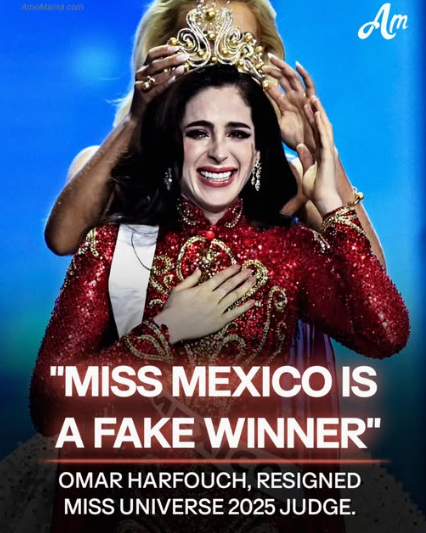
👑😱 DRAMA CONTINUES: MISS UNIVERSE FÁTIMA BOSCH HOLDS THE CROWN AS FORMER JUDGE CALLS HER A “FAKE WINNER”
The Miss Universe crown was supposed to represent achievement, confidence, beauty, intelligence, and the culmination of months of preparation.
Instead, the 2025 competition became surrounded by controversy even after the final winner was announced.
Mexico’s Fátima Bosch was crowned Miss Universe 2025 in Bangkok, Thailand, but her victory was quickly followed by allegations from a former judge who publicly questioned the legitimacy of the result. Former judge Omar Harfouch called Bosch a “fake winner” and alleged that the competition’s results had been influenced before the final night.
Those are serious allegations—but they remain allegations, not established facts.
So what caused the controversy?
👑 THE MOMENT FÁTIMA BOSCH WON
When Bosch was announced as the winner, Mexico celebrated another Miss Universe victory. Thailand’s Praveenar Singh finished as first runner-up, Venezuela’s Vanessa Pulgarin was second runner-up, the Philippines’ Ahtisa Manalo placed third runner-up, and Côte d’Ivoire’s Olivia Yacé finished fourth runner-up.
For Bosch, the moment represented the culmination of an extraordinary journey.
But almost immediately, another story began developing away from the stage.
Harfouch, who had resigned from the judging panel shortly before the final, publicly challenged the outcome.
His words were explosive.
He described Bosch as a “fake winner” and claimed that he had predicted before the final that Mexico would win. He alleged that Miss Universe owner Raúl Rocha had business connections with Bosch’s father and claimed that he had been encouraged to vote for Bosch.
The accusations rapidly spread online.
Suddenly, the conversation was no longer simply about who won the crown.
It became a debate about how the winner had been selected.
⚠️ THE “SECRET VOTE” CLAIM
One of Harfouch’s biggest complaints involved the selection of semifinalists.
He claimed that a secret vote had been conducted to pre-select 30 contestants from the 136 competitors and argued that people outside the official judging panel were involved.
According to Harfouch, this raised concerns about transparency and potential conflicts of interest. He said he could not publicly participate in a process he believed he had not been properly involved in.
That allegation immediately raised questions among pageant followers.
How were the semifinalists selected?
Who was allowed to participate in the process?
What voting procedures were actually used?
And most importantly, did the process influence the final result?
Those questions became central to the controversy.
🏢 MISS UNIVERSE ORGANIZATION RESPONDS
The Miss Universe Organization rejected Harfouch’s characterization of the process.
The organization stated that no unauthorized or improvised jury had been created and insisted that official competition evaluations continued according to its established procedures.
In other words, the organization disputed the suggestion that an unofficial group had secretly taken over the judging process.
That creates an important distinction.
There is a documented disagreement between a former judge and the organization over how the competition was conducted.
But that disagreement does not automatically establish that the pageant was rigged.
Determining whether the allegations are true would require evidence beyond social-media statements.
😳 WHY THE CONTROVERSY BECAME SO BIG
The timing made the situation even more dramatic.
Harfouch had resigned before the final.
Then Mexico won.
Then he publicly criticized the result.
Because his prediction preceded the final, supporters of his claims argued that his allegations deserved attention. Others pointed out that predicting a pageant winner is not itself proof that the result was predetermined.
That distinction is crucial.
A person can make an accurate prediction without knowing that a competition is rigged.
Likewise, an accusation of improper influence needs supporting evidence before it can be treated as established fact.
👸 FÁTIMA BOSCH SPEAKS OUT
Bosch did not simply disappear from the controversy.
She addressed the criticism surrounding her victory and rejected the narrative that her crown was illegitimate.
In subsequent comments, she described the criticism as a campaign of hate and defended her achievement.
That response is significant because the controversy directly affected the woman wearing the crown.
Imagine working for months toward one of the biggest moments of your life, finally hearing your name announced as the winner, and then seeing people around the world question whether you deserved it.
Whatever someone thinks about the judging controversy, Bosch herself became the public face of an argument that began largely around the competition’s internal processes.
🇲🇽 A VICTORY OVERSHADOWED
For Mexico, Bosch’s victory was supposed to be a moment of celebration.
Instead, much of the attention became focused on accusations and disagreements.
That doesn’t erase the achievement.
Bosch remains the officially crowned Miss Universe 2025, while the allegations surrounding the competition are a separate issue that requires evidence and verification.
This distinction is particularly important when social-media headlines use words like “fake,” “rigged,” “corrupt,” or “fixed.”
Those words can generate enormous attention.
But they can also make an unresolved dispute sound like a proven conclusion.
🌪️ THE CONTROVERSY STARTED BEFORE THE FINAL
The judging allegations were not the only controversy surrounding the 2025 competition.
Before the final, Bosch became involved in a public dispute with Thai pageant executive Nawat Itsaragrisil.
During an event, Bosch was publicly criticized over promotional responsibilities. She objected to the treatment, and several contestants showed solidarity with her. The confrontation became a major international story before the actual competition had even reached its conclusion.
That earlier incident made Bosch one of the most discussed contestants in the competition.
By the time she won the crown, millions of people were already familiar with her story.
Then the judging controversy arrived.
🔍 WHAT CAN ACTUALLY BE CONFIRMED?
Several facts can be established.
Fátima Bosch of Mexico won Miss Universe 2025.
Omar Harfouch was involved with the judging process but resigned before the final.
He publicly alleged that the competition had serious transparency problems and later called Bosch a “fake winner.”
The Miss Universe Organization rejected his description of an unauthorized judging process and maintained that established procedures were followed.
What cannot responsibly be stated as fact is that Bosch personally cheated or that the competition was definitively rigged.
Those are conclusions that go beyond the confirmed information.
The controversy is therefore best understood as a dispute involving allegations, denials, and questions about transparency.
❤️ BEHIND THE CROWN IS A REAL PERSON
Amid all the drama, it is easy to forget that there is a person at the center of the story.
Bosch has had to carry the crown while facing an extraordinary amount of public scrutiny.
Every appearance can now attract questions about the controversy.
Every photograph can produce comments about whether she deserved the title.
Every interview can become another opportunity for people to debate the result.
Yet the responsibility for explaining or defending the competition’s internal procedures does not necessarily belong to the winner.
Those questions are primarily about the organization and its judging system.
👑 THE CROWN REMAINS
For now, the most accurate description is simple:
Fátima Bosch is the officially crowned Miss Universe 2025, while the legitimacy of the competition has been challenged by a former judge.
The controversy has raised legitimate questions about transparency, but allegations should not be confused with proven wrongdoing.
The story has also demonstrated how quickly a beauty pageant can become a global conversation about ethics, fairness, business relationships, judging procedures, and public trust.
The crown may be sparkling under the lights, but behind it is a much bigger debate.
Was every part of the judging process as transparent as contestants and viewers expected?
Were the allegations made by the former judge supported by evidence?
How should international competitions handle conflicts of interest?
And what responsibility does an organization have to explain its procedures clearly?
Those questions matter.
For Bosch, however, the reality is that she walked onto the stage, heard her name announced, and left Bangkok wearing the Miss Universe crown.
The controversy that followed does not change the fact that she became the official winner.
At the same time, the allegations should not simply be dismissed without examination.
The truth lies in evidence—not in viral headlines, social-media rumors, or assumptions.
And that may be the most important lesson from the Miss Universe controversy: when a major event is questioned, the public deserves transparency, credible evidence, and clear answers.