A Cold, a Coma, and a Christmas Miracle: How a Young Mother Survived a Rare Brain Disorder
What began as an ordinary cold before Thanksgiving became a terrifying medical emergency for a young mother of two.
In late 2023, Shannon Finnegan Cook was 31 years old, working as an attorney and raising two young boys. Her children, just three years old and nine months old, attended daycare, so illnesses were hardly unusual in the household.
At first, Shannon’s symptoms seemed familiar: a fever, congestion and the lingering discomfort of what appeared to be a common cold.
But the illness refused to go away.
One week passed, then another. Thanksgiving came and went, and Shannon still wasn’t feeling well. Then, shortly after the holiday, something changed dramatically.
She developed an intense headache unlike anything she had experienced before.
“I feel like my brain is too big for my skull,” she told her husband, Matthew.
Neither of them could have imagined how serious those words would become.
A terrifying turn
Shannon went to bed hoping that rest would help her fever and headache. But during the night, she noticed something even more frightening: her left hand began to tingle.
By Saturday morning, her fever had not broken.
Shannon and Matthew decided she needed medical attention. When she left her home, she was still able to walk and get into the car.
But her condition deteriorated with astonishing speed.
By the time they arrived at a hospital in the Philadelphia suburbs, Shannon needed a wheelchair and assistance getting out of the vehicle.
Her husband later recalled how rapidly everything had changed. He feared that if they had waited even a few more minutes, getting her to the hospital might have been impossible.
Doctors quickly realized they were dealing with something far more serious than a routine infection.
Shannon was transferred to Penn Medicine’s Neuro Intensive Care Unit, where physicians began searching for an explanation.
Brain scans revealed a lesion and severe swelling. At first, doctors suspected that she might have a large brain tumor affecting both sides of her brain.
For Shannon, the diagnosis was almost impossible to comprehend.
She remembered thinking that it made no sense.
She had started with what seemed like a cold.
Now her brain was dangerously swollen.
An unexpected diagnosis
One of the doctors who reviewed Shannon’s scans was Daniel Yoshor, chair of neurosurgery at Penn Medicine.
Because of his experience with brain tumors, Yoshor recognized that something about Shannon’s scans did not look typical.
Rather than simply assuming the lesions were cancerous, he recommended a brain biopsy.
It was an extraordinary decision in an already critical situation.
The biopsy revealed that Shannon did not have a conventional brain tumor.
Instead, she had acute hemorrhagic leukoencephalitis, or AHLE.
AHLE is an extremely rare and aggressive inflammatory disorder in which the body’s immune system attacks the brain’s white matter. The condition can progress rapidly, causing brain swelling, neurological deterioration and coma.
There is no universally established treatment protocol because the disorder is so uncommon.
In many cases, the disease is diagnosed only after a patient has died.
Shannon’s doctors were now racing against time.
A race against the swelling
Among the specialists caring for Shannon was neurologist Jennifer Orthmann-Murphy, who specializes in rare disorders affecting the brain’s white matter.
Remarkably, just weeks before Shannon became ill, Orthmann-Murphy had attended a conference involving leukodystrophies and other rare neurological disorders.
The information she had recently learned was fresh in her mind.
That knowledge would prove crucial.
Orthmann-Murphy assembled a multidisciplinary team involving specialists from Penn Medicine and Children’s Hospital of Philadelphia.
Ordinarily, physicians treating an inflammatory neurological disorder might try one treatment, monitor the patient’s response and then decide what to do next.
Shannon did not have that luxury.
Her condition was deteriorating too quickly.
Doctors used several treatments simultaneously in an effort to stop the inflammation and reduce the pressure inside her skull.
Her treatment included antibiotics, steroids, monoclonal antibodies and multiple rounds of plasma exchange.
Plasma exchange involves removing plasma from a patient’s blood and replacing it with other fluids, with the goal of removing harmful substances circulating in the bloodstream.
But even these aggressive treatments were not enough to immediately control the swelling.
Doctors eventually performed surgery to remove part of Shannon’s skull, creating additional space for her swollen brain and reducing dangerous pressure.
A second brain biopsy was also performed to confirm the diagnosis and help guide treatment.
The situation remained extraordinarily serious.
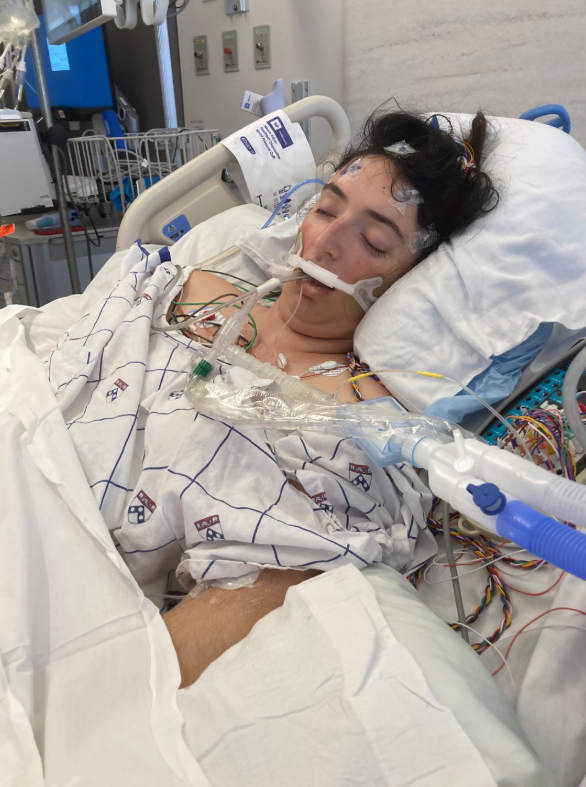
Shannon was placed into a coma and spent weeks in intensive care.
For her family, every day became a waiting game.
The Christmas miracle
Then, slowly, the treatment began to work.
The pressure inside Shannon’s brain started to decrease.
Her condition stabilized.
Her medications could gradually be reduced.
And then came the moment her family had been praying for.
Three weeks after being admitted to the Neuro ICU, Shannon woke from her coma just in time for Christmas.
It was particularly meaningful because it was her infant son’s first Christmas.
After weeks of uncertainty, the young mother was awake.
Alive.
Still fighting.
Shannon later described waking as a strange, dreamlike experience. She gradually learned what had happened to her and began to understand just how close she had come to dying.
Her recovery, however, was far from finished.
After approximately four weeks at Penn Medicine, she was transferred to a physical rehabilitation facility.
She had to relearn fundamental abilities, including walking and speaking.
For someone who had entered the hospital able to care for two young children, the road back to everyday life was long and difficult.
Learning to live again
Shannon eventually returned home in the spring of 2024.
Her recovery continued.
She had not immediately returned to her career, but she no longer required mobility assistance. She was able to care for her children and hold meaningful conversations with the people around her.
Every ordinary moment had become extraordinary.
Walking across a room.
Talking with her children.
Being home with her family.
Celebrating another Christmas.
Things that might once have seemed routine now represented milestones.
Her survival was not the result of a single treatment or one person’s decision. It involved an enormous team of physicians, nurses, surgeons, pharmacists, specialists and rehabilitation professionals.
It also depended on timing.
Shannon and her husband sought emergency care quickly when her symptoms changed. Specialists recognized that her condition did not fit the initial diagnosis. A biopsy revealed the rare disorder. And physicians were willing to move aggressively despite having limited precedent to guide them.
A story of hope
Shannon’s case also illustrates how unpredictable medicine can be.
A seemingly ordinary infection can occasionally be followed by an extraordinarily rare immune response. AHLE is uncommon, and its rapid progression can make diagnosis and treatment extremely difficult.
Her story is not evidence that every severe headache or fever indicates AHLE. Most people with colds and headaches do not develop anything remotely like this.
But Shannon’s experience demonstrates why sudden neurological symptoms should never be ignored.
Her worsening headache, fever, tingling and rapidly declining ability to move were warning signs that required immediate medical attention.
For Shannon and her family, the timing of her recovery gave Christmas a meaning they would never forget.
She had entered the hospital during the holiday season facing a disease that could have taken her life.
Instead, she woke from her coma just days before Christmas.
Today, her story stands as a remarkable example of medical teamwork, perseverance and an extraordinary recovery.
Perhaps most importantly, it is a reminder that miracles sometimes look less like a single dramatic moment and more like a collection of small things going right: a family recognizing that something was wrong, doctors asking difficult questions, specialists recognizing a rare disease, treatments being attempted quickly, and a patient continuing to fight.
Shannon once thought she was simply dealing with a cold.
Within days, she was fighting for her life.
And by Christmas, she was awake again.
For a mother with two young children waiting for her, that was the greatest gift of all.