Viral Claim About Obama and Hillary Clinton Sparks “Jail Time” Demands — But What Do the Alleged Texts Actually Prove?
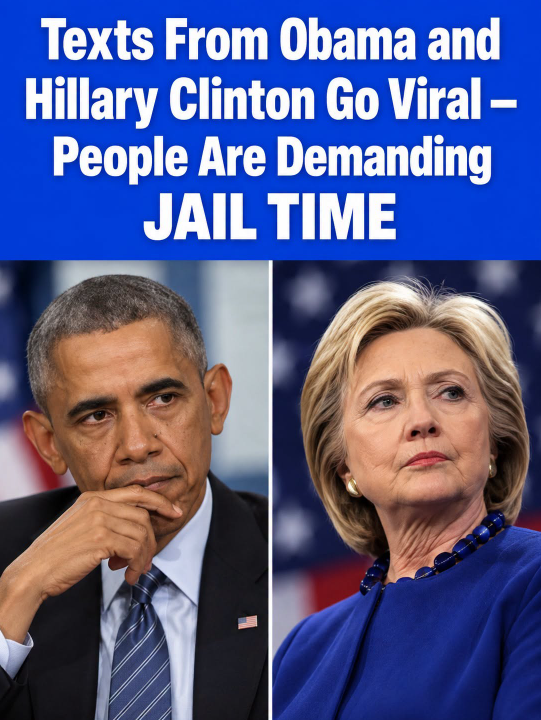
A dramatic political graphic circulating online has sparked intense reactions with a headline claiming that “texts from Obama and Hillary Clinton” have gone viral and that people are demanding “JAIL TIME.” The image, designed in the familiar style of viral Facebook political posts, presents the claim as if a major revelation has suddenly emerged.
But there is an important distinction between a viral headline and a verified news report.
At the time of writing, there is no reliable evidence establishing that a newly released set of text messages between Barack Obama and Hillary Clinton has produced a criminal case against either person. Searches for the exact wording of the viral headline do not turn up a credible current report confirming the dramatic claim. That means readers should be cautious before sharing the post as established fact.
The story is nevertheless interesting because it touches on one of the most politically explosive subjects in modern American politics: allegations surrounding the 2016 election, Hillary Clinton’s email controversy, the FBI investigation into the Trump campaign, and questions about what senior officials knew and when they knew it.
Why the headline is attracting so much attention
Political content is particularly well suited to social-media virality because it combines strong emotions with familiar public figures.
Obama and Clinton remain two of the most recognizable Democratic figures in American politics. Their names immediately attract supporters and critics alike. A headline suggesting that the two exchanged incriminating messages naturally creates curiosity.
The words “go viral” and “JAIL TIME” make the claim even more powerful. They imply that evidence has not merely surfaced but that the public has already reached a conclusion about criminal responsibility.
That is precisely where readers should slow down.
A person demanding an investigation or punishment online is not the same thing as prosecutors establishing that a crime occurred. Likewise, the existence of an email, text message, or government document does not automatically prove criminal wrongdoing.
There really were Obama-Clinton communications
There is historical documentation showing that Obama and Clinton communicated during the Obama administration.
The FBI’s investigation into Clinton’s use of a private email server examined communications involving Clinton and Obama, among many other records. Historical records also document communications between the two during Clinton’s time as secretary of state.
Those facts, however, should not be confused with the claim that a newly discovered collection of texts proves a criminal conspiracy.
That distinction is essential.
Political arguments frequently take genuine pieces of history and combine them with speculation. A real document can be presented alongside an unsupported interpretation, making the entire post appear authoritative even when the central allegation remains unproven.
The broader controversy goes back years
The controversy surrounding Clinton’s emails became one of the defining political stories of the 2016 presidential campaign.
Clinton used a private email server while serving as secretary of state. The FBI investigated whether classified information had been improperly handled. The investigation became deeply political, particularly after FBI Director James Comey’s July 2016 announcement that investigators had found evidence of carelessness but would not recommend criminal charges.
The issue never completely disappeared.
Later investigations and congressional inquiries continued to examine how federal agencies handled the Clinton investigation and how the FBI investigated connections between the Trump campaign and Russia.
Those separate investigations sometimes become mixed together in social-media posts.
That is one reason a headline claiming that “texts” prove everything should be treated carefully.
Text messages can be important — but context matters
Text messages have played a significant role in several political investigations.
For example, investigators examined text messages exchanged by FBI officials Peter Strzok and Lisa Page during the 2016 election period. Their messages became a major political controversy because some contained strongly anti-Trump sentiments. Republicans argued that the messages demonstrated political bias within the FBI, while others argued that individual employees’ personal views did not necessarily establish that the FBI’s investigations were politically motivated.
The broader controversy was examined by the Justice Department inspector general and became part of years of political debate.
This history helps explain why the word “texts” is so effective in a viral headline.
People remember previous controversies involving supposedly explosive messages, and a new graphic can quickly tap into those memories.
“Jail time” requires much more than an accusation
Perhaps the most important part of the viral headline is the phrase “JAIL TIME.”
In the United States, criminal punishment does not result simply because large numbers of people demand it online.
For someone to face imprisonment, prosecutors generally need evidence supporting criminal charges, and the case must proceed through the justice system. Depending on the circumstances, that can involve investigation, indictment, trial, conviction and sentencing.
Public anger is not a substitute for evidence.
Even when government officials make controversial decisions, those decisions do not automatically constitute criminal offenses.
That is why responsible reporting must separate three very different statements:
“People are demanding an investigation.”
“Investigators are examining possible wrongdoing.”
“A person has been charged or convicted of a crime.”
Those statements have completely different meanings.
Why readers should check the original documents
When a political graphic claims that explosive messages have surfaced, the most useful question is simple:
Where are the actual messages?
A credible report should identify the source of the documents, explain when they were created, describe how they were obtained and provide enough context for readers to understand what they mean.
Readers should also ask whether the messages have been independently authenticated.
Screenshots are particularly easy to manipulate. A message can be edited, cropped, stripped of context or falsely attributed to someone.
Even authentic messages can be misleading if only one sentence is presented while the surrounding conversation is omitted.
This is why professional journalism relies on corroboration rather than simply repeating a screenshot circulating on Facebook.
Viral politics rewards the most dramatic version
There is another reason posts like this spread so rapidly.
Social-media algorithms tend to reward engagement. Anger, fear and surprise encourage people to stop scrolling, comment, react and share.
A headline saying, “New documents are being reviewed by investigators” is unlikely to generate the same reaction as:
“SHOCKING TEXTS REVEALED — PEOPLE DEMAND JAIL TIME!”
The second headline creates urgency.
It also encourages readers to share before checking.
That is precisely the behavior viral misinformation depends on.
The problem is not limited to one political party. Similar tactics are used against politicians across the political spectrum. Democrats, Republicans, presidents, former presidents, senators and celebrities can all become targets of misleading viral claims.
What can responsibly be said right now?
The safest conclusion is that the viral graphic should not be treated as proof that Obama or Clinton have been exposed by newly revealed texts or that either has been sentenced, charged or ordered to serve prison time.
There have been extensive investigations and controversies involving both figures and the Obama administration, including Clinton’s email practices and the FBI’s handling of politically sensitive investigations. But those historical controversies should not automatically be presented as evidence of a new criminal case.
Earlier allegations about possible misconduct have circulated for years. Some investigations produced criticism, disputed findings and continuing political arguments. None of that means every new social-media claim is accurate.
A reminder before sharing
The image may be emotionally compelling, but a dramatic graphic is not the same thing as a court document, indictment or verified news report.
Before sharing a claim involving criminal accusations against a public figure, look for several things:
- The original documents.
- A credible news organization reporting the development.
- Confirmation from multiple independent sources.
- The date of the alleged revelation.
- The specific crime being alleged.
- Evidence that charges were actually filed.
- Statements from prosecutors, investigators or courts.
If those details are missing, the headline should be regarded as an allegation rather than established fact.
Political accountability is important. So is accurate information.
Americans have every right to demand investigations when they believe government officials have acted improperly. They also have the right to criticize presidents, former presidents, cabinet officials and political candidates.
But accountability is strongest when it is based on verified evidence rather than viral headlines.
The dramatic image claiming that Obama and Hillary Clinton are facing “jail time” may generate thousands of comments and shares, but the headline itself does not establish that a crime was committed or that either person is facing imprisonment.
In an era when a screenshot can reach millions of people within hours, the most powerful response is not simply to share the most shocking claim.