A Photo Locked in Time: New York Harbor on September 10, 2001
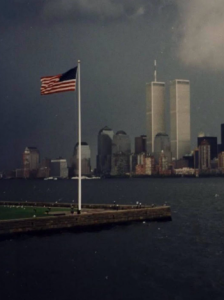
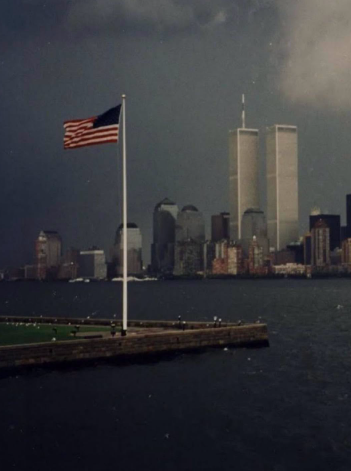
There are photographs that capture a beautiful moment, and then there are photographs that seem to capture an entire era. This image of New York Harbor, with the American flag waving in the foreground and the Twin Towers rising beyond the water, has become especially haunting because of the date associated with it: September 10, 2001, one day before the attacks that would forever change New York City, the United States, and the world.
At first glance, the photograph appears almost peaceful. The harbor is dark beneath an evening sky. The water stretches quietly toward Lower Manhattan. In the foreground, an American flag moves in the wind, illuminated against the fading light. And in the distance, the two enormous towers of the World Trade Center dominate the skyline.
Nothing in the photograph reveals what is about to happen.
That is what makes images like this so emotionally powerful.
The Twin Towers were more than buildings. For millions of people, they were part of the visual identity of New York City. Their distinctive shape could be recognized from miles away, from bridges, highways, airplanes, ferries, and across the surrounding waterways. They represented New York’s ambition, energy, commerce, and extraordinary scale.
On September 10, 2001, they were still standing.
Office workers were preparing for another ordinary Monday. Tourists were visiting the observation decks. Restaurants were serving customers. Families were returning home after summer vacations. Commuters were planning their morning journeys. Thousands of people were simply living their lives, unaware that history was about to divide itself into a “before” and an “after.”
The photograph therefore carries a strange kind of silence.
The people who might have looked at this skyline that evening had no reason to believe they were seeing it for the last time in its familiar form.
The Night Before
September 10 was an ordinary day in New York.
There was no visible warning in the skyline. The towers stood exactly as they had for years, rising more than 1,300 feet above Lower Manhattan. Their steel frames reflected the last light of the day, while surrounding buildings created the dense cityscape that made Manhattan instantly recognizable.
The American flag in the foreground adds another layer of meaning.
Normally, a flag waving above a harbor might simply symbolize patriotism. But when viewed after September 11, the image can evoke something much deeper: a country on the edge of an unimaginable tragedy, still unaware of what was coming.
The next morning, September 11, 2001, nineteen al-Qaeda terrorists hijacked four commercial airplanes. Two were flown into the World Trade Center towers in New York City. Another struck the Pentagon in Virginia, while United Airlines Flight 93 crashed in Pennsylvania after passengers attempted to regain control of the aircraft.
The attacks killed nearly 3,000 people.
The World Trade Center towers collapsed later that morning.
Suddenly, the skyline in this photograph belonged to history.
A Familiar Skyline That Disappeared
For generations, photographs of New York had featured the Twin Towers. They appeared in postcards, movies, television programs, advertisements, family vacation pictures, newspaper photographs, and personal snapshots.
Their absence after September 11 created an enormous visual void.
People returning to New York after the attacks often described looking toward Lower Manhattan and instinctively searching for the towers. Their familiar silhouettes were no longer there.
That is one reason photographs taken before September 11 became so important.
A picture that might once have been considered an ordinary tourist photograph suddenly became a historical document.
The people who took those pictures could not have known their significance at the time. They were simply photographing New York.
But history sometimes transforms ordinary photographs into extraordinary records.
The Human Stories Behind the Towers
It is easy when looking at the Twin Towers to focus on the architecture—the height, the steel, the massive scale of the buildings.
Yet the most important part of their history was the people inside them.
Thousands of workers occupied the offices every weekday. People worked in finance, technology, law, communications, restaurants, maintenance, security, transportation, and countless other professions. Visitors came from around the United States and around the world.
On September 11, each person had a story.
Someone was probably thinking about an upcoming vacation.
Someone was worried about a meeting.
Someone was planning to call a parent.
Someone was looking forward to dinner with friends.
Someone was thinking about their children.
Someone may have been having an ordinary, frustrating Monday morning.
That is what makes the photograph so difficult to look at decades later. It captures a world in which those ordinary plans still existed.
Why Photographs Matter
History is often remembered through major events, dates, speeches, and official records. But photographs provide something different.
They show us what the world looked like before we knew what was coming.
This particular image doesn’t show the attacks. It doesn’t show smoke, emergency vehicles, collapsing buildings, or crowds running through Lower Manhattan.
Instead, it shows stillness.
The harbor is calm.
The flag is flying.
The skyline is intact.
The towers are standing.
And that quietness can be more powerful than an image of destruction.
It reminds us that catastrophic events do not announce themselves to ordinary people. The evening before September 11 did not look like the beginning of a historical turning point. It looked like another night.
That is perhaps the greatest lesson contained within photographs from September 10.
Remembering Without Changing the Past
Today, when people see the Twin Towers in photographs, they often experience emotions that the original photographer could never have anticipated.
A modern viewer knows what happened the following morning.
The photographer did not.
That difference creates a powerful tension between the past and the present.
We look at the image knowing the future. The person standing behind the camera did not.
There is no way to warn the people in the photograph. There is no way to stop time. There is no way to preserve the towers exactly as they appeared that evening.
All that remains is the photograph.
And perhaps that is why the image feels like a time capsule.
It preserves a few seconds of a city before one of the darkest days in American history.
A Moment Before History Changed
The image of New York Harbor on September 10, 2001 should ultimately be remembered not only because of what happened afterward, but because of what it represents about ordinary life.
The night was not yet defined by tragedy.
The towers were not yet memorials.
The skyline was not yet a symbol of loss.
The American flag was simply waving over the harbor.
People were living their lives.
And the city was preparing for another morning.
One day later, everything would be different.
That is why this photograph feels “locked in time.” It captures New York at the precise edge of an enormous historical divide—a city that was still whole, a skyline that was still complete, and a nation that had not yet experienced the shock of September 11.
Looking at it today, the darkness surrounding the skyline seems almost symbolic, although it was simply an evening sky when the photograph was taken. We know the story that followed. The people in the picture did not.
Perhaps the most meaningful way to view such an image is not only with sadness, but with remembrance.
Remember the buildings.
Remember the skyline.
But most importantly, remember the people whose lives were forever connected to September 11, 2001.
A photograph can preserve architecture.
Memory preserves people.
And sometimes, a single quiet picture of a city before sunrise into history can remind us just how quickly an ordinary day can become a moment the world will never forget.