Can You Identify All 8 Men in This Unusual Presidential Photo? The Numbers Make It a Tricky Challenge
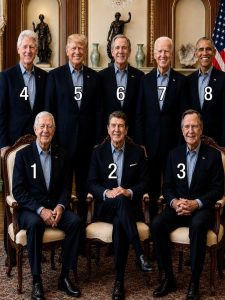
A photograph circulating online has caught the attention of thousands of people because it appears to show eight former U.S. presidents gathered together in the same room. Each person has been given a large number, from 1 through 8, and the challenge is simple: look closely at the picture and figure out who each number represents.
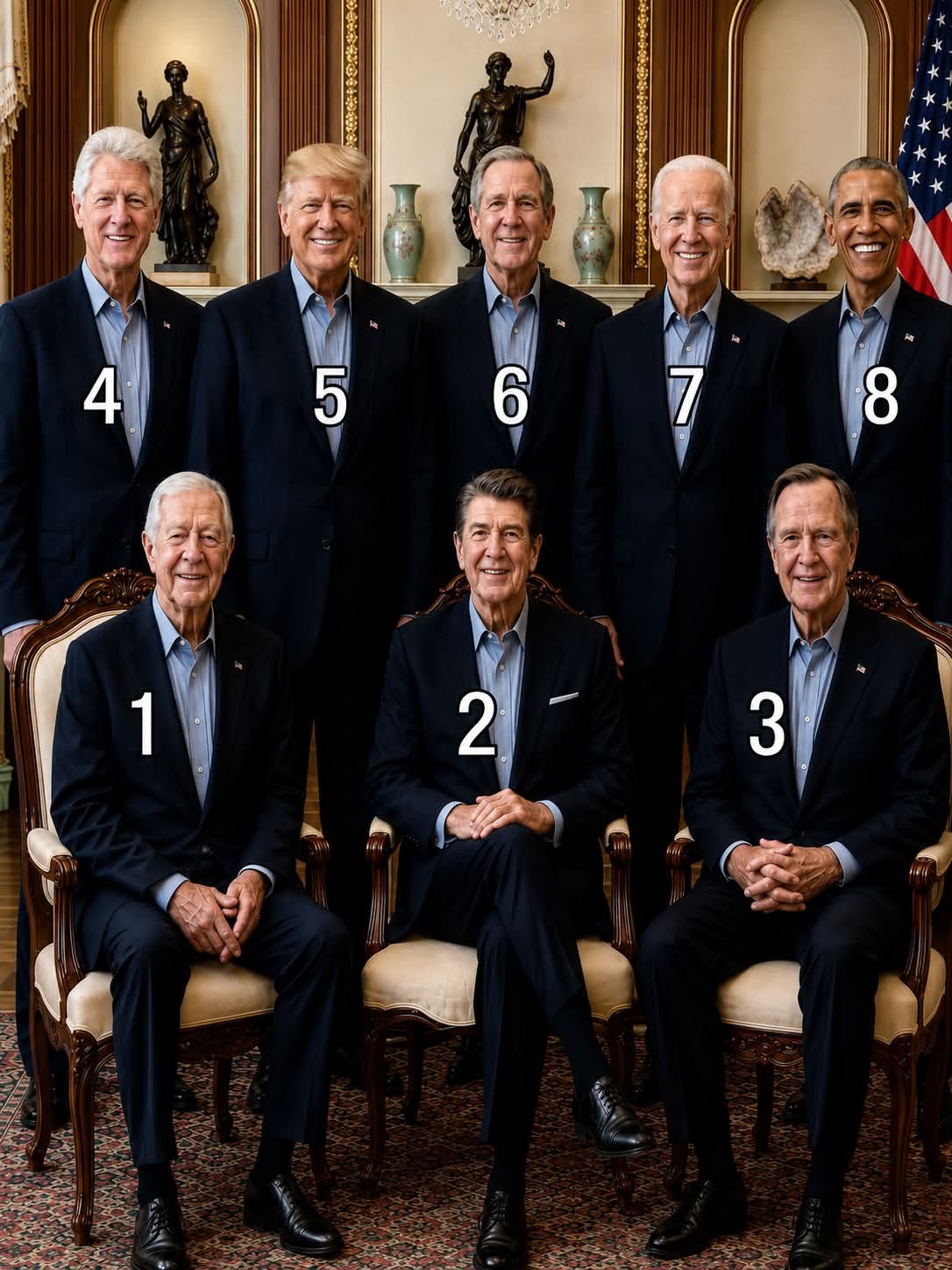
At first, the image looks like an ordinary formal group portrait. The men are dressed similarly, standing or sitting in an elegant room decorated with statues, vases, chandeliers, wood paneling, and an American flag.
But there is something unusual about the photograph.
The people shown span several different generations of American political history, and the numbers don’t represent their ages or the order in which they are standing.
That is what makes the image such an interesting brain teaser.
Look Closely at the Numbers
There are eight individuals in total.
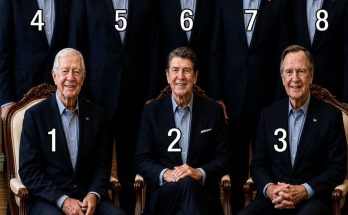
Three are seated in the front row, while five appear behind them. Large white numbers have been placed over each person:
- 1 — seated on the left
- 2 — seated in the center
- 3 — seated on the right
- 4 — standing on the far left
- 5 — standing second from the left
- 6 — standing in the middle
- 7 — standing second from the right
- 8 — standing on the far right
The arrangement immediately encourages viewers to start guessing.
However, there is an important detail that should not be overlooked: the image appears highly artificial or digitally generated. The lighting, facial details, proportions, and overall composition have characteristics commonly associated with AI-generated imagery or manipulated digital artwork.
That means the picture should not automatically be treated as an authentic historical photograph.
Why the Image Is So Convincing
One reason this image can fool people is its setting.
The room looks formal and presidential. The dark wooden walls, decorative artwork, classical statues, elegant chairs, chandelier, and American flag create the atmosphere of an official government residence.
The clothing also contributes to the illusion.
Every person is wearing a dark suit with a light-colored shirt. Their poses are formal, as if they have gathered for an official portrait.
The visual consistency makes the scene feel believable at first glance.
But when you examine the image carefully, some details may look slightly unnatural.
AI-generated images frequently struggle with small elements such as hands, fingers, facial symmetry, clothing folds, jewelry, and interactions between people and objects. Even when an image looks convincing from a distance, closer inspection can reveal inconsistencies.
That is why this photograph is better understood as a visual puzzle or digitally created scene, rather than automatically assuming it is a genuine historical event.
What Do the Numbers Mean?
The numbers are arguably the most interesting part of the challenge.
They run from 1 to 8, but they don’t appear to correspond simply to the order of the people in the photograph.
Instead, they appear to invite viewers to associate each individual with a particular point in presidential history.
The people depicted appear to represent a succession of American presidents from the late 20th century into the early 21st century.
For anyone familiar with U.S. political history, the clues are relatively recognizable.
The oldest-looking individual in the front row is associated with the administration that began in the late 1970s. Beside him is a former president strongly associated with the conservative political movement of the 1980s. The third seated figure represents the administration that followed at the beginning of the 1990s.
The back row then continues through later administrations.
That makes the photograph less about identifying faces and more about testing your knowledge of presidential chronology.
A Historical Timeline Hidden Inside the Picture
The eight individuals represented span an important period in American history.
Beginning in the late 1970s, the country experienced major political, economic, and international changes.
The 1980s brought a major shift in American politics, including debates over taxes, government spending, the Cold War, and the role of the federal government.
The early 1990s brought another change in political leadership, followed by a period marked by economic growth, globalization, technological development, and intense political debates.
The next administration entered office at the beginning of the 21st century, during one of the most consequential periods in modern American history. The September 11 attacks, wars in Afghanistan and Iraq, and major changes in U.S. foreign policy defined much of that era.
Later came another administration that dealt with the aftermath of the financial crisis, healthcare reform, technological transformation, and significant cultural and political changes.
Then came another dramatic political transition, followed by yet another change in the White House.
Looking at the photograph this way turns it into more than a simple guessing game. It becomes a visual timeline of several decades of American political history.
But There Is a Catch
The biggest mistake viewers can make is assuming that because an image looks realistic, it must be authentic.
Modern AI image-generation technology can create remarkably realistic scenes involving famous people, historical settings, and imagined events.
That makes critical thinking more important than ever.
An image showing several recognizable political figures standing together does not necessarily prove that they actually met in that exact location or posed for that photograph.
In fact, the polished appearance of this particular picture is one reason viewers should be cautious.
Before sharing an image described as “breaking news,” “rare footage,” or an “exclusive historical photograph,” it is worth asking a few simple questions:
Where was it originally published?
Who took the photograph?
When was it taken?
Is there an official source confirming the event?
Do reputable news organizations have the same image?
Those questions can prevent a convincing digital creation from being mistaken for genuine news.
The Fun Part: Test Yourself
Before looking for an explanation, take another look at the image.
Can you recognize the historical figures represented by numbers 1 through 8?
Don’t simply rely on facial recognition.
Consider their approximate ages, the eras in which they served, their positions in the presidential timeline, and the order in which the administrations occurred.
The image essentially turns American history into a visual memory test.
You might immediately recognize several of the people, while others may take longer.
And that’s exactly why these images become so popular on social media.
They encourage people to stop scrolling, study the picture, and challenge their friends.
Why People Love These Challenges
There is something naturally engaging about a puzzle that looks easy but requires knowledge.
A person may see eight familiar-looking faces and think, “I know all of them.”
Then the numbers create uncertainty.
Someone might correctly recognize six but struggle with the remaining two. Another person may confidently name all eight but get their chronological order wrong.
The conversation quickly becomes competitive.
Friends tag one another.
Family members compare answers.
History enthusiasts point out clues.
And people who initially knew very little about the subject may become curious enough to research the timeline themselves.
That is the power of a good visual puzzle.
It doesn’t simply provide information. It encourages participation.
The Bigger Lesson
Perhaps the most important lesson from this photograph isn’t whether someone can identify all eight individuals.
It is the reminder that images on the internet should be examined carefully.
A realistic picture can be fictional.
A familiar face can appear in an entirely invented setting.
And a photograph that looks like a historical record may actually be a modern creation.
As artificial intelligence becomes increasingly capable of producing realistic images, distinguishing genuine photographs from generated or manipulated ones will become an increasingly valuable skill.
So enjoy the challenge—but don’t automatically believe everything the picture appears to show.
Final Thought
This unusual portrait combines American presidential history, visual recognition, and modern AI technology into one fascinating puzzle.
The eight numbered figures are arranged as though they are participating in a formal gathering, creating the impression of a rare moment in political history.
But the visual evidence suggests that viewers should treat the image cautiously rather than assuming it documents a real event.
So before you scroll away, take one final look.
How many of the eight can you recognize?
And more importantly, can you tell which details look genuinely photographic—and which ones might reveal that the image was digitally created?