The Answer Is NOT 3! Can You Solve This Simple-Looking Math Puzzle?
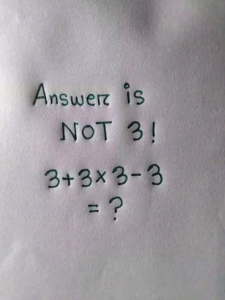
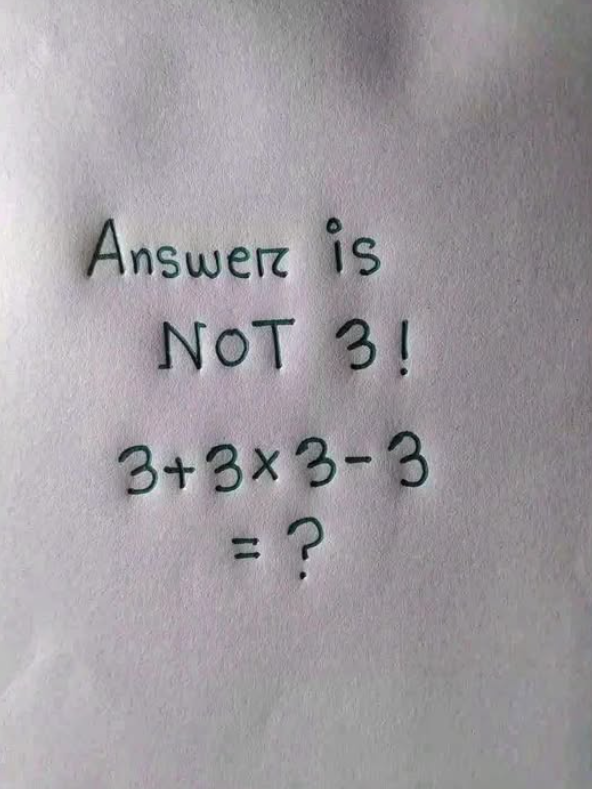
At first glance, the equation in the image looks incredibly simple:
3 + 3 × 3 − 3 = ?
It contains only a few numbers and three basic mathematical operations: addition, multiplication, and subtraction. Yet this tiny equation has managed to confuse countless people online.
Above the equation, the image adds an intriguing warning:
“Answer is NOT 3!”
That short sentence makes the puzzle even more interesting. If the answer is not 3, then what is it? And why would someone feel the need to warn us before we even attempt the calculation?
The solution becomes clear once we remember one of the most important rules in mathematics: the order of operations.
The Equation That Tricks Your Brain
When people see a short equation containing several operations, many instinctively begin calculating from left to right.
Following that approach, someone might do this:
3 + 3 = 6
Then:
6 × 3 = 18
And finally:
18 − 3 = 15
That produces 15.
But there is a problem: mathematics does not normally allow us to simply calculate every operation from left to right when multiplication and addition appear together.
The multiplication must be performed before the addition.
This is where the puzzle gets interesting.
Remember PEMDAS
In the United States, students are commonly taught the acronym PEMDAS, which represents the standard order of operations:
P — Parentheses
E — Exponents
M — Multiplication
D — Division
A — Addition
S — Subtraction
The important point here is that multiplication has priority over addition and subtraction.
There are no parentheses in this equation, and there are no exponents.
So we move directly to multiplication.
The equation is:
3 + 3 × 3 − 3
First, calculate:
3 × 3 = 9
Now the equation becomes:
3 + 9 − 3
At this point, there are only addition and subtraction left. These operations have equal priority, so we work from left to right.
First:
3 + 9 = 12
Then:
12 − 3 = 9
Therefore:
The answer is 9.
It is not 3, and it is not 15.
Why Do So Many People Get It Wrong?
The biggest reason these puzzles cause arguments is that humans naturally tend to read expressions from left to right.
When we see:
3 + 3 × 3 − 3
our eyes move naturally across the line. We see the first 3, then the plus sign, then another 3. It is tempting to add those two numbers immediately.
But mathematical notation gives multiplication priority.
This means the expression should not be interpreted as:
(3 + 3) × 3 − 3
If that were the intended equation, the parentheses would need to be shown.
Instead, the equation is:
3 + (3 × 3) − 3
That distinction changes everything.
With parentheses placed around the multiplication, the calculation becomes obvious:
3 + 9 − 3 = 9
What About the “NOT 3!” Warning?
The wording at the top of the image adds another layer to the puzzle.
It says:
“Answer is NOT 3!”
The exclamation mark appears to emphasize the statement. In ordinary language, it simply means the creator is strongly telling you that the answer isn’t 3.
However, mathematically, an exclamation mark can sometimes have another meaning.
In mathematics, 3! can represent the factorial of 3:
3! = 3 × 2 × 1 = 6
So if someone interpreted the phrase “NOT 3!” as mathematical notation rather than ordinary punctuation, it could technically be read as “not 6.”
But that is almost certainly not the intended interpretation of the image. The exclamation mark is being used as punctuation to emphasize the warning.
The actual equation remains:
3 + 3 × 3 − 3
And its standard answer is 9.
Could There Be Another Answer?
This is where internet math puzzles often become controversial.
Some people argue that different conventions or interpretations can produce different answers. In this particular equation, however, the standard order of operations gives a clear result.
Let’s compare the possibilities.
If you incorrectly calculate strictly from left to right:
3 + 3 = 6
6 × 3 = 18
18 − 3 = 15
Answer: 15
If you follow standard order of operations:
3 × 3 = 9
3 + 9 − 3 = 9
Answer: 9
If you somehow assumed the equation was structured differently:
For example, if it were written:
(3 + 3) × 3 − 3
then:
6 × 3 − 3 = 18 − 3 = 15
Again, the parentheses would be necessary to justify that interpretation.
So the original equation, as written, has a standard answer: 9.
The Real Lesson Behind the Puzzle
Although this looks like nothing more than a social-media brain teaser, it demonstrates an important mathematical principle.
The order of operations exists so that mathematical expressions can be interpreted consistently.
Imagine if everyone simply calculated from left to right regardless of the operation.
An expression such as:
2 + 3 × 4
could become:
(2 + 3) × 4 = 20
But under the standard order of operations:
3 × 4 = 12
and then:
2 + 12 = 14
The two answers are completely different.
Without agreed-upon rules, mathematical expressions would become ambiguous and difficult to communicate.
That’s why multiplication and division are handled before addition and subtraction.
A Simple Trick to Avoid Mistakes
When you see a puzzle like this, don’t rush.
Instead, scan the equation before doing any calculations.
Ask yourself:
- Are there parentheses?
- Are there exponents?
- Is there multiplication?
- Is there division?
- What addition or subtraction remains afterward?
For this puzzle:
3 + 3 × 3 − 3
There are no parentheses.
There are no exponents.
There is multiplication:
3 × 3 = 9
So replace it:
3 + 9 − 3
Now work from left to right:
3 + 9 = 12
12 − 3 = 9
Done.
Why Simple Puzzles Are So Popular
Images like this spread rapidly because they are easy to understand but surprisingly easy to get wrong.
A person can look at the equation for only a second, confidently announce an answer, and then discover that someone else calculated it differently.
That creates discussion, disagreement, and curiosity—the perfect ingredients for a viral puzzle.
The best part is that you don’t need advanced mathematics to solve it. You only need to remember a rule that most students encounter early in their education.
And that’s exactly what makes the puzzle so effective.
It isn’t really testing whether you can multiply 3 by 3. Almost everyone can do that.
It is testing whether you remember when to perform the multiplication.
Final Answer
So, if you were wondering what belongs after the question mark, the standard solution is:
3 + 3 × 3 − 3
= 3 + 9 − 3
= 12 − 3
= 9
Final answer: 9
The image was right to warn you that the answer is not 3. But the real challenge is resisting the temptation to calculate the expression in the order your eyes see it.