The Deep Meaning of Teamwork: Why No One Reaches the Finish Line Alone
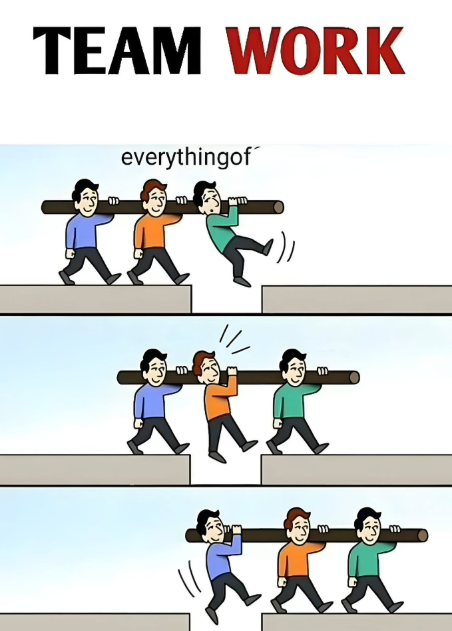
The simple illustration above carries a powerful message about teamwork, cooperation, leadership, and mutual support. At first glance, it appears to show three people carrying a long wooden pole while trying to cross a gap between two platforms. But when we look more carefully, the picture tells a much deeper story about life.
The word “TEAM WORK” appears prominently at the top. Below it, three people are attempting to move forward together. In the first scene, one person struggles while the others continue moving. In the second, the group adjusts its approach. In the final scene, they successfully cross the gap.
The lesson is simple:
When people work together, they can accomplish things that may be impossible alone.
But the image also teaches us that teamwork isn’t merely about being together. It is about understanding one another, adjusting, communicating, and helping when someone is struggling.
The First Step: Everyone Is Moving, But Not Everyone Is Helping
In the first part of the illustration, the three individuals are carrying the same pole. They appear to be moving in the same direction, but one person encounters difficulty at the gap.
This represents something we often see in real life.
A group can have the same goal without truly functioning as a team.
People may sit in the same office, belong to the same organization, work on the same project, or even live in the same household. Yet simply being part of the same group does not automatically create teamwork.
True teamwork requires awareness.
If one person is struggling while everyone else continues forward, the entire group can eventually suffer.
The image reminds us that your teammate’s problem can eventually become your problem too.
The Importance of Communication
In the second scene, the people appear to change their strategy.
Instead of simply continuing in exactly the same way, they adjust their positions and approach the obstacle differently.
This is an important lesson.
When a plan doesn’t work, a good team doesn’t immediately blame someone.
It asks:
What can we do differently?
Communication makes that possible.
People need to speak openly about problems. They need to listen to different opinions. They need to understand what their teammates are experiencing.
Sometimes the solution isn’t working harder.
Sometimes the solution is working smarter together.
A person struggling with a task may not need criticism. They may need someone to say, “Let me help you.”
That small sentence can completely change the outcome.
One Person’s Weakness Can Become the Team’s Strength
The illustration also challenges the idea that every member of a team must be equally strong at everything.
That isn’t realistic.
Every person has different abilities.
One person may be excellent at planning.
Another may be creative.
Someone else may be good at solving problems under pressure.
Another person may have experience that others don’t possess.
The strongest teams don’t waste energy trying to make everyone identical.
Instead, they recognize differences and use them.
A successful team asks:
“What does each person bring to the table?”
rather than:
“Who is the strongest person here?”
This distinction matters.
A team becomes powerful when individual strengths complement one another.
Helping Someone Doesn’t Make You Weaker
One of the most important lessons in the image is the importance of helping someone who is struggling.
In everyday life, people sometimes hesitate to ask for help because they believe it makes them look weak.
Others refuse to help because they believe someone else’s difficulty isn’t their responsibility.
Both attitudes can damage teamwork.
Imagine a workplace where employees refuse to help each other.
Imagine a family where everyone says, “That’s your problem.”
Imagine a sports team where every player only cares about personal statistics.
Such groups may contain talented individuals, but they won’t necessarily succeed.
Helping another person doesn’t reduce your own value.
In many cases, helping someone else succeed is one of the clearest signs of strength.
The Gap Represents Life’s Obstacles
The gap between the platforms is more than a physical obstacle.
It can represent anything that stands between us and our goals.
It could be financial difficulty.
It could be a failed business.
It could be a difficult school assignment.
It could be a workplace challenge.
It could be a family crisis.
It could be fear, uncertainty, or disappointment.
Every person eventually encounters a “gap.”
Sometimes we believe we have to cross it alone.
But the illustration offers another possibility.
Take the journey together.
When people cooperate, an obstacle that looks enormous from one perspective can become manageable from another.
Teamwork Requires Trust
There is another essential ingredient hidden in this image: trust.
The three people are holding the same object.
They have to trust one another.
If one person suddenly moves in the opposite direction, the others can be affected.
This is exactly how teamwork works.
When we work with others, our actions influence them.
Trust means believing that your teammates will do their part.
It also means knowing that if something goes wrong, people won’t immediately abandon you.
Trust takes time to build.
It requires consistency.
It requires honesty.
And most importantly, it requires people to keep their promises.
Without trust, even talented teams can fall apart.
A Good Leader Doesn’t Just Give Orders
The illustration can also teach us something about leadership.
A poor leader might simply say:
“Keep moving.”
A good leader notices that something isn’t working and asks why.
Leadership isn’t just about telling people what to do.
It is about helping people succeed.
A strong leader recognizes when a strategy needs to change. They listen to their team. They identify obstacles. They encourage people when morale is low.
Most importantly, a good leader understands that success belongs to the entire team.
When the team succeeds, everyone succeeds.
The Final Scene: Success Through Cooperation
The final part of the image shows the group successfully moving forward.
The obstacle hasn’t necessarily disappeared.
Instead, they have learned how to overcome it together.
This is a powerful distinction.
Life doesn’t always become easier.
Sometimes we become better at facing difficult situations.
The group’s success comes from adaptation and cooperation.
They didn’t quit when the first approach failed.
They changed their strategy.
That is an important lesson for anyone facing failure.
Failure doesn’t always mean the goal is impossible.
Sometimes it simply means:
Try another way.
Teamwork Applies Everywhere
The message applies far beyond workplaces.
Families need teamwork.
Friendships need teamwork.
Communities need teamwork.
Sports teams need teamwork.
Businesses need teamwork.
Schools need teamwork.
Even successful individuals often rely on a network of people behind the scenes.
Nobody truly accomplishes everything alone.
A successful person may receive encouragement from a parent, advice from a mentor, support from friends, cooperation from colleagues, and love from family.
Behind many individual achievements is a team that doesn’t always receive recognition.
That is why humility is so important.
When you achieve something, remember the people who helped you reach that point.
Don’t Leave Your Teammate Behind
Perhaps the deepest message of the illustration is this:
Don’t leave people behind simply because they are struggling.
You may be faster.
You may be stronger.
You may have more experience.
But someday, you may be the person who needs assistance.
Life changes quickly.
The person helping you today may need your help tomorrow.
A truly strong community understands this.
It doesn’t ask only, “What can I get from you?”
It asks:
“How can we help each other move forward?”
The Greatest Lesson
The word “teamwork” is easy to say, but difficult to practice.
Real teamwork requires patience.
It requires communication.
It requires trust.
It requires humility.
It requires compromise.
And sometimes it requires putting the group’s success ahead of personal pride.
The three people in the illustration eventually succeed because they stop treating the obstacle as an individual problem.
They treat it as a shared problem.
And that changes everything.
The image reminds us that we don’t always need a stronger person.
Sometimes we need a better strategy.
We don’t always need someone to carry us.
Sometimes we simply need someone to walk beside us.
And we don’t always need to be the person receiving help.
Sometimes our greatest contribution is being the person who notices someone else struggling and reaches out.
Final Thought
The deepest meaning of this illustration can be summarized in one sentence:
Alone, you may move faster—but together, you can go farther.
Success isn’t always about individual strength.
Sometimes it is about coordination.
Sometimes it is about patience.
Sometimes it is about lifting someone who has fallen.
And sometimes, the difference between failure and success is simply having people beside you who refuse to give up.
A great team doesn’t mean that everyone is perfect.
It means that when one person struggles, the others don’t walk away.
They adjust.
They communicate.
They support one another.
And together, they keep moving forward.