BREAKING: Trump’s Latest Iran Remarks Trigger Global Attention as Tensions Escalate
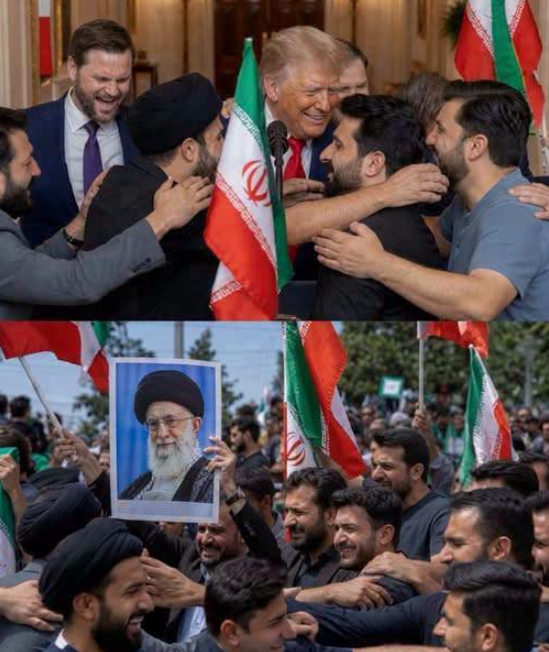
A dramatic image circulating online appears to show President Donald Trump surrounded by Iranian men while Iranian flags are displayed prominently in the background. The photograph has the appearance of a political celebration, while the lower portion shows a crowd holding Iranian flags and a large portrait of Iran’s Supreme Leader.
However, the image itself should not be treated as proof that Trump met with Iranian officials or that Iran has accepted a new agreement with the United States. The image appears to be digitally manipulated or AI-generated, and there is no reliable evidence accompanying it that confirms the scene actually occurred.
The real story behind the viral post is considerably more complicated—and far more serious.
As of September 5, 2026, the United States and Iran remain locked in a dangerous and unpredictable conflict. Recent reporting indicates that U.S. strikes against Iranian targets have continued, while Iran has retaliated against U.S. allies in the Gulf.
Trump calls Iran conflict “small potatoes”
On September 4, Trump made comments that immediately attracted international attention. Asked about the conflict with Iran, the president described it as a “military conflict” but called it “small potatoes” for the United States.
Trump also agreed with Vice President JD Vance, who had argued the previous day that the situation should not necessarily be described as a traditional war.
The remarks came despite the conflict having already produced significant consequences. According to Associated Press reporting, 18 U.S. service members had been killed and the conflict had cost American taxpayers more than $37.5 billion.
Trump defended his description by pointing to the absence of American ground troops inside Iran and the relatively limited number of U.S. casualties compared with earlier American wars.
He also reiterated one of his central arguments for the military campaign: that Iran must not be allowed to obtain a nuclear weapon.
That message has remained one of the administration’s principal justifications for confronting Tehran.
A conflict that has refused to disappear
What initially appeared to many observers to be a relatively short military confrontation has developed into a much longer and more complicated crisis.
The conflict began with major U.S.-Israeli strikes against Iranian military, governmental and infrastructure targets on February 28. Since then, Washington and Tehran have exchanged attacks while also exploring diplomatic possibilities.
Negotiations took place during the summer, including discussions aimed at establishing a framework for ending the fighting. Yet those diplomatic efforts have not prevented additional military confrontations.
The Strait of Hormuz has become one of the most important flashpoints.
The waterway is critical to global energy markets, and any prolonged disruption could affect fuel prices and international trade far beyond the Middle East.
Recent reports indicate that U.S. forces have conducted additional strikes against Iranian targets, while Iranian forces have responded with attacks directed toward countries and facilities connected to the American military presence in the region.
The viral photograph raises questions
The photograph circulating with dramatic captions adds another layer of confusion.
At first glance, it appears to show Trump smiling while surrounded by Iranian men. Iranian flags are clearly visible, and the atmosphere looks almost celebratory.
The lower half of the image shows a large crowd holding Iranian flags, while one person holds a portrait of Iran’s Supreme Leader.
But visual details alone cannot establish when, where or why such a scene occurred.
There is no credible reporting confirming that Trump recently appeared in Iran surrounded by Iranian supporters in the manner portrayed by the photograph.
For that reason, social-media users should be extremely cautious before sharing the image as evidence of a historic diplomatic breakthrough.
A photograph can be emotionally powerful while still being misleading.
Why the distinction matters
The difference between an authentic photograph and manipulated content becomes particularly important during a military crisis.
Images can travel across social media much faster than official statements or independent reporting. A dramatic photograph accompanied by a headline such as “Trump announces Iran has surrendered” or “Iran has accepted peace” can generate thousands of reactions before anyone checks whether the claim is real.
That is especially dangerous when the underlying situation is changing rapidly.
At present, credible reporting does not establish that Iran has surrendered, that the Iranian government has been replaced by an American-backed administration, or that Trump has announced a final peace agreement.
Instead, the available reporting points to continuing military and economic pressure.
The Trump administration has pursued both approaches simultaneously, combining military operations with sanctions intended to isolate Iran economically. The Treasury Department recently announced additional sanctions as part of an effort to cut financial lifelines available to Tehran.
Economic consequences are spreading
The consequences of the conflict are not limited to military targets.
Energy markets have been particularly vulnerable.
The Strait of Hormuz carries an enormous share of global energy shipments, making any threat to shipping there a concern for governments and consumers around the world.
Recent reporting has already linked the conflict to higher energy costs. The Associated Press reported that U.S. diesel prices reached a record average of $5.85 per gallon amid disruptions affecting global fuel flows.
That means developments thousands of miles away can eventually affect transportation, food prices, manufacturing and household budgets.
For ordinary Americans, the most immediate consequences of the conflict may therefore come not from headlines about military operations, but from what happens at gas stations and in supply chains.
New developments around Kharg Island
The situation became even more tense on September 5.
Reuters reported that an Iranian oil tanker near Kharg Island was reportedly struck by four U.S. missiles, according to Iran’s semi-official Tasnim news agency. Reuters noted that the claim had not been officially confirmed by Iranian authorities and that there was no immediate response from U.S. Central Command.
The Associated Press similarly reported that Iranian state television accused the United States of striking the tanker, while noting that Washington had not commented.
Kharg Island is strategically important because it has historically handled a major share of Iran’s crude oil exports.
Any sustained disruption there could therefore have consequences extending well beyond Iran.
What happens next?
The biggest question is whether the latest escalation eventually produces a negotiated settlement or pushes the region toward an even wider confrontation.
Trump has repeatedly emphasized his desire to prevent Iran from obtaining nuclear weapons. At the same time, officials have attempted to describe the current fighting as limited and intermittent.
That creates a difficult balancing act.
The administration must demonstrate military strength while avoiding an escalation that could become significantly more expensive in American lives and resources.
Iran faces an equally difficult situation.
Its leadership must respond to attacks while dealing with economic pressure and the possibility that continued escalation could further damage critical infrastructure.
Meanwhile, neighboring countries remain concerned about becoming directly involved.
The viral photograph therefore represents something different from what its dramatic appearance might suggest. Rather than proving that Trump and Iran have suddenly reached a historic agreement, it demonstrates how easily powerful imagery can become mixed with genuine breaking news.
The verified story is that tensions between Washington and Tehran remain extremely serious. U.S. military operations and economic pressure continue, Iran has retaliated, and diplomacy remains uncertain.
For anyone encountering the photograph online, the safest approach is simple: do not assume the image proves the headline.
The real developments surrounding Iran are already dramatic enough without adding fabricated or manipulated scenes to the story.