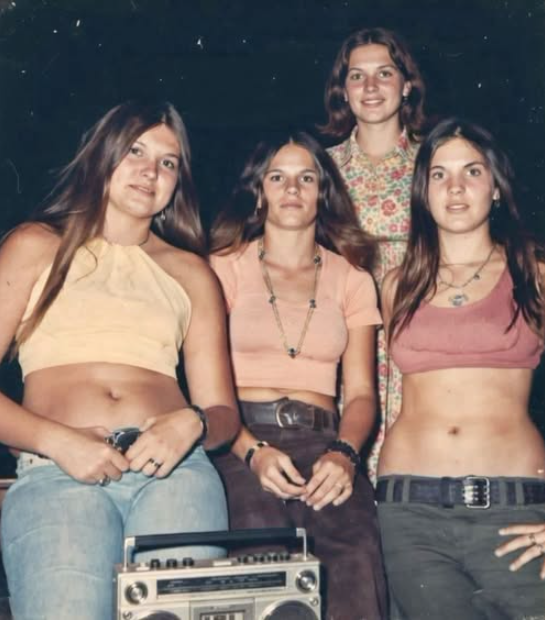
Women in the 70s… What Do You Notice? 🧐
Look at a photograph of women from the 1970s for a few seconds and you may notice something surprising.
At first, you might notice the clothing.
The wide-leg trousers.
The colorful dresses.
The enormous collars.
The boots.
The hairstyles.
The jewelry.
But look a little longer and something else begins to emerge.
A photograph from the 1970s isn’t simply a snapshot of fashion. It can reveal an entire period of social change.
The 1970s were a complicated decade, filled with cultural experimentation, economic difficulties, changing attitudes toward women, and a growing emphasis on personal freedom. Women’s clothing reflected many of those changes.
The Clothes Tell a Story
One of the first things people notice in photographs from the decade is how different the clothing looks from what many people wear today.
Bell-bottom trousers became one of the most recognizable styles of the era. Maxi dresses, flowing skirts, denim, ponchos, patterned tops, and platform shoes were also common elements of 1970s fashion.
But there wasn’t one single “70s look.”
That is one of the most interesting things about the decade.
A photograph might show one woman wearing jeans and a simple shirt while another wears a flowing dress. Someone else might be dressed in a tailored pantsuit.
The 1970s were about choice.
Women increasingly mixed traditionally masculine and feminine clothing. Trousers and suits became increasingly acceptable for work and formal occasions, while dresses could be practical, glamorous, romantic, or casual.
Fashion was becoming less about following one strict formula and more about expressing personality.
Look at the Hair
The hairstyles may be even more recognizable than the clothes.
Long, loose hair was common during much of the decade. Layered cuts, feathered styles, shags, afros, and other expressive hairstyles appeared throughout the era.
Later in the decade, the feathered hairstyle associated with Farrah Fawcett became particularly famous.
Hair was more than decoration.
For many people, appearance was becoming a form of personal expression.
Some women embraced natural textures. Others experimented with dramatic cuts, waves, layers, or color.
The variety is important because it reminds us that the 1970s weren’t visually uniform.
The Rise of Women’s Independence
Perhaps the most important thing to notice isn’t actually visible in the photograph.
It is the historical context surrounding the people in it.
The 1970s were an important period for women’s rights in the United States. The women’s liberation movement gained momentum, and women increasingly challenged traditional expectations about their roles in family life, employment, education, and public life.
Fashion reflected those changes.
Women were increasingly wearing trousers in situations where dresses and skirts had previously been expected. Pantsuits became a symbol of professional confidence, while practical sportswear offered greater freedom of movement.
The clothing wasn’t necessarily making the social change by itself.
Rather, both fashion and society were changing together.
Notice the Confidence
When looking at old photographs, people sometimes say that women from previous generations looked “more natural.”
That’s difficult to measure objectively.
Photography was different.
There were no smartphones constantly capturing thousands of spontaneous photographs. Pictures were often taken for particular occasions—birthdays, holidays, family gatherings, vacations, or special events.
Many photographs were also printed rather than immediately uploaded to social media.
That changes the feeling of an image.
A single photograph might have been carefully composed because film and developing cost money.
There may have been no expectation that hundreds of people would see it within minutes.
The Colors Were Bold
Another obvious feature is color.
The 1970s embraced earthy tones, strong patterns, warm shades, and distinctive combinations. At the same time, disco culture brought metallic fabrics, glamorous evening clothing, and more body-conscious styles.
Patterns could be dramatic.
Florals, geometric designs, stripes, plaids, and other prints appeared frequently.
Synthetic fabrics such as polyester were also heavily associated with the decade because they were affordable and practical for mass-produced clothing.
Today, some of those combinations may look unusual.
But that’s part of what makes vintage photographs so fascinating.
Every generation eventually develops its own idea of what looks normal.
The Everyday Details
If you have an old photograph available, don’t only look at the people.
Look behind them.
What is sitting on the table?
What kind of car is parked outside?
What does the building look like?
What are people carrying?
Are there advertisements in the background?
What kind of furniture is visible?
These seemingly insignificant details can sometimes tell us more about everyday life than the clothing itself.
A photograph of women standing outside a store, for example, can reveal signs, architecture, transportation, hairstyles, shopping habits, and clothing all at once.
That’s why historical photographs are valuable.
They preserve details that people at the time probably didn’t consider important.
A Decade of Contradictions
The 1970s were not simply an era of freedom and glamorous fashion.
They were also a decade of economic challenges, political conflict, changing family structures, and debates over traditional values.
Women experienced those changes differently depending on their circumstances.
A young woman living in a major city could have a very different experience from a woman living in a rural community.
A working professional could have different priorities from a homemaker.
Age, income, race, location, and family circumstances all influenced how women lived and dressed.
That’s why it is dangerous to look at one photograph and assume it represents every woman of the decade.
It doesn’t.
It represents one moment.
One group of people.
One particular place.
One particular day.
Why These Photos Still Fascinate Us
Perhaps the reason people love photographs from the 1970s is that they feel both familiar and completely foreign.
The people look like us.
They smile like us.
They socialize like us.
They celebrate birthdays, go shopping, spend time with friends, and pose for family photographs.
Yet almost everything surrounding them has changed.
The hairstyles are different.
The cars are different.
The clothing is different.
The technology is different.
Even the way photographs were created and preserved is different.
And that contrast makes vintage photography incredibly powerful.
So, What Do You Notice?
If you look at a photograph of women from the 1970s, don’t stop at the obvious details.
Yes, notice the bell-bottoms.
Notice the dresses.
Notice the hairstyles.
Notice the boots and oversized collars.
But also notice the expressions.
Notice the posture.
Notice how women are interacting with one another.
Notice the environment around them.
Most importantly, remember that you’re looking at real people rather than simply looking at costumes from an old decade.
They had hopes, frustrations, ambitions, friendships, families, jobs, worries, and dreams.
The photograph captured only a fraction of their lives.
That’s what makes old photographs so fascinating.
A single frame can freeze a moment, but it can never capture the entire story.
And perhaps that’s why, decades later, we can still look at a photograph of women from the 1970s and ask the same question:
What do you notice?
The answer may begin with the clothes.
But if you keep looking, you may discover an entire era hiding behind them.