Psychological Test: Which of These Four Babies Is a Little Girl?
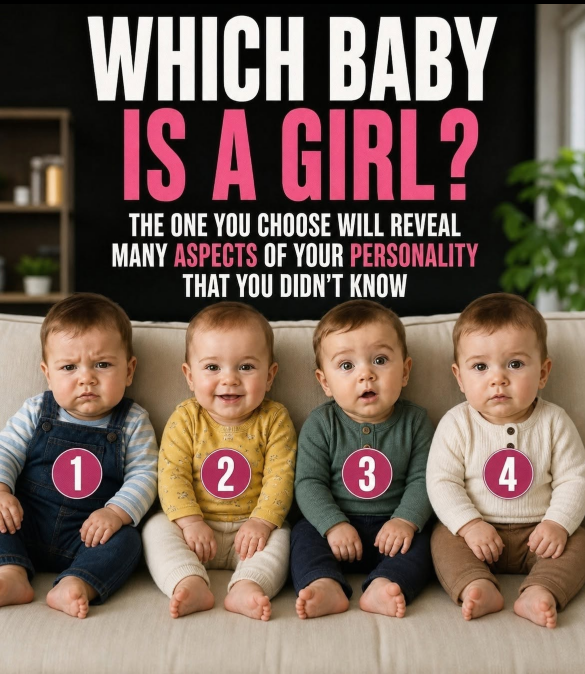
At first glance, this looks like a simple picture puzzle. Four adorable babies are placed side by side, and the challenge seems straightforward: Which one is the little girl?
Take a moment before reading further.
Look carefully at the four babies. Notice their expressions, clothing, hairstyles, colors and even the way they appear to be positioned. Which baby immediately catches your attention? Do you have a strong first impression, or are you completely uncertain?
This type of viral puzzle is often described online as a “psychological test.” It can certainly be entertaining, but there is an important distinction to make: you cannot reliably determine whether a baby is a boy or a girl simply by looking at a photograph.
That does not make the puzzle pointless. In fact, it can make the exercise more interesting because it reveals something about how our brains interpret visual information.
Trust Your First Impression — But Question It
When people see an image containing several similar subjects, the brain immediately begins searching for patterns.
It may notice a particular color, facial expression, hairstyle or item of clothing and quickly form a conclusion.
This happens automatically.
Our brains are designed to make rapid judgments based on limited information. In everyday life, that ability can be useful. Recognizing a familiar face, noticing danger or identifying an object quickly can save time.
But rapid judgments are not always accurate.
When an image contains four babies who look similar, your brain may rely on cultural expectations rather than genuine evidence. You might associate pink clothing with girls, blue clothing with boys, or certain hairstyles with one sex.
Those associations are learned rather than biological rules.
Why These Puzzles Are So Difficult
Babies are particularly challenging subjects for visual guessing.
Young children have not necessarily developed the physical characteristics that adults commonly associate with male or female appearance. Their hairstyles, clothing and facial features can also vary enormously.
A baby wearing a dress may be a girl — but a boy can wear a dress too.
A baby wearing blue may be a boy — but a girl can wear blue.
A baby with short hair may be a boy — or a girl.
A baby with long hair may be a girl — or a boy.
In other words, many of the clues people instinctively use are unreliable.
That is exactly what makes this kind of puzzle fascinating.
What Does Your Choice Say About You?
Although the image cannot scientifically reveal a baby’s sex, your reasoning process can be interesting to examine.
Did you immediately choose one baby?
If so, what made you choose that particular child?
Perhaps you noticed the clothing first. Maybe the facial expression influenced you. Maybe one baby’s hairstyle stood out.
Or perhaps you deliberately avoided obvious stereotypes and chose based on a different visual detail.
There is no scientifically validated personality profile associated with each possible answer. Any claims that choosing Baby One means you are “highly intelligent,” while choosing Baby Two means you are “emotional,” should be treated as entertainment rather than psychological science.
Still, thinking about your reasoning can reveal something useful: how easily your brain creates conclusions from incomplete information.
The Power of Stereotypes
One reason these puzzles become popular is that they expose everyday assumptions.
People grow up surrounded by messages about what boys and girls are “supposed” to look like.
Certain colors become associated with particular genders. Certain toys, hairstyles and clothes become categorized as masculine or feminine.
These conventions can become so familiar that we stop noticing them.
A visual puzzle can bring those assumptions to the surface.
If you looked at four babies and immediately thought, “That one must be the girl because of the pink outfit,” you were not necessarily being careless. Your brain was using a familiar cultural association.
But recognizing that association gives you an opportunity to question it.
Don’t Let Clothing Fool You
Clothing is probably one of the biggest sources of confusion in these puzzles.
Fashion changes constantly, and colors do not belong exclusively to any gender.
Pink, blue, yellow, green, white and every other color can be worn by anyone.
The same applies to dresses, shirts, hats and hairstyles.
A baby’s clothing is selected by parents or caregivers and does not provide definitive biological information about the baby’s sex.
That is why a puzzle that asks you to identify a baby’s gender from clothing is really testing your assumptions more than your observational ability.
Look at the Bigger Picture
If you are playing the puzzle purely for fun, take another look at all four babies.
Instead of asking, “Which one looks like a girl?” ask yourself:
“What specific evidence am I using to make that decision?”
This small change in wording can completely change the way you see the image.
You may suddenly realize that your original choice was based almost entirely on color.
Or perhaps you relied on hair length.
Maybe you noticed an accessory and unconsciously assigned it a gender.
Once you identify your reasoning, you can decide whether that clue is actually reliable.
Usually, it isn’t.
Why We Love Visual Brain Teasers
The popularity of these puzzles comes from something fundamental about human psychology: people enjoy solving mysteries.
A photograph with an apparent hidden answer creates curiosity.
You want to know whether your guess was correct.
You may even send the puzzle to a friend and challenge them to choose before revealing your answer.
These games encourage observation and discussion, even when there is no genuine psychological measurement involved.
They are especially popular on social media because they are quick to understand and easy to share.
One simple question can generate thousands of comments from people confidently defending completely different answers.
There May Be No Fair “Correct” Answer
This is perhaps the most important point.
Unless the original image comes with verified information about the babies, viewers cannot establish which child is a girl based solely on appearance.
If someone claims that one baby is definitely female because of facial structure, clothing or hairstyle, that claim goes beyond what the photograph can reliably tell us.
A person’s sex cannot be determined with certainty from stereotypes or superficial visual cues.
So if you guessed correctly, congratulations — but it may have been luck.
And if you guessed incorrectly, don’t worry.
The puzzle was never a scientifically valid test of intelligence.
The Real Test Is Your Thinking
The more interesting lesson is not whether you selected the “right” baby.
It is how quickly you formed your conclusion.
Did you make a judgment immediately?
Did you reconsider it?
Did you search for evidence?
Did you recognize your own assumptions?
These questions are much closer to genuine psychological reflection than assigning a personality type based on a single picture.
Good critical thinking often begins with a simple habit:
Pause before deciding.
Our first impressions can be useful, but they can also be influenced by expectations, experience and cultural stereotypes.
Challenge Your Friends
If you want to turn this into a fun group activity, show the image to several friends without giving them any clues.
Ask each person to choose one baby.
Then ask them why.
The explanations may be more entertaining than the answers themselves.
One person might focus on clothing. Another might choose based on hair. Someone else might insist that facial expressions provide a clue.
The conversation can become an excellent reminder that different people notice different details in exactly the same image.
Just avoid presenting anyone’s guess as a factual determination of a baby’s sex.
Final Thoughts
So, which of the four babies is the little girl?
If the puzzle provides verified information elsewhere, the answer may be known to whoever created the image. But from appearance alone, there is no reliable way for a viewer to determine it.
And perhaps that is what makes the puzzle worth discussing.
What looks like a simple guessing game actually demonstrates how quickly our minds search for patterns and apply familiar assumptions.
The next time you encounter a viral “psychological test,” don’t only ask whether you got the answer right.
Ask yourself why you chose it.
What did you notice first?
What assumptions influenced you?
And would you make the same choice if the colors, clothes and hairstyles were completely different?
Those questions can turn a simple internet puzzle into a small lesson in observation and critical thinking.
After all, sometimes the most interesting part of a brain teaser isn’t the answer.
It’s discovering how your own mind arrived there.