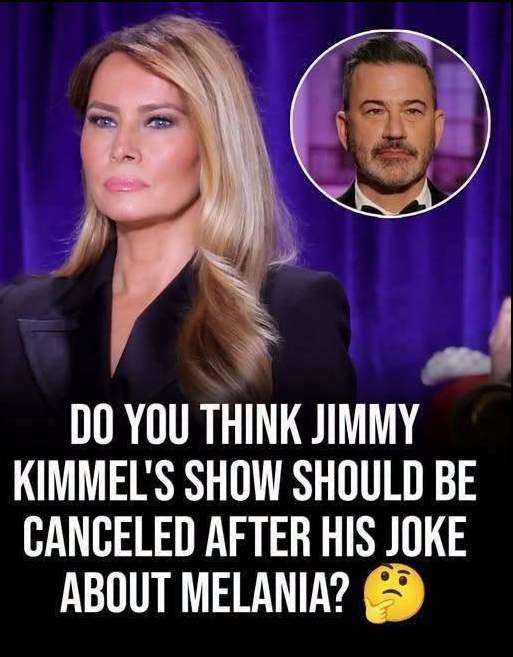
Kimmel’s Melania Joke Triggers Studio Shockwave
Late-night comedy has always lived in the uncomfortable space between entertainment and controversy. A comedian makes a joke, the audience laughs—or doesn’t—and the moment disappears into the next segment. But when the joke involves a sitting president and the first lady, the reaction can become much bigger than the punchline itself.
That is what happened after Jimmy Kimmel made a joke involving Melania Trump during a late-night monologue in April 2026. The joke quickly became part of a larger political confrontation, with Donald Trump and Melania Trump criticizing Kimmel and calling for consequences against the comedian.
The controversy became even more complicated because the joke came only days before the April 2026 White House Correspondents’ Dinner shooting. That timing transformed what Kimmel described as a joke about the age difference between Donald and Melania Trump into a much more politically charged dispute.
The Joke That Started the Firestorm
Kimmel was discussing the upcoming White House Correspondents’ Dinner when he delivered the controversial line involving Melania.
He imagined himself hosting the event and introduced the first lady with a joke referring to her as having “a glow like an expectant widow.”
The joke was intended as a dark-comedy reference to the significant age difference between Donald Trump and Melania. Kimmel later explained that he regarded it as a light roast rather than a serious statement or threat.
But the timing proved extraordinarily unfortunate.
Three days after the joke, a shooting occurred near the White House Correspondents’ Dinner. Trump and other officials were safe, and the incident immediately generated widespread concern and political discussion.
The proximity between the shooting and Kimmel’s earlier joke dramatically changed the atmosphere surrounding his comments.
Trump Responds
Donald Trump reacted angrily and called for Kimmel to be fired from ABC. Melania Trump also criticized the comedian, making the dispute a very public confrontation between the first family and one of America’s most recognizable late-night hosts.
For Trump, the joke crossed a line because it referenced his potential death.
For Kimmel, the timing was important. He emphasized that the joke had been made before the shooting and was not intended to encourage violence.
That distinction became central to the debate.
Can a comedian make an offensive or tasteless joke without being accused of encouraging real-world violence?
And when a tragic event happens afterward, should the comedian’s earlier words be judged differently?
Those questions quickly became larger than the original punchline.
Kimmel Defends Himself
Rather than simply apologize and move on, Kimmel defended the joke while expressing sympathy for what the Trumps and others experienced during the shooting.
He explained that his intention had been to make a joke about Trump’s age and his marriage to a younger woman, rather than to suggest that anyone should harm the president.
That distinction is important because political comedy frequently relies on exaggeration.
Comedians routinely joke about politicians losing elections, resigning, being embarrassed, being replaced, or experiencing political disaster. Dark humor can push those ideas even further.
But jokes involving death are particularly sensitive when the person being discussed is a real individual—and especially when that individual is a president.
When Comedy Meets Politics
Jimmy Kimmel’s relationship with Donald Trump has been contentious for years.
Kimmel has repeatedly criticized Trump on his late-night program, while Trump has repeatedly attacked Kimmel publicly. The comedian has made clear that political criticism is part of how he approaches his job.
That history meant the Melania joke did not occur in isolation.
For Kimmel’s supporters, the controversy represented another example of a comedian being targeted for making jokes about a powerful political figure.
For Trump’s supporters, it represented something very different: an example of late-night comedy becoming excessively personal and disrespectful.
The two sides were therefore unlikely to interpret the same joke in the same way.
The Bigger Question: Where Is the Line?
Comedy has always depended on boundaries.
If a comedian never crosses a boundary, the material may become predictable. But if the comedian crosses too many boundaries, audiences may decide that the joke is no longer funny.
Political comedy creates an especially difficult balancing act.
Presidents are among the most powerful people in the country. Satirizing them is an important part of democratic culture. Political cartoonists, comedians, writers, and entertainers have mocked presidents for generations.
At the same time, public figures remain human beings.
A joke can be legally permissible while still being considered cruel, offensive, or inappropriate by an audience.
That is why arguments over comedy rarely have simple answers.
Melania Becomes Part of the Conversation
Melania Trump has generally maintained a much lower public profile than her husband. As a result, jokes involving her can attract considerable attention precisely because she does not frequently participate in political debates herself.
The controversy surrounding Kimmel therefore placed her directly at the center of a national conversation.
The issue was no longer simply whether the joke was funny.
It became a discussion about respect, political satire, free expression, and the responsibilities of entertainers.
That is how a few seconds of television can become a national story.
The Studio Reaction
The phrase “studio shockwave” makes the event sound like the audience erupted into chaos, but there is no reliable evidence that a literal studio-wide meltdown occurred in the dramatic way some viral headlines suggest.
The real “shockwave” was the reaction beyond the studio.
The joke spread across political media and social platforms. Trump criticized Kimmel. Melania criticized Kimmel. Kimmel defended his position. Commentators debated whether the joke had crossed a line.
In other words, the controversy became much larger than the original television moment.
That is increasingly common in modern entertainment.
A joke that once would have lasted a few minutes can now become a headline within seconds.
Social Media Makes Everything Bigger
Social media has fundamentally changed the life cycle of controversial comedy.
A comedian tells a joke during a live broadcast.
Someone clips it.
Another person posts the clip with an angry caption.
Supporters share it.
Critics respond.
Political commentators discuss it.
Then news organizations report on the reaction.
Before long, the original audience may be the least important audience of all.
Millions of people who never watched the original program can encounter the joke completely outside its original context.
That can make understanding what actually happened much more difficult.
The Importance of Context
Context matters enormously in comedy.
A joke delivered during a political monologue is understood differently from a statement made during a serious news conference.
Tone matters.
Timing matters.
The comedian’s history matters.
And the audience’s expectations matter.
Kimmel’s defenders emphasized that his comment was part of a satirical monologue. His critics argued that jokes about a person’s death are inherently unacceptable.
Both reactions demonstrate why humor is subjective.
One person’s clever political satire can be another person’s deeply offensive insult.
A Debate Bigger Than Kimmel
Ultimately, the Kimmel-Melania controversy is not simply about one comedian or one first lady.
It reflects a much larger American argument about political speech.
How much criticism should presidents tolerate?
How far can comedians go?
Should entertainers face professional consequences for offensive jokes?
When does satire become irresponsible?
And who gets to decide?
There are no universally accepted answers.
American political comedy has always been provocative precisely because it challenges powerful people. But provocative comedy also comes with consequences. Audiences can criticize it, networks can evaluate it, and public figures can respond.
The debate itself is part of the culture surrounding free expression.
Why the Story Continues to Matter
The controversy surrounding Kimmel’s Melania joke demonstrates how quickly entertainment and politics can collide.
A few words from a late-night monologue became connected to a much larger national controversy. Donald Trump demanded action against Kimmel, Melania Trump publicly criticized him, and Kimmel defended the context and intent of his joke.
The episode also illustrates the dangers of taking provocative material out of context.
A comedian’s joke can be interpreted one way by a studio audience, another way by television viewers, and an entirely different way by political supporters watching a short clip online.
That is the reality of modern political comedy.
For some viewers, Kimmel’s joke was simply dark satire.
For others, it was tasteless and inappropriate.
For still others, the controversy became another chapter in the long-running battle between Trump and late-night television.
Whatever conclusion people reach, one thing is certain: the joke became far more consequential than anyone could have expected when it was first delivered.
And that may be the strangest lesson of all.
In today’s media environment, a single sentence can travel farther than an entire television program—and sometimes become a national political controversy before the comedian even gets to the next segment.