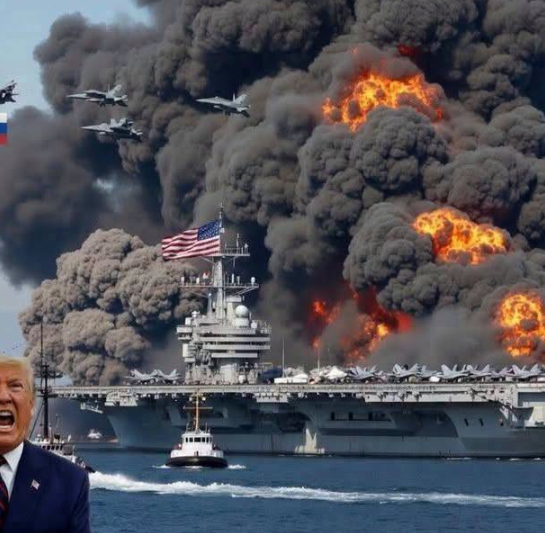
A dramatic headline claiming that a Russian Su-57 pilot destroyed a U.S. aircraft carrier carrying 700 tanks has been circulating widely online. The story sounds like the opening scene of a major military confrontation between two nuclear-armed powers, but there is an important problem: there is currently no credible evidence confirming that the alleged attack actually happened.
Searches for the exact claim have found social-media posts, videos, and websites repeating the headline, but not reliable confirmation from authoritative military or international news sources. One video using the same headline explicitly identifies its footage as a virtual military simulation.
That distinction matters enormously.
A headline describing the destruction of a U.S. aircraft carrier by a Russian fifth-generation fighter would represent an extraordinary international event. It would not be an ordinary military story that appeared only on social-media pages. Governments, defense ministries, military analysts, satellite-imagery specialists, and major international news organizations would be examining the incident.
Instead, what appears to be circulating is a sensationalized scenario presented as breaking news.
The story behind the headline
The claim is designed to create an immediate reaction.
“13 minutes ago” suggests that the event has just happened.
“Russian Su-57 pilot” introduces a sophisticated stealth fighter.
“U.S. aircraft carrier” introduces one of America’s most recognizable military platforms.
And “700 tanks” makes the supposed destruction sound even more enormous.
Put together, those details create a story that is almost impossible to ignore.
But dramatic wording is not evidence.
A report currently circulating online describes the alleged attack as involving a U.S. vessel supposedly transporting more than 700 tanks. Even that report acknowledges that there has been no official confirmation.
The lack of independent confirmation should therefore be the central fact when discussing the story.
The Su-57 is real
The Russian Su-57 is not fictional. It is a real fifth-generation fighter aircraft developed for the Russian military.
That fact can make misleading stories involving the aircraft appear more believable.
The Su-57 has been discussed extensively in defense circles because of its intended combination of stealth characteristics, advanced sensors, maneuverability, and weapons capabilities. Russia has promoted the aircraft as an important component of its modern combat-aircraft fleet.
But the existence of the Su-57 does not mean that every video or headline featuring it represents a real combat operation.
This is an increasingly important distinction in the internet era.
A real aircraft can be placed into a fictional scenario.
A genuine photograph can be used with an unrelated story.
A computer-generated scene can look like authentic battlefield footage.
And a military simulation can be presented without sufficient context, causing viewers to believe that they are watching an actual attack.
That appears particularly relevant to the current viral story.
What about the “700 tanks”?
This is another major reason to be skeptical.
An aircraft carrier is primarily designed to operate aircraft. Its enormous internal spaces support aviation operations, including aircraft maintenance, aviation fuel, weapons handling, crew accommodation, and other functions associated with operating an air wing.
It is not normally a giant tank transport ship.
Large quantities of armored vehicles are generally moved using specialized military cargo ships, roll-on/roll-off vessels, amphibious ships, or other logistical platforms.
Therefore, the description of an American aircraft carrier transporting 700 tanks should immediately prompt questions about what type of vessel the story is actually describing.
The detail appears designed to increase the emotional impact of the headline rather than provide a technically accurate description of a naval deployment.
The video problem
Perhaps the most revealing element is the footage associated with versions of the story.
A YouTube result using essentially the same headline states that the video is a virtual game simulation.
That is significant because military simulations can look remarkably realistic.
Modern computer graphics can reproduce aircraft, ships, missiles, explosions, smoke, radar screens, and battlefield environments in ways that can be difficult for casual viewers to distinguish from real footage.
Once a clip is removed from its original context and placed underneath a headline saying “13 minutes ago,” viewers may naturally assume they are witnessing breaking news.
But the footage itself does not prove that the event occurred.
This is one of the biggest challenges facing online audiences today.
Why fake military stories spread so quickly
Military stories have a powerful emotional advantage over many other forms of misinformation.
A normal false story might claim that a celebrity made an unusual statement.
A false military story can suggest that an international war has suddenly escalated.
That possibility naturally attracts attention.
People click because they want to know whether their country is under threat. They share posts because they believe friends and relatives need to know. Algorithms then reward the engagement, pushing the content toward even more users.
Within hours, an unverified claim can appear to be everywhere.
But popularity does not equal accuracy.
A story can receive thousands of views while still being completely unsupported.
What would happen if a U.S. carrier were actually destroyed?
If a U.S. aircraft carrier were genuinely destroyed by a Russian fighter, the consequences would be enormous.
Aircraft carriers are among the most heavily protected military assets in the world. They typically operate as part of larger formations rather than traveling alone. Their surrounding force can include other warships, aircraft, submarines, and extensive surveillance and defensive capabilities.
An attack resulting in the confirmed destruction of such a vessel would therefore represent a major military and geopolitical development.
It would almost certainly trigger intense international attention.
Officials would be expected to address the incident.
Defense organizations would investigate.
Satellite imagery would become extremely important.
Military analysts would examine the circumstances.
Major news organizations around the world would report on the event.
None of those consequences should be confused with the unverified online claims currently circulating.
Why verification matters
There is nothing wrong with being interested in military technology or following breaking defense news.
The problem begins when speculation is presented as fact.
A responsible reader should ask several questions before sharing a story like this:
Who first reported the event?
Is the source identifiable?
Has the U.S. government confirmed it?
Has Russia confirmed it?
Are reputable international news organizations independently reporting it?
Can the location of the alleged attack be established?
Has satellite imagery appeared?
Is the video original?
Could the footage be from a simulation, game, movie, training exercise, or older conflict?
Does the description of the military equipment make technical sense?
These questions can quickly expose many sensational claims.
The larger lesson
The viral Su-57 story is an example of how modern misinformation works.
It combines real military technology with an extraordinary fictional or unverified scenario.
The Su-57 exists.
U.S. aircraft carriers exist.
Tanks exist.
Military simulations exist.
But those facts do not automatically prove that the specific event described in the headline occurred.
That is the logical trap.
A story can contain several true individual facts while the central claim remains false.
What we can responsibly say
At this point, the claim that a Russian Su-57 pilot destroyed a U.S. aircraft carrier carrying 700 tanks should not be presented as confirmed news.
The available evidence points instead toward a viral, sensationalized scenario, with at least some of the associated video material identified as simulation footage.
That does not mean future military incidents are impossible. International tensions can change quickly, and real conflicts can produce unexpected developments.
It simply means that extraordinary claims require extraordinary evidence.
The phrase “13 minutes ago” should never be treated as proof that something happened 13 minutes ago.
A dramatic video is not automatically documentary evidence.
A viral post is not automatically journalism.
And a headline is not automatically a fact.
The most responsible approach is to wait for independent confirmation before treating a claim of this magnitude as real.
For now, the alleged destruction of a U.S. aircraft carrier by a Russian Su-57 carrying a supposed cargo of 700 tanks remains unverified, rather than an established military event. The story may generate enormous attention online, but attention should never replace evidence.
In an age when realistic simulations, edited footage, artificial intelligence, and sensational headlines can reach millions of people within minutes, the ability to pause and verify information has become more important than ever.
The real story is not necessarily the spectacular battle described by the headline.
The real story may be how easily a fictional or simulated military scenario can be transformed into something that looks like breaking news—and how important it is for readers to recognize the difference.