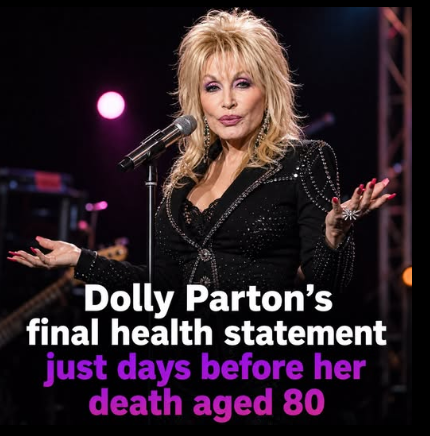
Dolly Parton’s Final Health Statement Just Days Before Her Death at 80
The world is mourning the loss of Dolly Parton, the legendary country singer, songwriter, actress, philanthropist, and businesswoman who died on August 25, 2026, at the age of 80. Her death came only days after she had spoken publicly about her health, making her final message to fans especially poignant. Her family announced her passing through her nephew, Bryan Seaver. No official cause of death had been disclosed at the time of the announcement.
Just four days before her death, Parton had offered fans an unusually candid glimpse into what she had been experiencing. In a statement shared with PEOPLE on August 21, she explained that she had been dealing with health problems that she had not properly addressed while caring for her husband, Carl Dean, during the final period of his life. Dean died in March 2025 after nearly six decades of marriage.
Parton’s words were striking not because they sounded like a farewell, but because they sounded like a promise to keep going.
She acknowledged that she was still recovering, while emphasizing that she remained determined to work. Her message reflected the attitude that had defined much of her extraordinary career: acknowledge the difficulty, but keep moving forward.
“I’m still healin’, I’m still workin’!” she told fans, according to the statement reported by ABC News. She also spoke about having many dreams and projects she still wanted to complete.
Those words now carry a different weight.
A Year of Health Challenges
Parton’s health concerns had become increasingly visible during 2026. Earlier in August, she missed the opening of a new attraction at Dollywood after her doctor advised her not to travel.
In a recorded message, Parton explained that she had experienced dizziness and dehydration. With her Nashville doctor concerned about her condition, she was told to remain home rather than make the trip. Even then, she approached the situation with the humor and warmth that fans had come to expect from her.
She joked that her doctor had “clipped my wings,” while reassuring fans that she wanted to keep them informed about what was happening.
Her health difficulties had also affected her professional plans. In May, Parton announced that she was canceling her planned Las Vegas residency. She explained that her immune and digestive systems had been affected over the previous couple of years and that she needed additional time to recover. At that point, she emphasized that her conditions were treatable and expressed optimism about eventually returning to work.
The cancellation was significant because Parton had spent much of her life performing despite exhaustion, setbacks, and personal challenges. Yet by 2026, she appeared to recognize that her body required more attention.
Grief Played a Major Role
One of the most important parts of Parton’s final health discussion was her acknowledgment that she had neglected herself while caring for Carl Dean.
Dean, whom Parton married in 1966, had remained largely outside the spotlight throughout their marriage. His death in 2025 marked one of the most painful chapters of Parton’s life.
For decades, Parton had spoken affectionately about their relationship while protecting their privacy. After his death, she continued working but also acknowledged the emotional toll of losing the man who had been beside her for most of her adult life.
In her final years, therefore, physical health and emotional grief became intertwined. She had spent so much energy caring for someone she loved that she admitted she had not always paid enough attention to herself.
That admission made her final health statement particularly human.
For someone who had spent decades appearing almost indestructible, Parton was acknowledging something many people eventually experience: sometimes caring for others can cause us to postpone caring for ourselves.
She Kept Working Until the End
Despite her health problems, Parton never stopped thinking about the future.
Her final months included numerous projects and plans. She continued developing business ideas, creative projects, and plans connected to her remarkable legacy.
She had also been working toward the Life of Many Colors Museum in Nashville and other ventures. Even after canceling her Las Vegas performances, she remained interested in finding ways to connect with audiences.
Her determination was evident in the way she described herself as still having dreams she wanted to see become reality.
That attitude became one of the defining themes of her final public messages.
Parton did not present herself as someone ready to surrender to illness. Instead, she portrayed herself as someone recovering, adapting, and continuing to dream.
Her Final Public Moments
Parton’s last major in-person public appearance came in June at the opening of Dolly’s Tennessean Travel Stop in Cornersville, Tennessee.
At the event, she appeared cheerful and engaged with the crowd. Reports from the appearance described her as upbeat and energetic.
She later continued communicating with fans through recorded messages and appearances.
That contrast between her public optimism and the seriousness of her subsequent health problems has left many fans reflecting on just how quickly circumstances can change.
Her family ultimately announced her death on August 25.
The announcement came only days after her health statement, leaving many people shocked by the speed of events. Importantly, however, the family did not immediately disclose an official cause of death, meaning that speculation about the precise circumstances should be treated cautiously.
A Legacy Far Bigger Than Music
Dolly Parton’s importance cannot be measured only by record sales or awards.
She became one of the most recognizable figures in American entertainment while remaining closely associated with the Tennessee upbringing that shaped her.
Songs such as “Jolene,” “9 to 5,” “Coat of Many Colors,” and “I Will Always Love You” became part of the cultural fabric. Her songwriting reached far beyond country music, and her work as an actress expanded her audience even further.
But perhaps her most lasting achievement was her philanthropy.
Through the Dolly Parton’s Imagination Library, she helped put books into the hands of children around the world, encouraging young readers regardless of their family’s financial circumstances.
She also supported medical research, education, disaster relief, and numerous charitable causes. Her $1 million contribution to COVID-19 vaccine research became particularly well known.
The Meaning of Her Final Words
In retrospect, Parton’s final health statement may be remembered less as a warning and more as a reflection of her character.
She admitted she was struggling.
She admitted she had neglected her health.
But she also insisted that she still had work to do.
That combination of vulnerability and optimism was quintessential Dolly Parton.
Her final words did not suggest that she had stopped dreaming. Quite the opposite. She was still imagining projects, still thinking about her fans, and still looking toward the future.
That is perhaps why her death feels so difficult for millions of people.
Dolly Parton spent her life making people believe that difficult beginnings did not have to determine the ending. She came from a poor family in the Tennessee mountains and transformed herself into an international superstar without abandoning the warmth, humor, generosity, and humility that made her beloved.
Now, following her death at 80, her final health statement takes on a deeply emotional significance.
She knew she was healing.
She knew she was tired.
She knew her health required attention.
But she also believed there were still things worth doing.
And that may be the most fitting final message from an artist whose entire life was built around turning dreams into reality.
Dolly Parton’s voice may no longer be heard on a new stage, but the songs she wrote, the children she inspired, the businesses she built, and the people she helped will continue carrying her story forward.
The Queen of Country music is gone, but the world she helped create will keep singing her name.