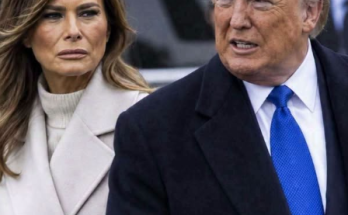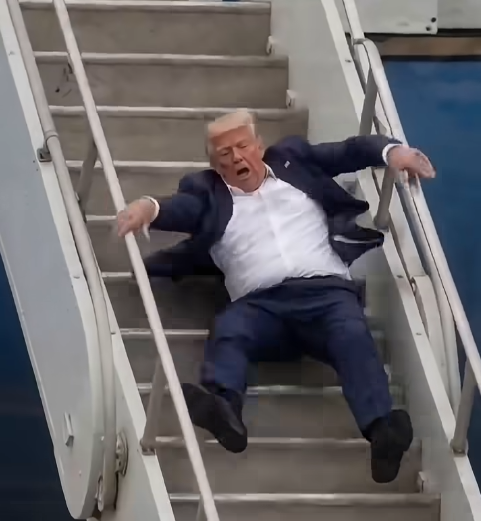
Trump “Falls Again”? What the Viral Health Claim Really Tells Us About the Growing Scrutiny Around the President
A dramatic headline circulating online claims: “Trump FALLS AGAIN! — White House Doctor Breaks S…”
The wording is deliberately alarming. It suggests that President Donald Trump has suffered another fall and that a White House physician has revealed something serious about his health. But when a claim involves the physical condition of a sitting president, especially one who is 80 years old, separating confirmed information from social-media speculation is extremely important.
At present, there is no reliable confirmation of a new fall matching the viral headline. That does not mean there are no legitimate questions surrounding Trump’s health. There has been considerable public discussion in recent weeks about his age, weight, physical appearance, daytime alertness, bruising and swelling. But those developments should not automatically be transformed into an unverified story about a new accident.
Why the Headline Is Getting Attention
Presidential health has always attracted intense public interest.
The president is not an ordinary public figure. The person occupying the Oval Office has enormous responsibilities, including making decisions involving national security, military operations, foreign policy and emergency situations.
Consequently, even a seemingly minor incident can become major news if it raises questions about a president’s ability to perform his duties.
The phrase “falls again” is particularly powerful because falling can be associated with serious injuries among older adults. A fall can sometimes result in fractures, head injuries or other complications.
But the existence of a frightening headline does not establish that such an event occurred.
Readers need to distinguish between a confirmed incident, a disputed report, an interpretation of video or photographs, and a completely unsupported social-media claim.
What Is Actually Known About Trump’s Health?
There is legitimate health-related reporting involving Trump.
Recent coverage has focused heavily on his weight. The Washington Post reported on August 23 that Trump had gained roughly 20 pounds compared with his campaign period and that physicians interviewed by the newspaper viewed the weight as a significant health concern.
Other recent reports have drawn attention to visible bruising and swelling. The Daily Beast reported that Trump’s right hand appeared swollen and bruised during recent public appearances and noted the White House’s previous explanation that bruising was related to frequent handshaking and aspirin use.
These observations have generated questions from commentators and medical professionals.
But there is an important distinction between saying that doctors have expressed concerns about risk factors and saying that Trump has suffered a specific medical emergency.
Those are not the same thing.
The White House’s Position
The White House has continued to portray Trump as capable of carrying out his responsibilities.
Earlier this year, an official memorandum from the White House physician documented a presidential medical evaluation.
Following Trump’s 2026 annual physical, reporting on the physician’s assessment stated that the president was considered in excellent health and physically and cognitively capable of serving. The examination reportedly included extensive testing and consultations with numerous specialists.
That assessment has not ended public debate.
Some outside physicians and commentators have questioned whether the available information provides enough transparency regarding the president’s overall health. A cardiologist, Jonathan Reiner, has publicly argued that Americans deserve more information about Trump’s condition.
This disagreement is important.
There is a difference between an official medical assessment and outside medical commentary based largely on public observations.
Neither should automatically be treated as proof of something that has not been documented.
Why “White House Doctor Breaks Silence” Headlines Are So Effective
The phrase “doctor breaks silence” has become a common formula in viral content.
It creates the impression that an insider has suddenly revealed a secret.
In reality, many posts use this wording even when the doctor has not made any new statement.
Sometimes an old medical statement is recycled.
Sometimes a physician commenting on general health risks is presented as though that physician personally examined the president.
Sometimes a photograph is paired with unrelated medical commentary.
And sometimes the entire story is based on speculation.
This is why readers should ask a simple question:
Which doctor supposedly said it, and where is the original statement?
If the article does not provide a name, date, quotation, official document or credible source, caution is warranted.
Age Has Become a Central Part of the Discussion
Trump’s age is another major factor.
At 80, he is among the oldest people ever to serve as president.
Age itself does not determine whether someone is capable of serving. Millions of older adults remain active, productive and independent.
However, aging can increase the likelihood of certain health challenges, including changes in balance, muscle strength, cardiovascular health and recovery from injury.
That is why observers pay close attention when an elderly political leader appears unsteady, tired or physically different from the past.
But appearance alone cannot establish a medical diagnosis.
A person can look tired without being seriously ill.
A person can have a bruise without suffering a major medical problem.
A person can stumble without having a neurological disorder.
Medical conclusions require actual examination, testing and clinical context.
Why Videos and Photographs Can Be Misleading
Social media has changed the way presidential health stories spread.
A few seconds of video can be isolated from a much longer event.
A photograph can capture an unusual facial expression or awkward movement.
A screenshot can remove the surrounding context.
Then a caption can assign an alarming interpretation to what viewers see.
Once thousands of people share it, the caption can become more influential than the original evidence.
This is particularly dangerous with health-related claims because ordinary physical movements can be interpreted as symptoms of serious illnesses without medical justification.
A responsible reader should therefore watch the complete video whenever possible and seek information from reliable reporting.
The Political Dimension
Trump’s health is also deeply political.
Supporters may accuse critics of exaggerating ordinary signs of aging.
Opponents may argue that the public deserves greater transparency.
Both sides can sometimes interpret the same photograph differently.
That makes objective reporting especially important.
The question should not be whether someone likes or dislikes Trump.
The question should be:
What actually happened?
Was there an accident?
Was there a documented injury?
Did a physician issue a statement?
Was the president examined?
Did officials confirm the event?
These questions matter more than partisan reactions.
Why Presidential Health Transparency Matters
The public has a legitimate interest in the president’s ability to perform the job.
At the same time, medical privacy remains important.
The challenge is finding the appropriate balance between transparency and personal medical confidentiality.
Presidents have historically released varying levels of health information. Some administrations have provided detailed medical reports, while others have disclosed less.
When unusual claims begin circulating, official communication becomes particularly important because silence can create an information vacuum.
That vacuum is quickly filled by speculation.
What Should Readers Make of the “Fall Again” Claim?
For now, the most responsible conclusion is that the viral headline should not be treated as confirmed news.
There is genuine ongoing scrutiny of Trump’s health, including his weight and visible physical changes. Recent reporting has documented those concerns.
But that does not establish that Trump suffered a new fall or that a White House doctor has issued a shocking revelation about such an incident.
The headline may be exaggerating another event, recycling an older story, or attempting to attract clicks through dramatic wording.
Until credible sources confirm the specific event, readers should avoid repeating the claim as fact.
The Bigger Story
Perhaps the most significant story is not one alleged fall.
It is the growing debate over how much information the public should receive about the health of an aging president.
Trump remains an active political figure, and his administration continues to conduct major domestic and foreign-policy activities. The White House’s official live page continues to list presidential and administration events.
At the same time, questions about his physical condition are likely to continue because of his age and the visibility of the presidency.
That makes accuracy more important than ever.
Sensational headlines may generate millions of clicks, but presidential health is too important to be reduced to speculation.
Final Thoughts
The words “Trump FALLS AGAIN!” are designed to make readers stop scrolling.
They create fear, curiosity and urgency.
But the evidence currently available does not confirm the specific new fall described by the viral headline.
What can be confirmed is that Trump’s health has become the subject of increased public scrutiny. Recent reporting has raised concerns about his weight, while photographs have prompted discussion about bruising and swelling.
At the same time, the White House has maintained that Trump remains capable of performing his duties, and his recent medical evaluation was described positively by his physician.
The lesson is simple: a dramatic headline is not evidence.
When the story concerns the health of a president, readers should demand more than a viral caption. They should look for an official statement, a named source, independent reporting and verifiable facts.
Until those pieces are available, the “Trump falls again” story should be regarded as an unverified claim rather than confirmed breaking news.