A Powerful Political Image Goes Viral: What Emotion, Democracy, and Political Disagreement Really Mean
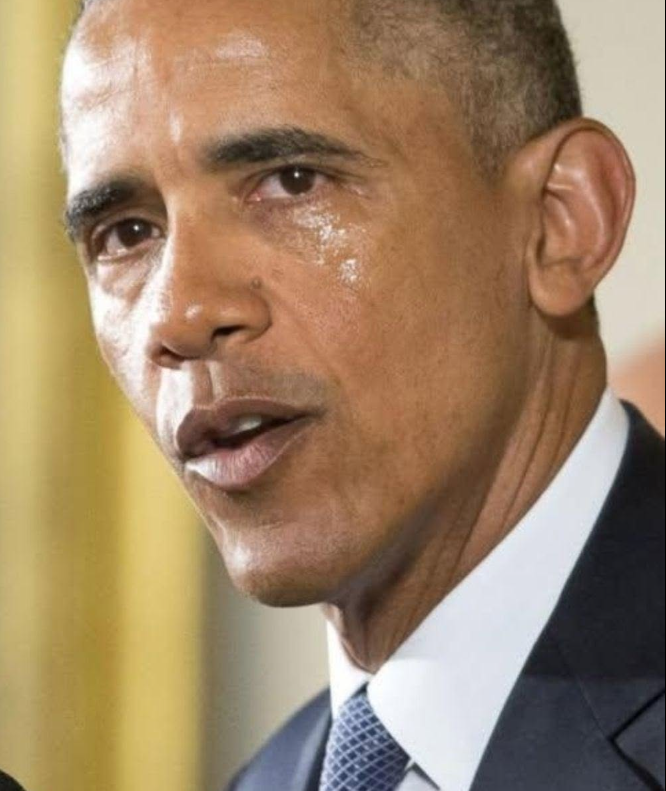
A striking photograph of a former American president with tears or visible moisture on his face has been circulating online alongside a provocative political message about Donald Trump, democracy, and the meaning of political support. The image is powerful because it appears to capture a deeply emotional moment, while the accompanying headline encourages readers to interpret that emotion as evidence of a larger political crisis.
But photographs can be complicated. A single frame can communicate sadness, exhaustion, frustration, concentration, or even something as simple as perspiration. Without knowing exactly when and where the photograph was taken, it is impossible to determine the emotion behind the expression merely by looking at the image.
That distinction becomes especially important when an old photograph is paired with a new political claim.
The Power of an Emotional Photograph
Political images have always played an important role in shaping public opinion. A photograph of a smiling candidate can suggest confidence and optimism. A photograph of an angry politician can create an impression of confrontation. A picture showing a leader appearing emotional can make viewers believe they are witnessing a deeply personal moment.
Social media has amplified that effect.
A photograph can be separated from its original context and reposted thousands of times with an entirely different caption. Once that happens, many people encounter the image without ever seeing the original speech, interview, event, or news report associated with it.
The result is that the caption can become more influential than the photograph itself.
That appears to be the broader issue surrounding this image. Rather than simply asking what the photograph shows, viewers should also ask what the accompanying text is trying to make them believe.
The Claim About Trump and Democracy
The political argument connected to the image is not entirely new. The former president pictured in the photograph has repeatedly expressed concerns about political polarization, democratic institutions, political rhetoric, and the responsibilities of citizens.
In a 2018 speech at the University of Illinois, he warned that indifference and cynicism could become serious threats to democracy. He argued that citizens have an important responsibility to participate in democratic life rather than withdrawing from politics.
He has also criticized Donald Trump politically on numerous occasions.
That history makes it understandable that social-media users might connect an emotional photograph of the former president with a statement about Trump’s political movement. However, that does not automatically prove that the person pictured made the exact statement attributed to him in a viral caption.
A Quote Needs Verification
One of the biggest problems with viral political posts is the use of quotation marks.
When a post says that a politician “said” something, readers naturally assume that the sentence came directly from a speech, interview, press conference, book, or social-media account.
But quotation marks are sometimes used loosely online.
The exact wording of the claim that supporting Trump demonstrates “disrespect for democracy” should therefore be treated carefully unless the original source can be identified. Searches of established reporting show that the former president has made numerous comments about democracy and Trump, but that does not by itself authenticate every version of a quote circulating on social media.
This is why the original video, transcript, interview, or official statement matters.
A quote without a source is not automatically false, but it should not automatically be treated as authentic either.
Political Disagreement Is Not Automatically Undemocratic
There is another important question beneath the viral headline: Can supporting a controversial political leader be compatible with democratic values?
The answer depends on what someone means by “support.”
Democracy does not require every citizen to agree with one political party or candidate. In a democratic system, people are allowed to have dramatically different opinions about taxation, immigration, foreign policy, government spending, abortion, education, criminal justice, national security, and the role of government.
Americans can support Trump because they agree with his policies. They can oppose him because they believe those policies are harmful. They can support some of his decisions while criticizing others.
That disagreement is part of democratic politics.
At the same time, democracy involves more than voting. It also depends on respect for elections, constitutional procedures, peaceful transfers of power, independent institutions, freedom of expression, and the right of political opponents to participate.
That means citizens can legitimately debate whether a particular political action strengthens or weakens democratic institutions.
The important point is that the debate should focus on specific actions and principles rather than automatically labeling millions of voters as enemies of democracy.
The Former President’s Own Record of Democratic Warnings
The image’s emotional impact may be amplified by the speaker’s long history of discussing democratic institutions.
In his 2017 farewell address, the former president discussed several pressures facing American democracy, including economic inequality, racial divisions, and the growing tendency of Americans to retreat into separate information and political “bubbles.” He emphasized the importance of citizens recognizing that political opponents can still love their country and participate in good faith.
In 2018, he returned to the subject, warning that democracy depends on participation and that political cynicism can discourage people from voting and engaging in public life.
And in later years, he continued to speak publicly about democratic institutions and political polarization.
So the general subject associated with the viral post is genuine. The question is whether the specific wording attached to the photograph accurately represents what he actually said.
Why Context Matters
Imagine a photograph taken during a speech about a personal tragedy.
Now imagine that same photograph being reposted years later with a caption saying the person is crying because of a current political event.
The photograph itself has not changed.
The meaning has.
This is why visual context is so important. A person’s facial expression cannot reliably establish the cause of an emotion.
The same applies to political speeches. A sentence taken from a longer discussion can sound dramatically different when isolated.
Responsible readers should therefore look for the complete event rather than relying on a cropped photograph and a short caption.
The Internet Rewards Strong Reactions
Social-media algorithms tend to favor content that generates engagement.
Anger, fear, shock, sadness, and outrage can all encourage people to comment and share. A neutral headline such as “Former President Discusses Democratic Institutions” is unlikely to produce the same reaction as “He Can’t Believe Americans Still Support Trump.”
This creates an incentive for increasingly dramatic captions.
That does not mean every viral political post is deliberately deceptive. Sometimes users share something because they sincerely believe it. But repetition does not turn an unverified statement into a verified one.
A claim can be shared by thousands of people and still be wrong.
What Viewers Should Ask
When encountering this image or a similar political post, several questions are useful.
When was the photograph taken?
If the post does not provide a date, that is an important missing piece of information.
Where was it taken?
Was it a campaign event, speech, interview, memorial, private gathering, or something else?
What was happening at the time?
The surrounding circumstances may completely change the interpretation of the image.
Where is the original quote?
If the post attributes specific words to a politician, readers should be able to locate a speech, transcript, interview, or recording.
Are reputable news organizations reporting the same claim?
Independent confirmation is especially important when a post involves an extraordinary political statement.
Democracy Requires Room for Disagreement
Perhaps the most useful lesson from the viral image is that democracy is not supposed to eliminate disagreement.
People will support different candidates. They will interpret the same political event differently. They will disagree about the direction of the country and about which policies will make Americans safer or more prosperous.
That disagreement can be uncomfortable, but disagreement itself is not evidence that democracy has failed.
The real challenge is maintaining a political culture in which disagreement does not automatically become hatred.
Citizens should be able to criticize presidents without treating their supporters as enemies. They should be able to defend politicians without dismissing every criticism as propaganda. They should be able to change their minds when credible evidence contradicts their assumptions.
That is a much harder standard than simply sharing a powerful photograph.
The Bigger Picture
The photograph is undeniably striking. Its emotional appearance invites viewers to create a story around it, particularly when paired with a provocative political caption.
But the most responsible response is to separate what the photograph visibly shows from what the caption claims it means.
The broader concerns about democracy are real subjects of political debate, and the former president has publicly discussed those concerns many times.
However, that does not mean every viral quotation attributed to him is genuine.
Before accepting the claim, readers should look for the original source, the date of the photograph, and the complete context surrounding the alleged statement.
Ultimately, the image can serve as a reminder of something larger than any one politician: democracy depends on citizens who are willing to question what they see, verify what they hear, and disagree without abandoning the search for facts.
In an age when a photograph can travel around the world in seconds, context may be just as important as the picture itself.