
How Donald Trump Found His Footing and Fought His Way Back to the White House 🇺🇸
Donald Trump’s return to the White House was one of the most extraordinary political comebacks in modern American history. After losing the 2020 presidential election, leaving office in January 2021, facing investigations and criminal indictments, surviving an assassination attempt, and enduring years of intense political controversy, Trump returned to the presidency after winning the 2024 election.
His comeback was not the result of one event. It was built through a combination of political persistence, an intensely loyal voter base, aggressive campaigning, a changing national mood, and a message that continued to resonate with millions of Americans.
The official Electoral College results show Trump and his running mate, JD Vance, winning 312 electoral votes to Kamala Harris and Tim Walz’s 226.
A Political Career That Refused to End
After Trump’s defeat in 2020, many political observers believed his influence over the Republican Party would eventually decline. Instead, he maintained an extraordinary presence within the party.
Trump continued holding rallies, speaking directly to supporters, criticizing President Joe Biden’s administration, and presenting himself as the leader of the “Make America Great Again” movement.
His relationship with his supporters became one of the central strengths of his political career.
Rather than disappearing after leaving office, Trump remained at the center of national political debate. He used rallies, interviews, social media, and conservative media outlets to communicate directly with voters.
That constant visibility helped him remain politically relevant while other potential Republican candidates competed for attention.
The Republican Primary
Trump’s first major challenge was securing the Republican nomination.
Several Republicans considered themselves capable of becoming the party’s next presidential nominee. Among them was Florida Governor Ron DeSantis, who was widely viewed as Trump’s most serious potential challenger.
Trump nevertheless maintained a commanding position.
His supporters argued that he had already won the presidency once and had the experience and political movement necessary to defeat Democrats again. His opponents inside the Republican Party struggled to break the bond between Trump and his core supporters.
Eventually, Trump secured the Republican nomination and began preparing for another general-election campaign.
Turning Legal Problems Into Political Energy ⚖️
One of the most unusual aspects of Trump’s comeback was the way he responded to his legal troubles.
Trump faced multiple criminal cases and investigations. Instead of allowing those controversies to push him out of public life, he incorporated them into his political message.
He repeatedly portrayed himself as the target of politically motivated persecution and argued that the legal system was being used against him.
His supporters embraced that interpretation, while his critics strongly rejected it.
Regardless of political perspective, the legal battles kept Trump in the headlines and ensured that his name remained one of the most recognizable in American politics.
What might have destroyed another candidate instead became part of Trump’s campaign narrative.
The Biden-Harris Campaign Changes Direction
The 2024 election initially appeared likely to be another contest between Trump and President Joe Biden.
That changed dramatically during the summer.
Following Biden’s disastrous debate performance against Trump, concerns about his age and ability to continue campaigning intensified within the Democratic Party.
Biden eventually ended his reelection campaign and endorsed Vice President Kamala Harris.
Harris quickly became the Democratic nominee, creating a dramatically different race.
For Trump, the change meant that he could no longer simply campaign against Biden’s record. He now had to compete against a younger opponent who attempted to present herself as a new generation of Democratic leadership.
The race became intensely competitive.
The Assassination Attempt
One of the defining moments of Trump’s comeback came in July 2024.
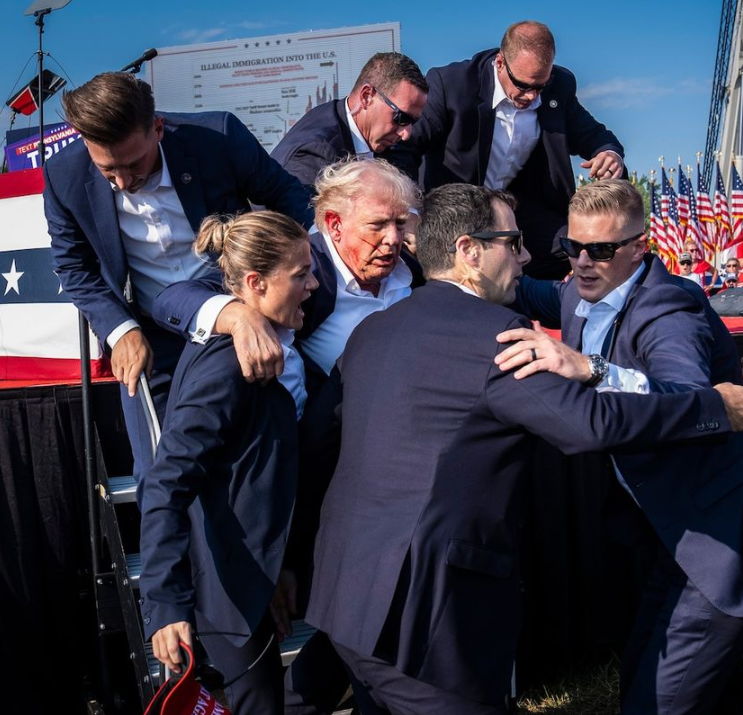
During a campaign rally in Butler, Pennsylvania, a gunman opened fire. Trump was wounded in the ear, one spectator was killed, and others were injured.
The attack shocked the country.
Images of Trump raising his fist after the shooting became some of the most recognizable images of the campaign. Trump later returned to the campaign trail, emphasizing his survival and encouraging supporters to remain united.
For his supporters, the incident became a symbol of his determination.
For the broader public, it was a reminder of the extraordinary level of political tension surrounding the election.
Trump’s ability to continue campaigning after the attack strengthened the narrative that he was willing to endure enormous personal hardship to return to office.
A Different Campaign Strategy 📱
Trump’s 2024 campaign also demonstrated how dramatically political communication had changed.
Rather than relying exclusively on traditional television advertising and conventional political events, the campaign embraced podcasts, social media, online influencers, and alternative media.
TIME reported that Trump’s campaign successfully reached young male voters through podcasts and social-media platforms, while also focusing heavily on economic concerns, immigration, and dissatisfaction with the Biden administration.
This strategy helped Trump reach audiences who might not regularly watch traditional political news.
He also continued his direct and highly recognizable communication style.
Short statements, provocative comments, campaign rallies, and social-media messages allowed Trump to dominate political conversation.
The Economy Became Central
Economic anxiety played a major role in the 2024 election.
Many voters were concerned about inflation, housing costs, food prices, wages, and the overall cost of living.
Trump argued that Americans were financially better off during his first presidency and promised to pursue policies designed to strengthen the economy.
His message was particularly powerful among voters who believed that the country had become less affordable.
Although economists and political opponents disputed many of Trump’s claims, the emotional impact of the economic message was significant.
For many voters, the election was not primarily about political personalities. It was about whether they believed their financial lives were improving.
Immigration and the Border
Immigration was another major issue.
Trump made border security one of the central themes of his campaign.
He promised tougher immigration enforcement and argued that the Biden administration had failed to adequately control the southern border.
This message resonated strongly with voters who viewed illegal immigration as a major national problem.
It also helped Trump reconnect with one of the most important themes of his original 2016 campaign.
Expanding Beyond His Traditional Coalition
Perhaps one of the most important developments in Trump’s victory was his ability to improve his performance among several demographic groups.
Trump continued to maintain overwhelming support among many white working-class voters, particularly in rural areas.
But his campaign also made gains among Latino voters, Black men, and younger male voters.
TIME’s analysis of the 2024 election highlighted Trump’s improved performance among Latino men and his efforts to reach younger male audiences through digital media.
Those gains mattered because presidential elections are decided not simply by enthusiasm among a candidate’s existing supporters but by whether that candidate can expand the coalition.
Trump succeeded in doing so.
Winning the Battleground States 🗳️
The election ultimately came down to a familiar group of competitive states.
Pennsylvania, Michigan, Wisconsin, Georgia, Arizona, Nevada, and North Carolina were among the states receiving enormous attention.
Trump’s campaign focused heavily on economic concerns, immigration, national security, and cultural issues.
When the votes were counted, Trump won enough battleground states to secure a clear Electoral College victory.
The Associated Press described the result as a remarkable political comeback after Trump’s 2020 defeat and the legal and personal challenges that followed.
The National Archives records the final Electoral College result as 312 votes for Trump and 226 for Harris.
A Historic Return
Trump’s return to the presidency was historic because he became only the second U.S. president to win nonconsecutive terms, following Grover Cleveland.
His comeback represented more than a personal political victory.
It demonstrated the continued strength of the movement he had created inside the Republican Party.
Trump had gone from president to defeated incumbent, from political outsider to party leader, from candidate facing serious legal challenges to presidential nominee, and finally back to the White House.
That journey was extraordinarily unusual.
What Made the Comeback Possible?
Several factors came together.
🔥 Persistence: Trump refused to disappear from national politics after losing the 2020 election.
📱 Direct communication: His campaign used social media, podcasts, rallies, and alternative media to reach voters directly.
💰 Economic concerns: Inflation and the cost of living became powerful issues.
🛂 Immigration: Border security remained one of Trump’s strongest campaign themes.
👥 A loyal political base: Millions of voters remained committed to Trump throughout years of controversy.
🎯 Battleground strategy: His campaign concentrated heavily on states that could determine the Electoral College.
🗳️ Broader coalition: Trump improved his support among several demographic groups compared with 2020.
The Meaning of Trump’s Return
Trump’s comeback changed American politics again.
Supporters saw his victory as evidence that voters wanted a dramatic change in direction.
Critics viewed the result as a warning about the country’s political polarization and Trump’s approach to executive power.
But regardless of political viewpoint, one fact is undeniable: Trump’s political career proved far more durable than many observers expected.
His journey from the aftermath of the 2020 election to the presidency again demonstrated his unusual ability to dominate political attention, maintain a devoted base, survive enormous controversies, and adapt his campaign strategy.
Today, Trump’s second presidency continues to shape American politics. His influence remains central to Republican strategy, including the party’s preparations for the 2026 midterm elections. Recent reporting shows Trump continuing to involve himself directly in Republican campaigns and fundraising efforts.
Conclusion 🇺🇸
Donald Trump’s return to the White House was not a simple story of one candidate winning one election.
It was a years-long political comeback.
He survived defeat, controversy, legal battles, intense opposition, an assassination attempt, and a rapidly changing political landscape. He maintained his relationship with his supporters while rebuilding his campaign and expanding his coalition.
In November 2024, that persistence produced a second presidential victory.
Whether people view Trump’s comeback as inspiring, troubling, surprising, or historic depends heavily on their political perspective. But as a chapter in American political history, it is difficult to ignore.
Trump did not simply return to the national stage.
He fought his way back to the White House. 🇺🇸🔥