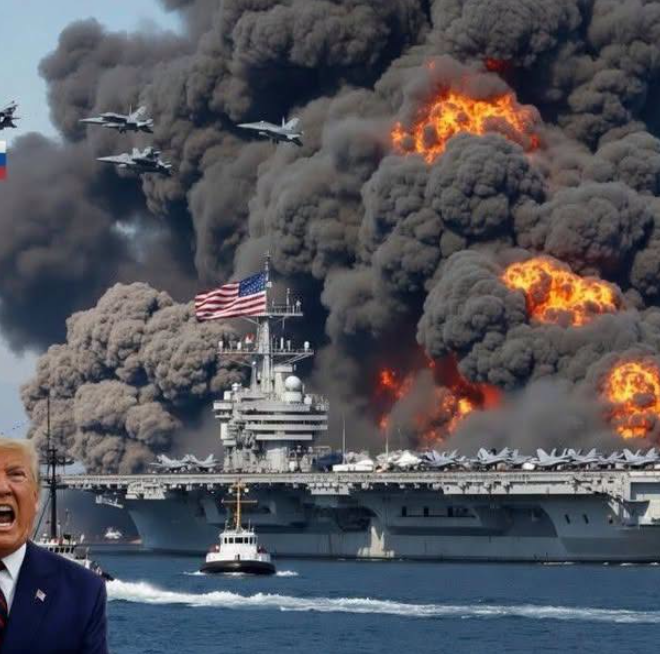
Russian Su-57 Pilot “Destroys” U.S. Aircraft Carrier Carrying 700 Tanks: What the Viral Claim Really Shows
A sensational claim spreading across social media says that a Russian Su-57 pilot has destroyed a U.S. aircraft carrier allegedly carrying 700 tanks. The headline is designed to sound like an extraordinary breaking-news event, but available evidence does not confirm that such an attack actually happened.
The claim appears to have circulated through Facebook, Instagram, Threads, X, and YouTube posts using nearly identical wording. One YouTube result carrying the headline explicitly describes its footage as a virtual game simulation, rather than real combat footage. Other social-media posts repeat the same claim without providing independent evidence, official military statements, location information, photographs, satellite imagery, or credible reporting from established news organizations.
That distinction is important. A dramatic video or a rapidly shared headline can make an event appear real before anyone has verified what viewers are actually seeing.
The Su-57 Makes the Story Sound Plausible
The Russian Sukhoi Su-57 is a real fifth-generation fighter aircraft. It was developed as an advanced multirole combat aircraft incorporating stealth characteristics, sophisticated sensors, and modern weapons systems. Because the aircraft is genuinely associated with Russian military power, fabricated or simulated combat stories involving the Su-57 can appear convincing to casual viewers.
But the existence of the Su-57 does not establish that a particular attack occurred.
A real destruction of a U.S. aircraft carrier would be an enormous international military event. American aircraft carriers are among the most heavily protected military platforms in the world. They normally operate as part of carrier strike groups containing multiple ships and aircraft, rather than traveling alone. Any confirmed sinking of such a vessel would almost certainly produce extensive reporting from multiple independent sources.
No credible evidence found in the current search establishes that a Russian Su-57 recently destroyed a U.S. aircraft carrier carrying 700 tanks.
The “700 Tanks” Detail Raises Another Question
The phrase “aircraft carrier carrying 700 tanks” is also a major warning sign.
Aircraft carriers are designed primarily to operate aircraft. Their internal arrangements include aviation fuel, weapons storage, maintenance facilities, crew spaces, hangars, elevators, and aviation-support equipment. A conventional U.S. nuclear-powered aircraft carrier is not normally used as a transport ship carrying hundreds of main battle tanks.
That does not mean the United States cannot transport hundreds of armored vehicles overseas. It can. But such equipment would ordinarily move aboard specialized military sealift vessels, cargo ships, or other transport platforms rather than being packed onto a carrier designed to launch and recover aircraft.
Consequently, the wording appears to combine several military concepts into one dramatic scenario.
The number may have been selected because it makes the headline more shocking. “700 tanks” sounds enormous, suggesting that the supposed attack destroyed not only a warship but also a massive quantity of military equipment. Yet the claim provides no credible documentation establishing that such a cargo existed.
What About the Video?
The most important clue comes from the online footage associated with the story.
A YouTube result using virtually the same headline identifies the material as a virtual game simulation. That means viewers should not automatically interpret explosions, aircraft, missiles, ships, or other combat scenes shown in such footage as recordings of an actual military engagement.
Modern video games and computer-generated simulations can look remarkably realistic. They can include detailed aircraft models, naval vessels, explosions, missile launches, camera effects, smoke, and realistic environments. When such footage is separated from its original context and reposted with a breaking-news headline, viewers can easily mistake fiction or simulation for documentary evidence.
This phenomenon is especially common with military videos. Old footage, video-game sequences, military exercises, edited clips, and computer-generated imagery can all be presented as if they depict a newly occurring war.
What Would Confirmation Look Like?
If a U.S. aircraft carrier had genuinely been destroyed by a Russian fighter, verification would require much more than a social-media post.
There would likely be evidence from several independent sources. Satellite imagery could potentially show the condition and location of the ship. Maritime tracking information might provide clues. Official statements from the U.S. Department of Defense would be expected, particularly if American personnel were involved.
Russia would also have a major incentive to publicize such a victory if it could prove it. International news organizations would investigate the event, and analysts would examine imagery and other evidence.
Instead, the material currently circulating consists primarily of repeated social-media headlines. The repetition of a claim does not make it independently verified.
In fact, seeing the same headline on many accounts can create a false impression that numerous sources are confirming the story when those accounts may simply be copying one another.
Why These Headlines Spread So Quickly
The phrase “13 minutes ago” is particularly effective at creating urgency.
It encourages readers to click immediately rather than pause to verify the information. The wording suggests that the reader is receiving information before everyone else. Add phrases such as “Russian Su-57 pilot,” “destroys U.S. aircraft carrier,” and “700 tanks,” and the result becomes almost perfectly designed for viral sharing.
Social-media algorithms can amplify such content because emotionally charged headlines often generate comments, shares, and reactions.
That does not necessarily mean everyone sharing the story believes it is true. Some users may simply be surprised by it. Others may share it because they want to ask whether it is real. Unfortunately, every additional share can make an unverified story appear more credible.
The Real Strategic Context
There is nevertheless a genuine and serious military issue behind the sensational headline: the growing importance of long-range precision weapons, stealth aircraft, electronic warfare, drones, and naval defenses.
Modern aircraft carriers remain powerful symbols of military reach, but they operate within increasingly complex threat environments. Carrier strike groups depend on layered defenses involving fighter aircraft, surface-to-air missiles, electronic warfare, radar systems, helicopters, drones, and escort ships.
The Su-57 is part of Russia’s effort to maintain advanced combat aviation capabilities. But claiming that one pilot simply destroyed a U.S. carrier carrying hundreds of tanks dramatically oversimplifies how modern naval warfare works.
A carrier strike group is not a single target sitting defenseless in the ocean. Detecting, identifying, approaching, targeting, and successfully attacking such a formation would be an extremely complicated military operation.
A Viral Story Is Not the Same as Breaking News
The biggest lesson from this story is the importance of distinguishing between a viral claim and a verified event.
At the time of writing, searches for the alleged incident did not produce credible confirmation that a Russian Su-57 had destroyed a U.S. aircraft carrier carrying 700 tanks. Instead, the strongest directly relevant result identified the circulating video as a virtual game simulation.
There are also unrelated reports about Russian naval power. For example, recent reporting says Russia’s only aircraft carrier, Admiral Kuznetsov, has faced years of serious maintenance problems and is reportedly headed toward disposal rather than returning to regular service. That real-world situation is very different from the viral claim about a Su-57 destroying an American carrier.
For readers, the safest conclusion is therefore straightforward: the headline should not be presented as a confirmed military event.
It may be entertaining, dramatic, or alarming, but without reliable evidence it remains an unverified claim.
The story is a useful reminder that modern misinformation does not always look obviously fake. Sometimes it uses real aircraft, real countries, real military technology, and realistic video—but combines them into an event that never happened.
Before sharing a headline claiming that a major warship has been destroyed, especially one involving the United States and Russia, readers should look for confirmation from multiple reputable sources and determine whether the accompanying footage is real combat footage, an exercise, archival material, computer-generated imagery, or a video-game simulation.
In this case, the available evidence strongly suggests that the dramatic “Su-57 destroys U.S. carrier carrying 700 tanks” story is viral misinformation or simulated footage rather than confirmed breaking news.