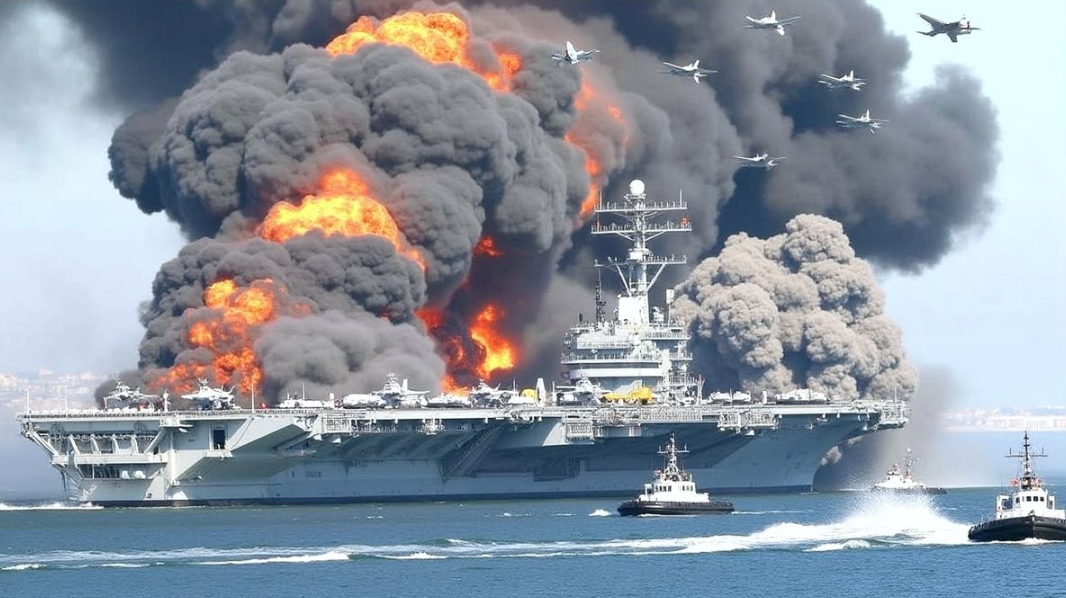
 2 Minutes Ago: Russian Su-57 Pilot “Destroys” U.S. Aircraft Carrier Carrying 500 Tanks — What the Viral Video Really Shows
A dramatic headline claiming that a Russian Su-57 pilot destroyed a U.S. aircraft carrier carrying 500 tanks has been spreading across social media, accompanied by videos designed to look like spectacular military footage. The story sounds like a major international military incident, but there is a crucial detail that changes everything: the widely circulated video is identified as a virtual game simulation, not real combat footage.
That means viewers should be extremely cautious before treating the headline as breaking news.
The claim has appeared in several versions online, including posts saying that the event happened “13 minutes ago” or “today.” Some versions mention a carrier carrying 500 tanks, while others use slightly different numbers. A Facebook post also repeats the same claim and explicitly connects it with Arma 3, a military-themed video game.
A Headline Designed to Look Like Breaking News
The wording is unmistakably sensational.
“2 minutes ago” creates an immediate sense of urgency. “Russian Su-57 pilot” identifies a powerful military aircraft. “Destroys U.S. aircraft carrier” suggests an extraordinary confrontation between two major military powers. Finally, “carrying 500 tanks” dramatically increases the apparent scale of the disaster.
Put together, those words can make a fictional scenario feel like an authentic battlefield report.
But a dramatic headline is not evidence.
A genuine destruction of a U.S. aircraft carrier by a Russian fighter would represent an extraordinary military development. Such an incident would be expected to generate immediate reporting from multiple major news organizations and official sources. The material found behind this particular viral claim instead points toward a simulated scenario.
The Video Is a Simulation
The most important fact is found in the description associated with the circulating video.
The YouTube result using the same headline explicitly states that the video is a virtual game simulation. Another video using almost identical wording also identifies the footage as a virtual simulation.
That is a critical distinction.
Modern video-game graphics can look remarkably realistic, especially when recordings are edited with dramatic camera movements, explosions, sound effects, and military-style narration. Someone encountering the clip without its original description could easily mistake it for authentic combat footage.
In this case, however, the evidence indicates that viewers are watching a fictional scenario rather than an actual attack.
What Is the Su-57?
The Sukhoi Su-57 is a real Russian fifth-generation fighter aircraft. It is designed for air-superiority and strike missions and incorporates stealth characteristics, advanced sensors, and modern weapons systems.
The aircraft has attracted considerable international attention because Russia presents it as one of its most advanced combat aircraft.
Recent reporting has also focused on Russia’s efforts to expand the Su-57 program and promote the fighter for export. For example, India has considered possible procurement of the aircraft, while other countries have been linked to discussions about advanced Russian fighters.
But the existence of a sophisticated aircraft does not mean every video showing that aircraft represents real combat.
That distinction is especially important with military-themed videos circulating on social media.
What About the “500 Tanks”?
The claim that the aircraft carrier was carrying 500 tanks is another reason to question the story.
A U.S. aircraft carrier is primarily designed to operate aircraft. Its main function is not to transport hundreds of main battle tanks as cargo.
There are other types of large military and amphibious vessels designed to transport substantial quantities of vehicles and equipment. But describing a conventional U.S. aircraft carrier as carrying 500 tanks is highly unusual.
This does not prove by itself that a particular video is fictional, but it is an important clue that the headline may have been constructed for dramatic effect rather than based on an actual military report.
Why Do These Videos Go Viral?
There is a simple reason: spectacle attracts attention.
A fighter jet attacking a massive warship creates exactly the kind of dramatic imagery that performs well on social media. Add explosions, cinematic music, a countdown-style headline, and phrases such as “breaking news” or “2 minutes ago,” and viewers are encouraged to react before investigating.
People may share the video because they believe they are witnessing a historic military event.
Others may share it because they find the scenario fascinating.
Once enough people interact with a post, algorithms can push it to increasingly large audiences.
The result is a feedback loop: more views create more shares, more shares create more views, and eventually a fictional scenario can begin to look like established fact.
Why the Distinction Matters
Military misinformation is particularly serious because international tensions can already be high.
A fabricated report claiming that Russia has destroyed an American aircraft carrier could cause unnecessary alarm. Someone seeing the headline without checking the source might reasonably believe that the United States and Russia have entered direct military conflict.
That is an enormous claim.
The difference between “a video shows a simulated attack” and “Russia attacked a U.S. aircraft carrier” could not be greater.
The first is entertainment or fictional military simulation.
The second would be an event of enormous geopolitical significance.
Readers should therefore avoid repeating the second claim when the available evidence only supports the first.
The Real Military Balance Is More Complicated
The United States and Russia possess powerful military capabilities, but their forces are structured differently.
The U.S. Navy operates a large fleet of aircraft carriers, supported by destroyers, cruisers, submarines, aircraft, logistics vessels, and extensive intelligence and surveillance capabilities.
Russia also maintains sophisticated naval, air, missile, and submarine forces. Its Su-57 represents an important part of its effort to field advanced tactical aviation.
An actual confrontation between the two countries would involve much more than one fighter attacking one ship.
Modern naval warfare can involve satellites, submarines, long-range missiles, electronic warfare, aircraft, drones, air defenses, cyber capabilities, and extensive intelligence networks.
That is another reason why a cinematic video showing one fighter apparently destroying a massive carrier should not be interpreted as a realistic representation of how a real conflict would necessarily unfold.
The Power of Simulation
Military simulations can be surprisingly useful for education and entertainment.
Games such as Arma 3 allow players and creators to construct elaborate fictional battle scenarios. They can feature aircraft, ships, armored vehicles, infantry, explosions, and large-scale engagements.
Because the game engine can produce realistic environments, screenshots and videos can sometimes be separated from their original context and reposted as if they were genuine footage.
That appears to be what happened with versions of this Su-57 story.
The original context is important. Once it is removed, viewers may have no easy way of knowing that they are looking at a game.
How to Check a Viral Military Video
When a dramatic military video appears online, several simple questions can help.
First, check the original uploader. Is the account associated with a military organization, established news outlet, or government agency?
Second, read the video description. Important disclaimers may identify the footage as a simulation.
Third, search the exact headline. If dozens of accounts repeat identical wording, the story may be part of a viral content network rather than independent reporting.
Fourth, look for official confirmation. A genuine attack involving a U.S. aircraft carrier would be extraordinarily significant.
Finally, check multiple reputable news organizations. Do not rely on a single social-media post.
What We Can Actually Say
Based on the available evidence, there is no credible confirmation that a Russian Su-57 pilot has just destroyed a U.S. aircraft carrier carrying 500 tanks.
The viral videos using this claim are identified as virtual game simulations, and social-media posts have repeatedly recycled the scenario with “breaking news” language.
The Su-57 itself is real, and Russian military aviation capabilities are real. The U.S. Navy’s aircraft carriers are also real and highly capable. But the particular attack described by the viral headline should not be presented as an actual event.
Final Thoughts
The internet has made it possible for spectacular military simulations to reach millions of people within hours. That can be entertaining, but it also creates a serious challenge for anyone trying to understand real-world events.
A headline saying “2 minutes ago” may create urgency, but urgency should never replace verification.
In this case, the evidence points toward a fictional military scenario rather than a confirmed Russian attack on a U.S. aircraft carrier.
The story may look dramatic. The explosions may look convincing. The aircraft may look authentic. But the most important detail is hidden behind the spectacle: the footage is a simulation.
Before sharing a shocking military video, take a moment to check its source, description, date, and context. In an age of increasingly realistic digital imagery, sometimes the most important question is not “What happened?” but simply:
“Did this actually happen at all?”