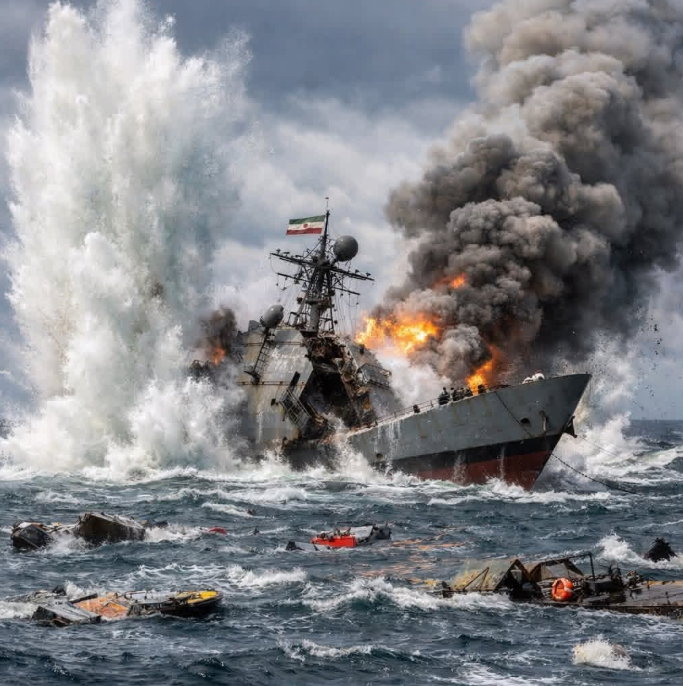
Russian Su-57 Pilot “Destroys” U.S. Aircraft Carrier Carrying 700 Tanks — What the Viral Claim Really Shows
A dramatic headline claiming that a Russian Su-57 pilot destroyed a U.S. aircraft carrier carrying 700 tanks has been spreading rapidly across social media. The wording is designed to sound like an extraordinary breaking-news event: a Russian fifth-generation fighter supposedly carrying out a devastating attack against one of the most powerful symbols of American military strength.
But there is an important problem with the story: there is no credible evidence that such an attack actually happened.
A search for the claim turns up several social-media posts repeating almost identical language, including Facebook, Threads, X, and YouTube posts. One YouTube result explicitly identifies its footage as an Arma 3 virtual-game simulation, rather than real combat footage.
That distinction matters, particularly when a headline describes an alleged attack between nuclear-armed powers.
The Viral Story
The claim says a Russian Su-57 pilot destroyed a U.S. aircraft carrier transporting approximately 700 tanks. Some versions add references to Ukraine and suggest the carrier was carrying enormous quantities of American military equipment.
The dramatic language encourages readers to imagine a real-time battlefield event: a stealth fighter approaching an American carrier, launching its weapons, penetrating the carrier group’s defenses and destroying a massive warship.
However, the posts found online do not provide the kind of evidence normally expected for an event of this magnitude. There are no reliable reports from major international news organizations confirming the destruction of a U.S. carrier, nor is there publicly verified evidence showing such an attack.
Instead, versions of the same headline appear repeatedly on social-media accounts and video channels. Some posts simply reproduce the headline without providing independently verifiable evidence.
The “700 Tanks” Problem
The number itself should immediately make readers cautious.
U.S. aircraft carriers are enormous warships, but they are primarily designed to operate aircraft, not transport hundreds of main battle tanks as ordinary cargo. Large quantities of armored vehicles can be transported by specialized military sealift ships, roll-on/roll-off vessels and other logistics platforms.
That makes the phrase “aircraft carrier carrying 700 tanks” particularly questionable.
A carrier strike group’s logistical ecosystem can involve many different ships, aircraft and supply vessels. But describing a conventional U.S. aircraft carrier as a ship carrying 700 tanks is not consistent with its normal mission.
This does not mean the United States cannot move hundreds of armored vehicles by sea. It can. The distinction is that those vehicles would normally travel aboard appropriate transport or logistics vessels rather than being packed onto the flight deck and hangars of a nuclear-powered aircraft carrier.
The Su-57 Is Real
The story does involve a real aircraft.
Russia’s Su-57 is a fifth-generation fighter developed as a high-end multirole combat aircraft. It incorporates reduced-signature features, advanced avionics and weapons carried partly inside internal bays.
The aircraft has become one of the most recognizable symbols of Russia’s effort to maintain a technologically advanced fighter force.
But the existence of the Su-57 does not make every dramatic claim involving the aircraft credible.
A modern fighter attacking a U.S. carrier strike group would face a highly complex defensive environment. An aircraft carrier does not operate alone. It is protected by a network involving escorting surface ships, aircraft, sensors, electronic warfare systems and other defensive capabilities.
Consequently, destroying an American carrier would be an enormous military event—not something that could realistically happen without generating extensive international reporting and strategic consequences.
Why the Story Sounds Convincing
One reason these stories spread so quickly is that they combine genuine military technology with fictional or unverified scenarios.
The Su-57 is real.
U.S. aircraft carriers are real.
American armored vehicles are real.
Russia and the United States possess advanced military capabilities.
Those facts create a believable foundation for a story that may nevertheless be completely fabricated.
The addition of phrases such as “13 minutes ago,” “breaking news,” “destroyed,” and “700 tanks” creates urgency and encourages readers to share the content before checking it.
This is a common pattern in viral misinformation.
The Role of Simulation Footage
The strongest warning sign in this particular case comes from the video material associated with the claim.
One circulating YouTube result explicitly describes the footage as “ARMA3,” meaning it is a virtual game simulation rather than genuine battlefield footage.
Arma 3 is capable of producing remarkably realistic military scenes. With customized vehicles, aircraft, explosions and environments, screenshots and videos can sometimes look surprisingly similar to genuine combat footage.
A viewer who encounters a short clip without context could easily mistake simulated footage for real reporting.
This is why videos accompanying sensational military claims should not automatically be treated as proof.
What Would Happen If a U.S. Carrier Were Actually Destroyed?
If a U.S. aircraft carrier were genuinely destroyed by a Russian fighter, the consequences would be extraordinary.
An American carrier is not simply another warship. It represents a central component of U.S. naval power and normally operates as part of a larger carrier strike group.
The destruction of such a vessel would immediately become a major international story.
Governments would issue statements. Military officials would be questioned. Satellite imagery would likely receive intense scrutiny. Defense analysts around the world would examine photographs, radar information and other available evidence.
The political consequences could be even greater than the military ones.
An intentional Russian attack destroying an American carrier could represent a direct confrontation between two nuclear-armed states. The risk of rapid escalation would be enormous.
That is another reason the absence of credible confirmation is significant.
Russia’s Own Carrier Situation
There is also an interesting irony surrounding viral stories about Russian naval power.
Russia’s only aircraft carrier, Admiral Kuznetsov, has experienced serious mechanical and maintenance problems and has spent years undergoing repairs. Recent reporting indicates Russia has been moving toward scrapping or selling the troubled vessel rather than returning it to operational service.
That reality contrasts sharply with online narratives portraying Russia as routinely destroying American carriers with advanced fighter aircraft.
Russia certainly possesses serious naval, missile and aviation capabilities. But military power is more complicated than viral videos suggest.
Why Verification Matters
False military stories can be more dangerous than ordinary celebrity rumors because they involve national security.
A fabricated celebrity story may embarrass someone or generate unnecessary gossip. A fabricated report claiming that Russia has destroyed a U.S. aircraft carrier can create fear, confusion and political outrage.
Readers should therefore ask several simple questions before sharing such a story:
Who originally reported it?
Is there confirmation from a credible news organization?
Has the U.S. government acknowledged the incident?
Has Russia acknowledged it?
Are there independent photographs or satellite images?
Does the accompanying video actually show the event described?
Is the video from a simulation or computer game?
These questions can quickly expose many sensational claims.
The Bigger Lesson
The viral Su-57 story illustrates how modern misinformation works.
A dramatic headline is created.
Real military equipment is inserted into the story.
A huge number—700 tanks—is added to increase the sense of scale.
Video-game footage or unrelated military footage may accompany the claim.
The post is then presented as breaking news.
Social-media users share it, and repetition creates the illusion of confirmation.
But repetition is not evidence.
At the time of writing, the available search results do not substantiate the claim that a Russian Su-57 pilot destroyed a U.S. aircraft carrier carrying 700 tanks. Instead, the claim appears to originate from viral social-media posts, while at least one associated video is explicitly identified as an Arma 3 simulation.
The Su-57 itself is real, and U.S. aircraft carriers are real. The alleged attack, however, should be treated as unverified and highly likely fictional rather than genuine breaking news.
In an era when realistic simulations, edited videos and AI-generated material can spread worldwide within minutes, the most important response to a sensational headline is not immediate outrage or excitement. It is verification.
The story may sound like the opening scene of a major military confrontation, but dramatic wording alone cannot turn a fictional scenario into a real event. Before believing or sharing claims about attacks involving the world’s major military powers, readers should look for independent confirmation from credible sources and examine the origin of the footage itself.
In this case, that basic fact-checking step changes the entire story: what appears at first to be a shocking battlefield victory is, based on the available evidence, a viral claim without credible confirmation.