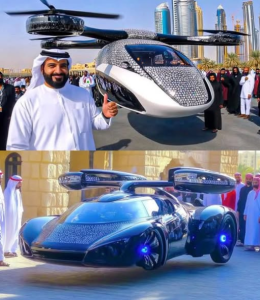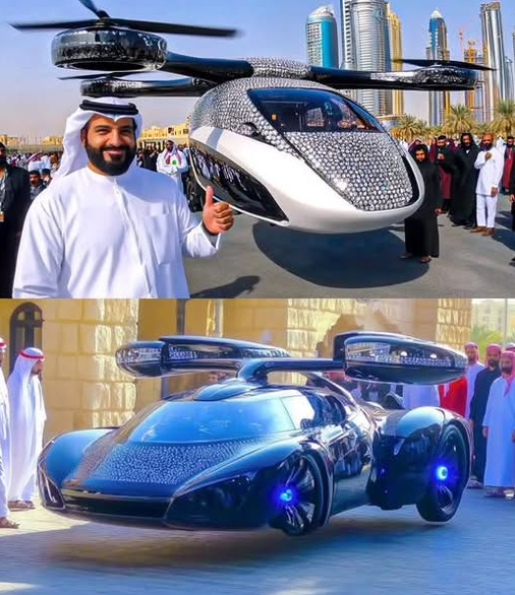
BREAKING: Dubai’s Flying-Car Dream Is Getting Closer—But Is the $4,999 Claim Real?
A sensational headline claiming that the Dubai Crown Prince has released a $4,999 flying car is spreading rapidly online, promising that the futuristic vehicle is already real, affordable and ready to transform transportation.
The idea sounds almost too good to be true—and there is an important reason for that.
Dubai really is pursuing flying taxis and electric vertical takeoff and landing aircraft, commonly known as eVTOLs. The city has been working toward commercial air-taxi operations and has attracted major companies developing these futuristic aircraft. But there is no reliable evidence that Dubai’s Crown Prince has released a mass-market flying car priced at exactly $4,999.
The viral claim appears to combine genuine developments in Dubai’s flying-vehicle program with an unsupported price claim.
Dubai Really Is Building the Future of Transportation
The remarkable part of the story is that flying cars are no longer purely science fiction.
Dubai has spent years positioning itself as a global testbed for futuristic transportation. Officials have repeatedly discussed electric flying taxis capable of carrying passengers above the city’s famously congested roads.
The vehicles being developed are generally not traditional cars with wings. Instead, they are electric vertical takeoff and landing aircraft. They use multiple electric motors and rotors to rise vertically, then transition into forward flight.
That technology could eventually allow passengers to travel between major destinations without dealing with ground traffic.
Dubai has previously announced plans for vertiports—special facilities where flying taxis can take off, land and recharge. Earlier plans identified locations including Dubai International Airport, Downtown Dubai, Palm Jumeirah and Dubai Marina.
The $4,999 Price Is the Big Question
The most eye-catching part of the viral headline is the supposed $4,999 price tag.
That figure would be extraordinary if it represented the purchase price of a complete, certified passenger-carrying aircraft.
Current eVTOL technology involves sophisticated batteries, electric propulsion systems, flight-control computers, sensors, redundant systems and aviation-grade safety requirements. Developing, certifying and manufacturing such an aircraft is enormously expensive.
Available reporting on Dubai’s flying-taxi plans does not support a $4,999 retail price.
In fact, earlier reporting on Dubai’s proposed flying-taxi service indicated that passenger fares would be closer to limousine-service pricing rather than ordinary taxi fares.
That distinction matters.
A $4,999 consumer vehicle and a flying-taxi ride costing perhaps tens or hundreds of dollars are two completely different things.
What Is Actually Flying in Dubai?
One of the companies connected with Dubai’s ambitions is Joby Aviation.
Joby’s electric aircraft is designed as an air taxi rather than a conventional road car. The aircraft uses multiple rotors and can take off vertically before transitioning to forward flight.
According to reporting about Dubai’s program, the Joby aircraft can carry a pilot and passengers, reach speeds of around 200 mph and travel roughly 150 miles before requiring a recharge.
That is a remarkable engineering achievement.
Imagine leaving Dubai International Airport, taking off vertically and flying toward another part of the city rather than sitting in traffic on Sheikh Zayed Road.
That is the kind of transportation future Dubai is trying to create.
Another Company Is Bringing a Different Vision
Dubai has also attracted attention from Chinese company XPeng AeroHT.
The company has demonstrated its Land Aircraft Carrier, a futuristic vehicle combining a road-going platform with a detachable electric flying vehicle.
The concept is closer to what many people imagine when they hear the phrase “flying car.”
The road vehicle can transport the aircraft, while the aircraft can take off separately for aerial travel.
In 2025, XPeng AeroHT demonstrated its technology in the United Arab Emirates and said it planned to make the Land Aircraft Carrier available in Dubai in 2027. The company said regional customers had already placed hundreds of orders.
This is genuine progress.
But it still does not establish the viral claim that Dubai has released a $4,999 flying car.
Why Dubai Wants Flying Vehicles
The motivation is easy to understand.
Dubai is a city famous for extraordinary architecture, rapid population growth and heavy road traffic.
The city’s roads can become extremely congested, particularly during busy periods.
A flying taxi could potentially bypass traffic entirely.
Instead of spending an hour traveling across the city, a passenger could theoretically reach a destination in a fraction of the time.
Previous Dubai plans envisioned routes connecting major transportation and tourist destinations. One earlier proposal suggested that a journey from Dubai International Airport to Palm Jumeirah could take only several minutes by air taxi.
If the technology becomes commercially practical, the impact could extend far beyond tourism.
Business travelers could move rapidly between meetings.
Emergency services could potentially use aerial vehicles.
Tourists could enjoy aerial transportation without booking a conventional helicopter.
And commuters could eventually have another option besides roads and rail.
The Technology Still Has Major Challenges
Despite the excitement, flying cars face enormous obstacles.
The first is safety.
A vehicle operating several hundred feet above a city cannot be treated like an ordinary automobile. A mechanical failure, battery problem or software malfunction could have serious consequences.
That means regulators must impose strict requirements on aircraft design, maintenance, pilot training and emergency procedures.
Battery technology presents another challenge.
Electric aircraft need enormous amounts of energy to lift themselves vertically. Unlike a conventional electric car, which can coast along a road, an eVTOL must continuously generate lift to remain airborne.
Engineers therefore have to balance range, battery weight, passenger capacity and safety.
Then there is air-traffic management.
Imagine thousands of small aircraft traveling above a city.
They would need sophisticated systems to prevent collisions and coordinate takeoffs and landings.
That requires infrastructure, communication networks, trained personnel and detailed regulations.
Flying Cars May Not Be Cars at All
Another misconception comes from the phrase “flying car.”
The term makes people imagine a normal automobile that suddenly sprouts wings and flies away.
The emerging technology looks very different.
Most commercial concepts are closer to compact helicopters, airplanes or drones than traditional cars.
They may not even be designed to drive on roads.
Instead, they are specialized aircraft intended for short-distance urban transportation.
Some newer concepts, such as XPeng AeroHT’s Land Aircraft Carrier, are attempting to combine road and air transportation into one system.
That could eventually bring the technology closer to the popular idea of a true flying car.
Could Flying Cars Become Affordable?
This is perhaps the biggest question.
The technology will probably become cheaper over time if manufacturers achieve large-scale production.
The history of technology shows that expensive innovations can eventually become affordable.
Televisions, computers, smartphones and electric vehicles all became more accessible as manufacturing improved.
But aviation has additional regulatory and safety requirements.
A passenger aircraft cannot simply be mass-produced like a household gadget.
Every component must meet strict standards, and the aircraft itself must undergo certification.
That makes a $4,999 fully certified personal flying car extremely difficult to imagine in the immediate future.
However, prices could decline significantly if eVTOL technology becomes mature and production expands.
Dubai’s Bigger Vision
The real story may actually be more exciting than the viral headline.
Dubai is not simply trying to sell people flying cars.
The emirate is attempting to build an entire urban air-mobility ecosystem.
That includes aircraft, vertiports, charging infrastructure, air-traffic systems, regulations and passenger services.
The goal is to make flying vehicles part of the city’s transportation network.
If successful, Dubai could become one of the world’s first major cities where passengers routinely travel by electric aircraft over urban roads.
That would be a historic change.
What Passengers Could Experience
Picture a traveler arriving at Dubai International Airport.
Instead of waiting for a traditional taxi, the passenger walks to a nearby vertiport.
A quiet electric aircraft arrives.
The passenger boards, the rotors begin spinning and the aircraft rises vertically.
Within moments, the city streets are far below.
The vehicle transitions into forward flight and heads toward Palm Jumeirah or another destination.
Instead of watching traffic lights and brake lights for an hour, the passenger sees Dubai’s skyline from above.
That experience may sound futuristic today, but technology companies and Dubai officials are actively working toward making versions of it possible.
The Bottom Line
The viral claim that “Dubai Crown Prince Releases First $4,999 Flying Car” contains a kernel of truth surrounded by significant exaggeration.
Dubai genuinely is pursuing flying taxis.
Electric vertical takeoff and landing aircraft are being tested and developed.
XPeng AeroHT has demonstrated futuristic flying-vehicle technology in the UAE, while Joby Aviation has been connected with Dubai’s plans for commercial air taxis.
But there is no credible evidence supporting the claim that Dubai has released a $4,999 flying car for ordinary consumers.
The real development is still remarkable.
Dubai is preparing for a future in which transportation may no longer be limited to roads, trains and conventional aircraft. Electric air taxis could eventually carry passengers above traffic, connecting airports, business districts and tourist destinations in minutes.
Whether privately owned flying cars eventually become affordable remains an open question.
For now, the safest conclusion is simple: the flying-car revolution is real, but the $4,999 mass-market breakthrough described in the viral headline has not been confirmed.
And perhaps that is the most important part of the story. The future of transportation really is arriving—but separating genuine technological progress from sensational internet claims is essential.
Dubai may not have put a $4,999 flying car in every driveway, but its ambition to bring electric aircraft into everyday urban transportation is very real.
The skies above Dubai could soon become much busier.