Everything We Know About the Long-Awaited Sequel
Few science-fiction movies have developed a fan following quite like Alita: Battle Angel. When Robert Rodriguez’s 2019 film arrived in theaters, audiences were introduced to a visually spectacular cyberpunk world filled with cyborg warriors, futuristic cities, dangerous competitions and a heroine whose story was clearly far from finished.
More than seven years later, the biggest question remains the same: Will Alita: Battle Angel 2 actually happen?
The answer is encouraging, although fans should be careful about exaggerated claims circulating online. The sequel has been discussed for years, and the filmmakers have repeatedly expressed their commitment to continuing Alita’s story. Most importantly, James Cameron said in 2025 that he and Rodriguez were working on the sequel’s script and remained committed to making another Alita movie. However, there is still no officially announced theatrical release date, and reports claiming that a specific year such as 2028 or 2029 is guaranteed should be treated as speculation.
The Story Began With an Unfinished Journey
The first Alita: Battle Angel introduced audiences to Alita, a mysterious cyborg discovered in a scrapyard by Dr. Dyson Ido.
Alita initially remembers almost nothing about her past. As she begins exploring Iron City, however, fragments of her identity gradually return. She discovers that she possesses extraordinary combat abilities and eventually becomes involved in the dangerous world of bounty hunters, Motorball and the larger political mystery surrounding the city.
The movie ends with Alita preparing to pursue Nova, the mysterious figure associated with the technologically advanced city of Zalem.
That ending was intentionally designed to leave room for a sequel.
The appearance of Edward Norton as Nova was particularly significant. Although the character does not speak in the first movie, his presence clearly suggested that the filmmakers were establishing a larger story. Other casting choices and cameos were also reportedly intended to provide possibilities for future installments.
For audiences, that created excitement — but it also created one of the longest waits in modern science-fiction cinema.
Why Has Alita 2 Taken So Long?
The biggest obstacle has not necessarily been a lack of interest from the filmmakers.
James Cameron has been heavily occupied with the Avatar franchise, while Robert Rodriguez has continued directing and producing other projects.
That scheduling problem has been repeatedly mentioned over the years. In 2023, Rodriguez confirmed that discussions about a sequel were happening but acknowledged that Cameron and producer Jon Landau were heavily occupied with Avatar.
The timing is particularly important because Alita: Battle Angel itself was an ambitious production. The movie relied heavily on performance capture, visual effects and detailed digital environments.
Making another film at that scale requires enormous amounts of planning.
There is also the question of studio approval. Although Cameron and Rodriguez can develop the creative concept, a major theatrical sequel still needs the appropriate studio commitment, financing and production schedule.
Consequently, saying that a sequel is “in development” is not the same thing as saying that filming has officially begun.
James Cameron Has Not Given Up
Perhaps the most encouraging development for fans came in 2025.
Cameron and Rodriguez continued discussing the sequel, with Cameron indicating that the two filmmakers were working together on the script. Reports also described their commitment to making at least another Alita film, with the possibility of additional stories depending on how the next installment develops.
That is considerably more meaningful than an old rumor.
The project has been discussed for years, but the fact that the creators continue to work on the screenplay demonstrates that the idea has not simply disappeared.
Fans have therefore had reason to remain hopeful.
Rosa Salazar Wants to Return
Another major piece of the puzzle is Rosa Salazar, who played Alita through performance capture in the original film.
Salazar has repeatedly expressed enthusiasm about returning to the role.
In an interview discussed by GeekTyrant, she said that she was still bringing up Alita and suggested that the sequel might still happen.
That enthusiasm matters because Alita is not simply a character that could easily be recast.
Salazar’s performance is central to the character’s personality. Her facial expressions, movement and emotional performance helped make the digitally created Alita feel like a living character rather than merely a computer-generated creation.
If the sequel moves forward, fans naturally expect Salazar to return.
What Could the Story Be About?
Nothing resembling a complete official plot synopsis has been released, so any detailed story description should be treated as speculation.
Still, the ending of the first movie provides several obvious possibilities.
The most important is Zalem.
For most of the first movie, Zalem exists above Iron City like a mysterious technological paradise. Ordinary residents of Iron City look upward toward it, while access appears extremely restricted.
Alita’s journey toward Zalem could therefore dramatically expand the world established in the original.
The sequel could also explore Nova in much greater detail.
Who exactly is he? What does he want? How much control does he possess over Iron City and the world above it?
These questions were deliberately left open.
A second film could also explore Alita’s identity as a warrior. The first movie established that she possesses memories and combat abilities connected to a much larger history.
Her past could become one of the central elements of the sequel.
Motorball Could Return
Motorball was one of the most visually memorable elements of the first film.
The futuristic sport combined speed, combat and strategy, giving the movie some of its most energetic sequences.
A sequel could potentially expand the Motorball storyline, particularly because Alita’s journey through the sport was not simply about entertainment. It became part of her development and her determination to reach a higher level of power and recognition.
More advanced visual-effects technology could also allow the filmmakers to make these sequences even more elaborate.
The World Could Become Much Larger
One of the greatest opportunities for Alita: Battle Angel 2 would be expanding beyond Iron City.
The original movie established a fascinating world but only revealed a fraction of it.
A sequel could introduce new cities, technologies, cyborg factions and characters.
The source material created by Yukito Kishiro is extensive, meaning the filmmakers have plenty of material from which to draw inspiration. The original movie was already an adaptation rather than a completely original story, and the manga contains significantly more material than could fit into a single feature film.
That gives the filmmakers room to expand the cinematic universe while maintaining the characters audiences already know.
What About Christoph Waltz?
Christoph Waltz’s Dr. Dyson Ido became one of the emotional anchors of the first film.
Ido discovers Alita and helps restore her body, effectively becoming an important father figure.
Waltz has previously expressed disappointment about the long delay surrounding a sequel. In an earlier interview, he said he had not heard about concrete plans at the time and wondered whether the Disney acquisition of 20th Century Fox had affected the project’s prospects.
If the sequel moves forward, his return would make sense dramatically, although fans should wait for an official casting announcement before assuming that every original performer will return.
The Fanbase Has Remained Remarkably Loyal
Perhaps the most extraordinary part of the Alita story is the dedication of its fans.
The movie developed a passionate community that continued campaigning for another installment long after its theatrical run.
Fan campaigns have included social-media activity, theatrical re-release efforts and repeated appeals for studios to recognize the demand for more Alita.
That support has helped keep the franchise visible.
Even years after the original movie, online communities continue discussing potential storylines, characters and future installments.
Is There a Release Date?
This is where fans need to be particularly careful.
There is currently no confirmed release date that should be treated as official.
Various websites and social-media accounts have circulated potential dates, including claims about 2028 and 2029. Those dates should not be presented as confirmed unless the studio officially announces one.
The fact that Cameron and Rodriguez have continued working on the concept is encouraging, but a completed screenplay, studio greenlight, production schedule, filming, visual-effects work and post-production would all still be necessary before a theatrical release could occur.
In other words, fans should celebrate progress without assuming that the movie is already scheduled for theaters.
Why the Wait Could Be Worth It
The long delay is frustrating, but there is one potential advantage.
Visual-effects technology has continued to advance since the first Alita movie.
The original film already represented a major technical achievement. A sequel could take advantage of newer performance-capture systems, rendering technology and digital filmmaking techniques to create an even more convincing version of Alita’s world.
The filmmakers also have the opportunity to learn from the first movie.
They know which characters audiences connected with, which elements of the world generated excitement and which questions were left unanswered.
That could make a sequel more ambitious while remaining emotionally grounded.
The Future of Alita
For now, the best description of Alita: Battle Angel 2 is a long-awaited sequel that remains in development, with its key creative figures still committed to the project, but without an officially announced release date.
James Cameron and Robert Rodriguez have continued working toward another Alita story, while Rosa Salazar has remained enthusiastic about returning.
That does not guarantee that the movie will arrive soon.
But it does mean that the story is not simply forgotten.
Alita’s journey ended the first movie with her looking toward Zalem, sword in hand, ready for the next battle. Years later, fans are still looking in the same direction.
If Alita: Battle Angel 2 finally becomes reality, the challenge will be enormous. It will need to justify the long wait, expand the world, answer the mysteries surrounding Nova and Zalem, and preserve the emotional heart that made the original film so memorable.
For now, fans have something more valuable than another rumor: the filmmakers are still working toward it.
And after years of waiting, that may be the most encouraging update Alita fans have received.
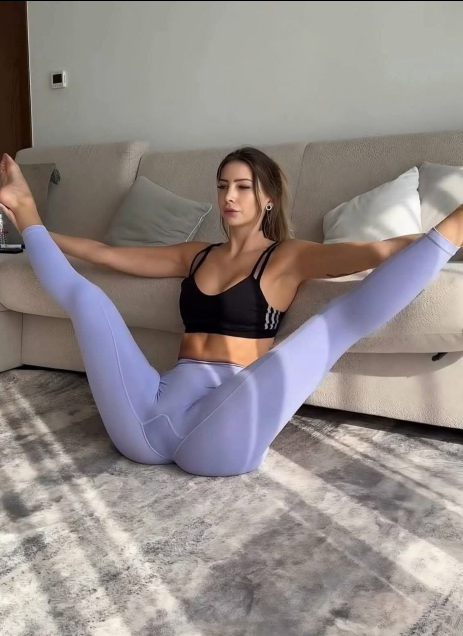
The Power of Flexibility: What This Stretching Pose Reveals About Strength, Balance, and Mobility
A striking fitness photograph can sometimes communicate far more than words. The image here shows a woman seated on a carpeted floor in a comfortable home setting, performing a challenging flexibility exercise. Her legs are extended widely to either side while her arms reach outward, creating a pose that requires a combination of mobility, balance, coordination, and concentration.
Although the position may look effortless, exercises involving a wide leg extension can require considerable flexibility in the hips and inner thighs. They can also challenge the muscles responsible for maintaining posture and stability. The photograph therefore offers an interesting look at how flexibility training can become part of a broader approach to physical wellness.
Flexibility Is More Than Being Able to Stretch
When people think about flexibility, they often imagine someone performing a split or touching their toes. In reality, flexibility is a much broader component of physical fitness.
Flexibility refers to the range of movement available around a joint. Different joints have different natural ranges of motion, and factors such as age, genetics, activity level, previous injuries, muscle tension, and training habits can influence how flexible a person becomes.
The pose shown in the photograph places considerable emphasis on the hips and legs. The wide position of the legs requires mobility through the hip joints while the muscles surrounding the pelvis and thighs work to maintain control.
Developing flexibility gradually can make everyday movements more comfortable. Bending, reaching, climbing stairs, getting up from the floor, and participating in recreational activities can all benefit from healthy mobility.
The Importance of Proper Technique
One of the most important lessons from any advanced stretching photograph is that appearance should not be confused with technique.
A pose may look impressive, but flexibility should never be developed by forcing the body into a position it cannot comfortably handle. Stretching too aggressively can cause pain or injury.
A safer approach is gradual progression. Someone beginning flexibility training might start with gentle hip-opening movements, seated stretches, hamstring stretches, and controlled leg movements. Over time, consistent practice may increase range of motion.
Warm muscles are generally more prepared for movement than muscles that have been suddenly stretched while cold. A few minutes of light activity can help prepare the body before deeper flexibility work.
The goal should be controlled movement rather than simply achieving the widest possible position.
Why Hip Mobility Matters
The hips are among the body’s most important movement centers. They connect the upper body and lower body while allowing movements such as walking, running, squatting, climbing, and rotating.
Limited hip mobility can sometimes make certain movements feel uncomfortable or restricted. However, improving mobility is not simply a matter of stretching one muscle group.
The hips are surrounded by numerous muscles, including the hip flexors, glutes, adductors, and external and internal rotators. Mobility exercises can help people explore comfortable movement through different directions.
The position shown in the photograph particularly emphasizes lateral movement of the legs. This can place substantial demand on the inner-thigh muscles, commonly referred to as the adductors.
Because these muscles are involved in stabilizing the legs and pelvis, gradually training them can be useful for people participating in activities such as dance, gymnastics, martial arts, yoga, and certain sports.
Strength and Flexibility Work Together
There is a common misconception that flexibility and strength are opposites. In reality, the two qualities can complement one another.
A person may be extremely flexible but lack the strength needed to control a large range of motion. Conversely, someone may have considerable strength but limited mobility.
The healthiest approach is often to develop both.
Strength training can help the muscles control movement, while flexibility exercises can help maintain or improve comfortable range of motion. Balance and coordination then help the body use that range effectively.
The pose in the photograph illustrates this relationship. Maintaining an upright torso while holding the legs in an extended position requires more than loose muscles. The abdominal muscles, back muscles, hips, and legs all contribute to stability.
Breathing and Concentration
Stretching is also an exercise in concentration.
When performing a demanding flexibility movement, slow breathing can help a person remain relaxed and focused. Holding the breath or becoming tense can make a stretch feel more difficult.
A steady breathing pattern encourages relaxation and gives the person an opportunity to notice how the body feels.
There is an important distinction between the normal sensation of stretching and pain. A gentle pulling sensation can be expected during many stretches, but sharp, burning, or sudden pain is a warning sign to stop or reduce the intensity.
Listening to the body is an essential part of responsible fitness.
Creating a Comfortable Home Workout
The photograph also demonstrates that flexibility exercises do not necessarily require an expensive gym or complicated equipment.
A comfortable floor surface, appropriate clothing, sufficient space, and a few minutes of uninterrupted time may be enough for a basic stretching session.
However, the simplicity of the environment does not mean every advanced pose is suitable for everyone.
Beginners can start with easier movements and gradually progress. For example, they might begin with seated forward stretches, gentle butterfly stretches, hip rotations, and controlled leg extensions.
Consistency is usually more valuable than attempting an extreme position once and then stopping.
Even ten minutes of mobility work performed regularly can become a meaningful part of a fitness routine.
The Psychological Benefits of Movement
Physical exercise can also influence mental well-being.
Stretching sessions often encourage people to slow down and focus on the present moment. Instead of concentrating on screens, work, or daily responsibilities, a person can pay attention to breathing and physical sensations.
This can create a calming ritual at the beginning or end of the day.
For some people, flexibility training becomes a form of personal discipline. Progress may be slow, but noticing even small improvements can provide motivation.
One week might bring only a slightly greater range of motion. Several weeks later, a movement that once felt difficult may become more comfortable.
That gradual progress can reinforce the idea that physical development does not happen overnight.
Avoiding Comparison
Fitness photographs on social media can sometimes create unrealistic expectations.
People may see someone performing an advanced pose and assume they should be able to reproduce it immediately. But every body is different.
Two people can follow the same routine and develop different levels of flexibility. Factors such as anatomy, previous training, injury history, and natural mobility all matter.
Instead of comparing one person’s range of motion with another’s, a better measure is personal progress.
If a stretch becomes more comfortable, balance improves, posture becomes easier to maintain, or everyday movement feels better, those can all represent meaningful achievements.
A Reminder About Patience
Flexibility is generally developed through repetition and patience rather than force.
A person attempting a challenging pose should prioritize stability and comfort. If the body is not ready for a particular position, there is no benefit in pushing beyond a safe range simply to imitate a photograph.
Professional guidance can also be valuable, particularly for people recovering from injuries or dealing with persistent pain.
A qualified fitness professional, physical therapist, or other appropriate healthcare professional can help determine which exercises are suitable for an individual’s circumstances.
Final Thoughts
The photograph captures an impressive example of flexibility and controlled movement, but its deeper message goes beyond the pose itself.
Physical fitness is not simply about appearance. Mobility, strength, balance, coordination, posture, and body awareness all contribute to functional movement.
A challenging flexibility position may be the result of many weeks, months, or years of consistent practice. What appears effortless in a photograph can represent considerable dedication behind the scenes.
For anyone inspired by the image, the most valuable lesson is not to immediately copy the pose. Instead, it is to appreciate the principles behind it: move gradually, develop strength alongside flexibility, breathe consistently, pay attention to technique, and respect the body’s limits.
With patience and regular practice, flexibility can become an enjoyable part of a balanced fitness routine. The ultimate goal is not simply to achieve an impressive-looking position, but to build a body that can move comfortably, confidently, and under control.