Trump “Falls Again”? What the Latest Reports Actually Show
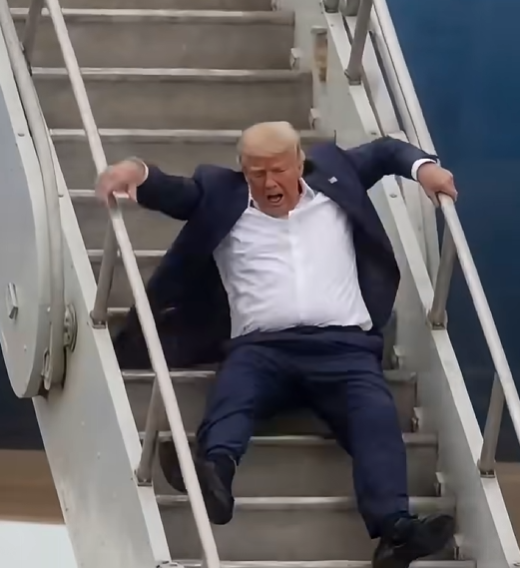
A sensational headline circulating online claims, “Trump FALLS AGAIN! — White House Doctor Breaks Silence.” The wording is dramatic, but the available evidence does not establish that President Donald Trump has suffered a new fall or that his White House physician has issued a statement confirming a serious medical incident. The headline appears to be part of a social-media post designed to generate curiosity and clicks rather than a verified breaking-news report.
That distinction matters, especially when the subject is the health of a sitting president.
Recent footage and reporting have nevertheless renewed public discussion about Trump’s physical appearance and alertness. On August 10, 2026, Trump participated in a White House event during which he signed an executive order concerning childhood vaccination policy. Multiple reports said he appeared sleepy or drowsy at portions of the ceremony, with his eyes closed and his head tilted while other officials spoke.
Those observations quickly became the subject of online speculation. Some commentators interpreted Trump’s posture as evidence of declining health, while others argued that appearing tired during a lengthy public event is not, by itself, proof of an illness.
The distinction between what can be observed and what can be medically concluded is extremely important.
Trump is now 80 years old, and his age naturally means that his health receives considerable public attention. Presidential health has always been a politically sensitive issue because the president carries enormous responsibilities and must be capable of performing demanding duties. But photographs, short video clips, facial expressions, or moments of apparent fatigue cannot substitute for a medical examination.
The White House physician, Dr. Sean Barbabella, has previously released information about Trump’s health. In May 2026, a physician’s memo released by the White House stated that Trump remained in excellent health while also acknowledging issues including lower-leg swelling and benign bruising on his hand. The memo said his cardiac, pulmonary, neurological, and overall physical functions were strong.
That information provides important context for evaluating dramatic claims about a supposed new collapse.
It is also worth remembering that Trump has faced health speculation throughout his public career. During his first presidency, questions about his medical condition frequently generated intense media coverage. In more recent years, discussions have focused on his age, visible bruising, leg swelling, and his appearance during public events.
Some claims have been exaggerated or unsupported.
That is why a headline saying “Trump falls again” should not automatically be interpreted as confirmation of a medical emergency.
The viral headline itself offers another clue. Posts using phrases such as “See more,” “doctor breaks silence,” or “full story in the comments” are frequently structured to encourage users to click through rather than provide the essential facts directly. One Facebook post carrying essentially the same headline currently exists, but its wording does not provide reliable evidence establishing that Trump experienced a new fall.
Meanwhile, legitimate reporting has focused on a different development: Trump’s appearance during the August 10 White House event.
According to reports, Trump appeared to doze off at several moments while officials discussed the administration’s new vaccine policy. The event lasted roughly 40 minutes and included remarks from Health and Human Services Secretary Robert F. Kennedy Jr. and NIH Director Jay Bhattacharya. Trump nevertheless participated in the event, answered questions, and signed the executive order.
The policy itself has attracted significant controversy. Trump’s order calls for changes to childhood vaccination practices, including encouraging separate administration of measles, mumps, and rubella vaccines rather than relying on the combined MMR shot. Public-health experts have criticized the approach and warned that additional appointments could create barriers to vaccination.
The health debate surrounding Trump therefore extends beyond questions about his own physical condition. His administration’s decisions on public health have also placed him at the center of intense medical and political debate.
At the same time, the president’s personal health should not be confused with disagreements over his policies.
A person can criticize a presidential health policy while still demanding accurate reporting about the president’s medical condition. Likewise, someone who supports Trump can acknowledge that he appeared tired without concluding that he has a serious disease.
This is particularly important in the social-media era, where a dramatic photograph can spread around the world within minutes.
A single frame may capture someone blinking, leaning forward, resting their eyes, losing balance momentarily, or reacting to something outside the camera’s view. Without context, the image can be interpreted in almost any way.
That is why responsible reporting requires multiple sources and, ideally, an official statement.
As of the latest information available, there is no reliable evidence confirming the sensational claim that Trump has suffered another serious fall accompanied by a new alarming statement from his physician. The confirmed recent story is that Trump appeared drowsy during a White House event and that his health remains a subject of public discussion.
The difference may sound small, but it is enormous.
“Trump appeared sleepy during an event” is a factual observation supported by published reports.
“Trump collapsed because of a serious medical condition” is a medical conclusion that requires evidence.
“White House doctor breaks silence about a new fall” would require an actual statement from the physician confirming such an incident.
Without that evidence, the claim remains unverified.
For readers, the lesson is simple: dramatic headlines deserve careful examination. Before sharing a post claiming that a president has collapsed, been hospitalized, suffered a stroke, or received a frightening diagnosis, check whether reputable news organizations have independently reported the same event.
Presidential health is too important to become a vehicle for viral misinformation.
Trump’s age, public schedule, and highly visible role guarantee that his physical condition will continue attracting attention. Every stumble, pause, tired expression, or unusual moment is likely to be examined by millions of people.
But responsible journalism requires separating observation from speculation.
For now, the strongest verified picture is more measured than the viral headline suggests. Trump recently appeared tired during a public White House ceremony, prompting renewed discussion about his stamina and health. His physician has previously described him as being in excellent overall health while acknowledging certain medical issues. There is, however, no solid evidence in the latest reporting that he has suffered the dramatic new fall implied by the viral headline.
The story is therefore less about a confirmed medical emergency and more about how quickly uncertainty can become “breaking news” online.
And until an official medical statement or multiple credible reports establish otherwise, readers should treat claims of another Trump fall with caution.