 For most of my life, I believed there were no surprises left between my husband and me.
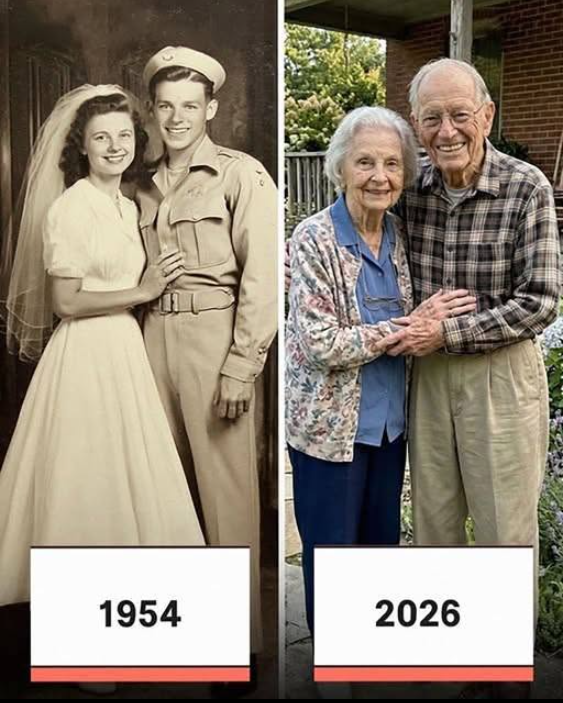
Jean and I had been married for seventy-two years. We built a life from almost nothing, raised three children, welcomed grandchildren and great-grandchildren, and weathered every season together. We celebrated birthdays with homemade cakes, spent countless evenings watching the sunset from our porch, and found comfort in the ordinary routines that became the foundation of our marriage.
Jean rarely spoke about the years before we met.
I knew he had served in the army during his youth. I knew he had seen things he preferred not to remember. Occasionally, he would wake in the middle of the night after a bad dream, quietly walk to the kitchen, and sit in silence until dawn. Whenever I asked if he wanted to talk, he would simply smile and say, “Some stories are better left where they happened.”
Over time, I stopped asking.
When he passed away peacefully at the age of ninety-five, surrounded by our family, I thought I had reached the final chapter of the man I loved.
I was wrong.
The funeral was small, exactly as Jean had wanted. Friends, neighbors, relatives, and fellow veterans filled the chapel with quiet respect. There were no elaborate speeches, only heartfelt memories and gentle laughter between tears.
As everyone began leaving, I noticed an elderly man standing near the back.
He wore a faded military jacket covered with carefully preserved insignia. His white hair peeked from beneath an old cap, and his weathered face carried an expression that was impossible to describe.
He looked at Jean’s photograph for a very long time.
Finally, he walked toward me.
“My name is Henri,” he said.
“I served with Jean.”
I apologized for not recognizing him.
“We lost touch many years ago,” he replied. “Life has a way of doing that.”
Then he reached inside his coat and removed a small wooden box.
It wasn’t fancy.
The wood had faded with age, and tiny scratches covered every side. A brass clasp kept it closed.
“He asked me to keep this,” Henri said quietly.
“He told me that if anything ever happened to him, I was to place it in your hands.”
I stared at the box.
Jean had never mentioned it.
Not once.
With trembling fingers, I lifted the clasp.
Inside rested a silver pocket watch.
Beneath it lay several yellowed letters tied together with a blue ribbon.
At the bottom was an old black-and-white photograph.
The moment I saw it, my breath caught.
Jean stood smiling beside a young woman holding a little girl who couldn’t have been older than four.
“Oh my God…”
The words escaped before I could stop them.
“Who are they?”
Henri remained silent for several moments.
“They were the Dubois family,” he finally answered.
“I don’t understand.”
Henri gently picked up the photograph.
“During the war, Jean’s unit passed through a small village that had been heavily damaged. Most families had already fled, but one little girl became separated from her parents during the evacuation.”
He pointed toward the child in the picture.
“Her name was Claire.”
According to Henri, Jean found the frightened girl hiding inside the ruins of a church.
For nearly three days, Jean searched nearby villages until he finally located her parents.
“The reunion…” Henri whispered, shaking his head.
“I’ve never seen anything like it.”
The mother had embraced Jean with tears streaming down her face.
The father insisted on giving him the family’s treasured silver pocket watch.
Jean refused repeatedly.
Eventually, the father slipped it into Jean’s backpack while they weren’t looking.
“He considered it a debt that could never truly be repaid,” Henri explained.
I picked up the watch.
Engraved inside were words in French.
“To the man who returned our future.”
Tears blurred my vision.
“But why didn’t he ever tell me?”
Henri smiled gently.
“Because Jean never believed heroes should introduce themselves.”
I carefully unfolded the letters.
The first one had been written nearly seventy years earlier.
It thanked Jean for saving their daughter.
The next described Claire starting school.
Another included photographs from her graduation.
There were wedding pictures.
Holiday cards.
Birth announcements.
Every few years, another letter arrived.
The final envelope had been written only six months earlier.
It came from Claire herself.
She wrote that she had become a grandmother.
She thanked Jean once again for giving her a life she otherwise never would have lived.
She ended with words that left everyone in the room crying.
“Every birthday I celebrate belongs partly to you. Every smile from my children and grandchildren exists because one young soldier chose kindness instead of walking away. We have never stopped praying for you.”
I pressed the letter against my heart.
“Why did he keep all this hidden?”
Henri looked toward Jean’s photograph.
“He believed kindness loses something the moment it’s performed for recognition.”
Before leaving, Henri handed me one final envelope.
“This one is from Jean.”
My heart pounded.
It was addressed simply:
For My Beloved Wife.
Inside was a handwritten letter.
My dearest,
If you’re reading this, it means I’m gone. Please don’t be upset that I never spoke much about those years.
I didn’t hide them because I didn’t trust you.
I hid them because I wanted our life together to be built on peace instead of war.
The greatest thing I ever accomplished wasn’t during my years in uniform.
It was loving you.
You gave me the home I dreamed about during every difficult day overseas.
If those letters teach you anything, I hope it’s this: the smallest act of kindness can echo across generations.
Promise me you’ll keep smiling.
And whenever you hear children laughing, remember that somewhere in the world, another family still carries our story in their hearts.
Forever yours,
Jean.
I could no longer hold back my tears.
Neither could our children.
A few weeks later, Claire and her family traveled across the ocean to visit us.
The moment she stepped through my front door, she hugged me as though we had known each other forever.
She introduced me to her children.
Then her grandchildren.
Three generations.
Every single one existed because of one decision Jean had made decades earlier.
That afternoon, our families sat together around the same dining table where Jean and I had shared thousands of meals.
Stories were exchanged.
Photographs were compared.
Laughter filled the house once again.
As the sun began to set, I looked at the empty chair where Jean always sat.
For a brief moment, I could almost imagine him smiling quietly, happy that everyone else was receiving the attention instead of him.
That was exactly who he had always been.
After seventy-two years of marriage, I discovered there was still one final chapter of my husband waiting to be told.
It wasn’t a story about medals or recognition.
It was a story about compassion.
And in the end, I realized that the greatest legacy a person can leave behind isn’t fame or fortune.
It’s the lives they quietly change without ever expecting anything in return.