230 People Perished When TWA Flight 800 Exploded. Twenty-Five Years Later, the Wounds Are Still Raw.
On the evening of July 17, 1996, what began as an ordinary international flight quickly became one of the deadliest aviation disasters in American history. Trans World Airlines Flight 800, a Boeing 747 traveling from New York’s John F. Kennedy International Airport to Paris, exploded in midair just minutes after takeoff, crashing into the Atlantic Ocean near Long Island. All 230 people on board—212 passengers and 18 crew members—lost their lives.
More than two decades later, the tragedy continues to leave a lasting impact on families, investigators, first responders, and the aviation industry. While years have passed since the devastating accident, those directly affected often say the emotional wounds remain as painful as ever.
A Routine Flight That Turned Into Disaster
TWA Flight 800 departed JFK Airport at approximately 8:19 p.m. on a warm summer evening. Witnesses along the Long Island shoreline later reported seeing what appeared to be a bright flash in the sky before the aircraft broke apart. Within moments, the massive jet plunged into the Atlantic Ocean.
The crash shocked the nation. Television networks interrupted regular programming to report the unfolding tragedy, and emergency response teams rushed to the scene. Coast Guard vessels, Navy ships, helicopters, and local fishermen joined an enormous recovery effort that would continue for months.
Because the aircraft had broken apart over a wide area, investigators faced one of the most difficult aviation investigations ever conducted in the United States.
Families Left Searching for Answers
For the families of the victims, the disaster brought unimaginable heartbreak.
Passengers included vacationers heading to Europe, business travelers, students, teachers, flight attendants, pilots, and entire families beginning summer holidays. Among the victims were sixteen students and five adult chaperones from a French Club at Montoursville Area High School in Pennsylvania.
Entire communities mourned together.
Many relatives waited anxiously for news during the first hours after the crash, hoping loved ones had somehow survived. As recovery operations continued, hope slowly gave way to grief.
Even decades later, many family members describe July 17 as the hardest day of every year.
One of the Largest Aviation Investigations
The National Transportation Safety Board (NTSB) led the investigation, assisted by the FBI, Federal Aviation Administration, Boeing, engine manufacturers, and numerous technical experts.
Initially, investigators considered many possibilities.
Because numerous witnesses reported seeing streaks of light near the aircraft, speculation quickly spread that Flight 800 may have been destroyed by a missile or terrorist attack. These theories received extensive media attention and fueled years of public debate.
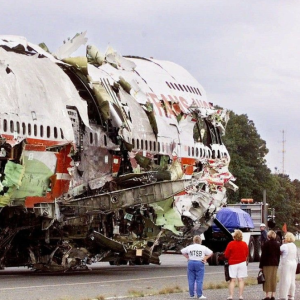
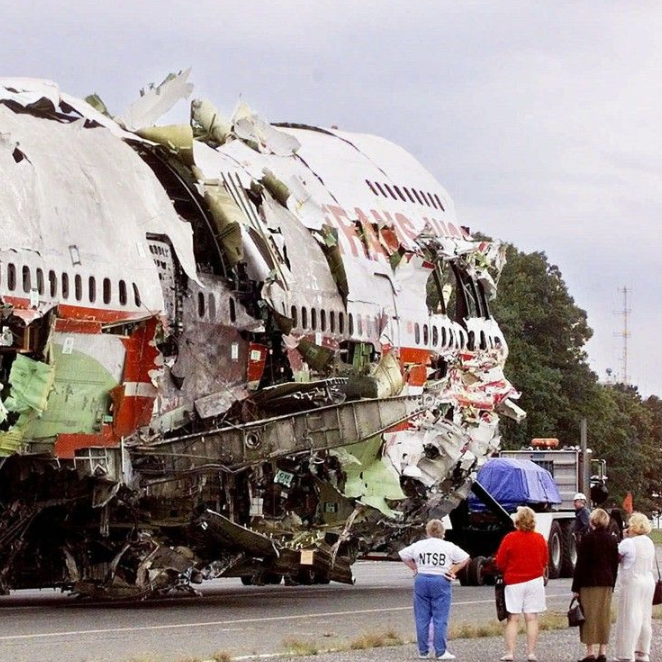
Investigators examined thousands of pieces of evidence recovered from the ocean floor. Divers worked in dangerous conditions to retrieve wreckage that was eventually reconstructed inside a massive hangar.
More than 95 percent of the aircraft was recovered—an unprecedented achievement that allowed experts to carefully study the airplane’s structure.
The Official Conclusion
After four years of investigation, the NTSB announced its findings.
According to the official report, the explosion most likely began inside the aircraft’s center wing fuel tank. Investigators concluded that a short circuit probably allowed electricity to ignite flammable fuel vapors inside the tank, causing a catastrophic explosion.
The blast destroyed the structural integrity of the airplane, leading it to break apart in flight.
Although alternative theories have continued to circulate over the years, no evidence was found during the official investigation that a missile strike or bomb caused the disaster.
Changes That Improved Aviation Safety
The tragedy prompted significant changes throughout the aviation industry.
Aircraft manufacturers began redesigning fuel tank systems to reduce the risk of ignition. Airlines adopted additional inspection procedures for aging aircraft wiring. Regulations were strengthened to improve fuel tank safety standards.
One of the most important developments involved nitrogen-generating systems that reduce oxygen levels inside fuel tanks, making accidental ignition far less likely.
The lessons learned from Flight 800 influenced aircraft safety around the world.
Remembering the Victims
Every anniversary brings renewed memories for families.
Memorial services are held to honor the 230 victims, allowing relatives and friends to gather, share stories, and remember the lives lost.
At the TWA Flight 800 International Memorial in Smith Point County Park on Long Island, engraved names stand as a permanent reminder of those who never returned home.
Visitors often leave flowers, photographs, and personal messages.
For many families, these ceremonies provide comfort, even though the pain never completely disappears.
First Responders Still Remember
The crash also left a lasting impression on first responders.
Coast Guard personnel, Navy divers, medical examiners, police officers, fishermen, and volunteers spent countless hours searching the Atlantic Ocean.
Many have described the recovery operation as one of the most emotionally difficult experiences of their careers.
Recovering victims and aircraft debris over several months required extraordinary dedication and resilience.
Years later, many responders still recall specific moments from those difficult days.
The Human Cost
Statistics alone cannot capture the tragedy.
Behind every number was a person with dreams, ambitions, friendships, and loved ones waiting for them.
Some passengers were celebrating anniversaries.
Others were beginning vacations.
Some were traveling for work.
Students were looking forward to exploring Europe with classmates.
Flight attendants and pilots were simply doing their jobs.
Their stories remain an important part of the legacy of Flight 800.
Why the Disaster Still Matters
Aviation accidents often become turning points for safety improvements.
Just as earlier disasters transformed cockpit procedures, weather forecasting, and air traffic control, Flight 800 changed how engineers think about aircraft fuel systems and electrical wiring.
Modern commercial aviation is significantly safer today partly because investigators carefully studied what happened on that July evening.
Every recommendation implemented following the accident has contributed to preventing future tragedies.
A Legacy of Remembrance
Twenty-five years after the explosion—and now decades beyond that milestone—the legacy of TWA Flight 800 continues.
Family members still gather to honor birthdays that were never celebrated, graduations that never happened, and futures that were suddenly taken away.
Investigators continue using Flight 800 as a case study for aviation safety.
Students of aviation history examine the investigation as an example of meticulous accident reconstruction.
Communities continue honoring the memory of those who lost their lives.
The passage of time has not erased the sorrow experienced by families or the significance of the disaster. Instead, it has reinforced the importance of remembering the victims while continuing to improve aviation safety.
The story of TWA Flight 800 is ultimately one of profound loss, relentless investigation, and enduring remembrance. Although no explanation can undo the heartbreak suffered by the families of the 230 victims, the lessons learned from the tragedy have helped make commercial aviation safer for millions of travelers around the world.
For those who lost parents, children, siblings, spouses, friends, and colleagues, however, the passage of time does little to lessen the absence. As anniversaries continue to pass, the names of the 230 victims remain forever connected to one of the most significant aviation disasters in U.S. history—a solemn reminder that behind every safety improvement lies the memory of lives that can never be replaced.