The Cloud That Looked Like a Dog: Why Our Brains Love Finding Hidden Shapes in the Sky
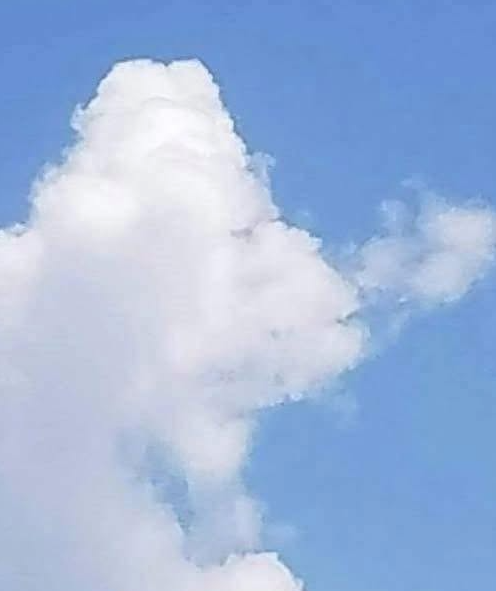
Have you ever looked up at the sky and suddenly noticed a cloud that looked exactly like an animal, a face, or even a famous landmark? One moment it’s just an ordinary cloud drifting across a blue sky, and the next it becomes something extraordinary. The image above is a perfect example. At first glance, it appears to be nothing more than a fluffy white cloud. But after looking a little longer, many people begin to see what resembles the profile of a dog or wolf gazing into the distance.
This fascinating experience is something nearly everyone has had at some point in life. Whether lying on the grass during a summer afternoon or gazing out an airplane window, people naturally search for familiar patterns in the ever-changing shapes of clouds.
Scientists have a name for this phenomenon: pareidolia. It refers to our brain’s ability to recognize meaningful images in random or ambiguous visual patterns. It’s the same reason people sometimes see faces in tree bark, the “man in the moon,” or animals in rock formations.
Our brains are designed to recognize patterns quickly. From an evolutionary perspective, this skill helped early humans identify friends, predators, and food sources in their surroundings. Spotting a face or an animal in the distance—even if it turned out to be a false alarm—was often safer than missing a real threat.
Today, that same ability turns ordinary clouds into works of imagination.
The cloud in this image has several features that encourage this interpretation. The upper portion forms what looks like the top of a dog’s head, while a protruding section resembles a snout pointing toward the right side of the picture. Another small cloud nearby could even be imagined as something the dog is looking at or sniffing.
Of course, not everyone will see the same thing.
One person may see a dog.
Another may see a lion.
Someone else may think it resembles a polar bear or a mythical creature.
None of these interpretations are right or wrong. They simply reflect how each person’s brain organizes visual information.
Children are often especially good at spotting imaginative shapes because they tend to approach images with fewer expectations. Adults, on the other hand, may notice objects based on memories, hobbies, or experiences. A veterinarian might immediately recognize an animal, while an artist may focus on the cloud’s texture and composition.
Cloud watching has entertained people for centuries. Long before smartphones and streaming services, families would spend afternoons outdoors identifying shapes in the sky. It was a simple activity that encouraged creativity, conversation, and observation.
Meteorologists, however, see clouds differently. They focus on the physical processes that create them. Clouds form when warm, moist air rises into the atmosphere and cools. Water vapor condenses into tiny droplets or ice crystals that cluster together, producing the clouds we see overhead.
Wind currents constantly reshape these formations. What looks like a perfect dog’s face now may become an unrecognizable puff of vapor just a few minutes later. This temporary nature is part of what makes cloud watching so enjoyable—every shape is unique and fleeting.
The psychology behind pareidolia has fascinated researchers for decades. Studies suggest that the human brain processes possible faces extremely quickly, often within fractions of a second. This rapid recognition helps explain why so many people instantly notice face-like or animal-like patterns without consciously searching for them.
Artists and photographers frequently use this tendency to create engaging images. By capturing naturally occurring shapes that resemble familiar objects, they encourage viewers to pause and look more carefully. A photograph that initially seems ordinary can become memorable once someone points out the hidden resemblance.
Social media has amplified this phenomenon. Images of oddly shaped clouds often go viral as thousands of users debate what they see. Some insist the cloud is clearly a dragon, while others argue it resembles a rabbit, horse, or famous cartoon character. These discussions reveal how differently people interpret the same visual information.
Clouds have also inspired countless stories and legends throughout history. Many cultures viewed unusual cloud formations as signs, symbols, or messages from nature. While science explains cloud formation through atmospheric processes, their beauty continues to inspire imagination and storytelling.
Looking at clouds can even have mental health benefits. Spending time outdoors while observing the sky encourages mindfulness—a practice of focusing on the present moment without judgment. Watching clouds drift slowly across the sky can create a calming experience that reduces stress and promotes relaxation.
The image shown here reminds us that beauty often lies in perspective. A simple collection of water droplets becomes something meaningful because our minds connect random shapes with familiar memories and experiences.
Perhaps that’s one of the reasons people continue to enjoy cloud watching generation after generation. It combines science with imagination, reality with creativity, and observation with wonder.
So what do you see?
Is it a loyal dog looking toward the horizon?
A majestic wolf surveying its surroundings?
Or perhaps something entirely different?
There is no single correct answer. The cloud itself has no intended shape. Instead, it becomes a mirror reflecting the remarkable ability of the human mind to discover meaning where none was deliberately placed.
The next time you find yourself outdoors beneath a bright blue sky, take a few moments to look up. You may be surprised by the incredible gallery of shapes floating overhead. Every cloud tells a different story—not because the clouds change, but because the imagination of every observer is wonderfully unique.