The Running Man
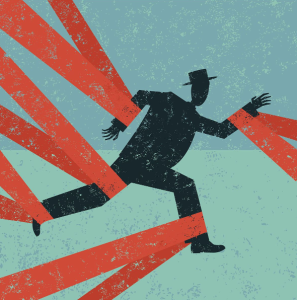
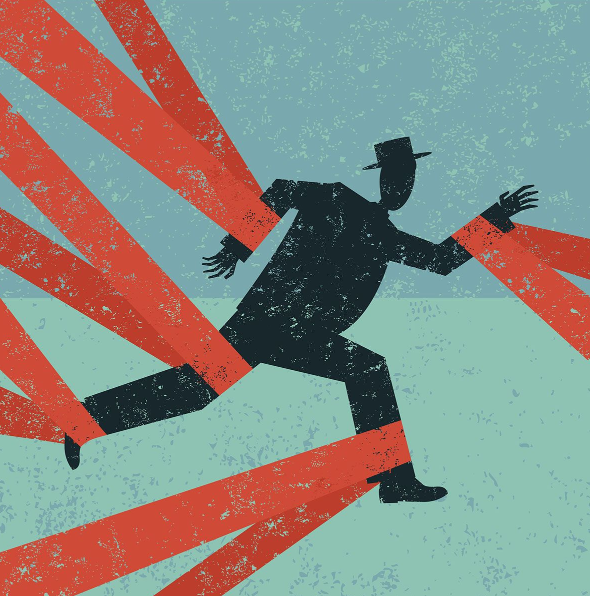
The image is deceptively simple yet profoundly unsettling: a black silhouette of a man in a fedora, captured mid-sprint, his body contorted in urgent motion. Thick red beams slash across the frame like laser sights or chains, striking him from multiple directions. The textured teal background feels cold and infinite. This visual is a modern allegory for the human experience — a raw depiction of pursuit, pressure, vulnerability, and defiant resilience.
The Anatomy of the Symbol
The central figure is anonymous, stripped of facial features or personal details. He is every person. The fedora hints at classic noir aesthetics — the detective, the fugitive, the everyman navigating a world of shadows. His posture conveys both determination and desperation: arms extended for balance or protection, legs in full stride. He is not standing still; he is actively fighting to move forward.
The red beams are the true antagonists. Bold, aggressive, and unyielding, they represent the multifaceted forces that assail us daily. Psychologically, they embody intrusive thoughts, anxiety disorders, and the weight of expectations. Societally, they stand for systemic barriers — economic inequality, discrimination, political surveillance, and social judgment. In the digital era, they mirror the constant scrutiny of social media, algorithmic tracking, and information overload that leaves individuals feeling perpetually exposed and targeted.
The color contrast is deliberate and powerful. Red evokes danger, urgency, passion, blood, and alarm. Teal suggests detachment, institutional coldness, or the vastness of an indifferent universe. The distressed texture adds layers of grit and history, implying this struggle is not new but part of an ancient human narrative.
Existential and Philosophical Dimensions
This image resonates deeply with existential philosophy. It recalls Sisyphus eternally pushing his boulder, or Kafka’s protagonists trapped in absurd bureaucracies. The man runs not toward a visible goal but away from immediate threats. In Jean-Paul Sartre’s terms, he confronts radical freedom amid absurdity — he must keep moving despite no guarantee of escape.
Spiritually, the beams can be seen as trials or tests of faith. Many religious traditions describe life as a journey through adversity. The runner’s persistence mirrors the pilgrim’s path or the idea that growth emerges only through confrontation with suffering. There is quiet heroism in his continued motion: he has not collapsed. This embodies Viktor Frankl’s logotherapy — finding meaning even in unavoidable pain.
Modern Relevance
In 2026, this artwork feels eerily prophetic. We live in an age of hyper-visibility. Surveillance capitalism tracks our every move. Economic pressures force many into precarious “hustle” lifestyles. Mental health crises have surged, with burnout, anxiety, and depression becoming normalized responses to relentless demands. The image captures the sensation of being “under fire” from all sides — work emails, family obligations, global crises, and personal insecurities.
For marginalized communities, the beams take on sharper meaning: racial profiling, gender-based violence, immigration struggles, or class warfare. The running man becomes the refugee crossing borders, the activist evading authorities, or the single parent juggling multiple jobs.
Even positive pursuits — ambition, self-improvement, creativity — can feel like running through obstacles. The “hustle culture” glorified on social media often hides exhaustion. The image critiques this: constant motion does not always equal progress when external forces actively hinder you.
Psychological Insights
From a mental health perspective, the silhouette illustrates the fight-or-flight response. Chronic activation of this state leads to exhaustion, a phenomenon psychologists call “allostatic load.” The open hands suggest a desire for connection or help, highlighting how isolation worsens the struggle. Many viewers may see their own experiences reflected — the late-night overthinker, the person masking anxiety at work, or someone recovering from trauma while society demands they “just keep going.”
Yet the image also offers empowerment. Motion itself is resistance. Psychological resilience research shows that agency — the belief that one can influence outcomes — is protective. The runner chooses direction. He breaks some beams with his momentum. Small, consistent actions compound into meaningful change.
Broader Societal Commentary
On a collective level, the artwork critiques a world that values productivity over well-being. Late-stage capitalism, with its emphasis on individual responsibility for systemic problems, leaves people feeling personally targeted by abstract forces. The red beams resemble both literal weapons (surveillance, policing) and metaphorical ones (debt, prejudice, climate anxiety).
It also speaks to connection. While the man runs alone, the image invites empathy. How many others are running similar races unseen? Building supportive communities — whether through friendships, therapy, activism, or policy change — can weaken the intensity of those beams.
Hope Within the Struggle
Despite its dark tone, the piece is not nihilistic. The man’s forward lean suggests optimism and purpose. He runs toward something better, even if unseen. History is full of such figures: civil rights leaders, scientists, artists, and ordinary people who persisted through adversity and reshaped society.
Art of this nature serves as both mirror and catalyst. It validates exhaustion while inspiring reflection: What beams are striking you? Which ones can you dodge, break, or ignore? Are you running in the right direction?
In a fragmented world, such images remind us of shared humanity. We are all running. Recognizing this fosters compassion — for ourselves and for others whose struggles remain invisible.
The silhouette endures. The beams persist. But so does the unbreakable human will to keep moving, to seek light beyond the red glare, and ultimately to transform the chase into a journey of purpose