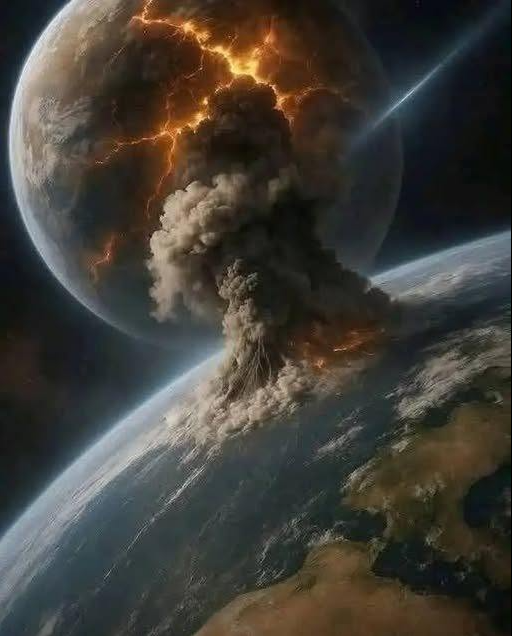
BREAKING NEWS 🚨 NASA Confirms That in 2026, Earth Will Begin to… Here’s the Truth
Social media is no stranger to dramatic headlines that promise world-changing revelations. One recent claim reads: “BREAKING NEWS 🚨 NASA confirms that in 2026, Earth will begin to… See more.” The headline is designed to spark curiosity, but it leaves out the most important part: the facts.
As of now, NASA has not announced that Earth will begin undergoing any extraordinary or catastrophic event in 2026. Headlines like this often rely on suspense and incomplete information to encourage people to click, share, or speculate before checking reliable sources.
That doesn’t mean 2026 won’t be an exciting year for science. In fact, NASA and other space agencies have several ambitious missions planned that could expand our understanding of the universe. However, none of these involve Earth suddenly changing in a dramatic way.
One area of ongoing research is climate science. NASA continuously monitors Earth’s atmosphere, oceans, glaciers, forests, and weather systems using satellites. Scientists have documented long-term trends such as rising global temperatures, changing weather patterns, melting ice sheets, and sea-level rise. These are gradual processes that have been studied for decades rather than sudden events beginning in a single year.
NASA also keeps a close watch on near-Earth objects, including asteroids and comets. Through advanced telescopes and tracking systems, astronomers identify objects whose orbits bring them close to Earth. The overwhelming majority pose no immediate threat, and the agency regularly publishes updates about newly discovered objects to keep the public informed.
Another fascinating field of research involves the Sun. Our star follows an approximately 11-year solar cycle that influences the number of sunspots, solar flares, and coronal mass ejections. Increased solar activity can affect satellite communications, GPS signals, and power systems, but scientists monitor these events carefully to help minimize potential impacts.
NASA is also preparing for future exploration beyond Earth. The Artemis program aims to return astronauts to the Moon and establish a sustainable human presence there, serving as a stepping stone for future missions to Mars. Engineers continue developing new spacecraft, habitats, and technologies that could eventually support long-duration space travel.
Meanwhile, Earth-observing satellites continue collecting valuable information about agriculture, forests, water resources, hurricanes, droughts, and wildfires. This data helps governments, researchers, and emergency responders make informed decisions that can protect lives and property.
Artificial intelligence is playing an increasingly important role in space exploration as well. NASA researchers are exploring ways to use AI to analyze enormous volumes of scientific data, improve spacecraft operations, and assist astronauts during future missions. These technologies may significantly enhance scientific discovery over the coming years.
Despite these exciting developments, sensational headlines often exaggerate routine scientific announcements. A headline may hint at an astonishing discovery while the actual story simply describes ongoing research or a planned mission. This style of writing is commonly known as “clickbait,” where curiosity is used to attract readers even if the content doesn’t match the dramatic headline.
Critical thinking is especially important when reading science news online. Before accepting extraordinary claims, it’s helpful to ask a few simple questions:
- Did the information come directly from NASA or another reputable scientific organization?
- Are multiple trustworthy news outlets reporting the same story?
- Does the headline accurately reflect the article’s content?
- Is there evidence supporting the claim?
Scientific discoveries are typically announced through official press releases, peer-reviewed research, or public briefings rather than mysterious social media posts with missing information.
NASA’s work is often exciting enough without exaggeration. Every year brings discoveries about distant galaxies, black holes, exoplanets, the Moon, Mars, and our own planet. Researchers continue learning more about climate systems, planetary geology, the origins of the universe, and the possibility of life beyond Earth.
Public interest in astronomy has grown dramatically thanks to powerful observatories such as the James Webb Space Telescope, which has captured breathtaking images of galaxies formed shortly after the Big Bang, as well as detailed observations of planets orbiting distant stars. These discoveries continue to reshape our understanding of the cosmos.
At the same time, Earth remains an extraordinary world worthy of study and protection. NASA scientists collaborate with researchers worldwide to better understand natural disasters, changing ecosystems, water supplies, and environmental conditions. Their work helps communities prepare for future challenges while improving scientific knowledge.
The excitement surrounding space exploration reminds us that curiosity is one of humanity’s greatest strengths. People have always looked toward the night sky with questions about where we came from and what lies beyond our planet. Modern technology allows scientists to investigate those questions with unprecedented precision.
So if you encounter a headline claiming “NASA confirms that in 2026, Earth will begin to…”, it’s worth pausing before assuming the worst. In most cases, the missing words are far less dramatic than the headline suggests, and there is no evidence that NASA has announced any sudden global event scheduled to begin in 2026.
Science thrives on evidence, careful observation, and transparency. While the future undoubtedly holds exciting discoveries, they are most meaningful when shared accurately and supported by reliable data rather than sensational speculation