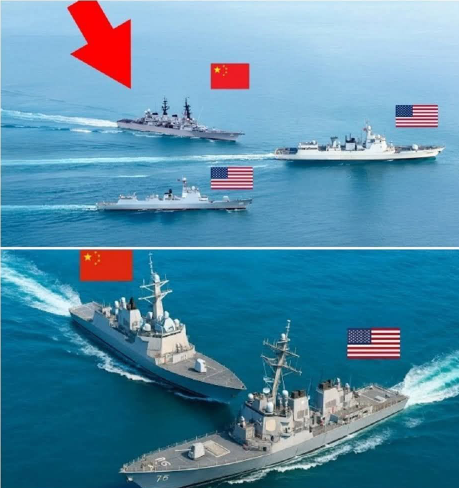
China Challenged the US Navy in the South China Sea: Tensions Escalate Amid Ongoing Maritime Rivalry
This morning, reports emerged of heightened activity in the South China Sea, where Chinese vessels reportedly shadowed or confronted US naval operations as part of broader freedom of navigation patrols. While no single dramatic clash matches the sensationalism of some headlines, the incident fits a persistent pattern of assertive Chinese maneuvers against US and allied presence in disputed waters. These encounters underscore the fragile balance of power in one of the world’s most strategically vital regions.
The South China Sea spans approximately 1.3 million square miles and serves as a critical artery for global trade, with an estimated $3.4 trillion in annual shipborne commerce passing through its waters. It holds significant oil and natural gas reserves, rich fisheries, and is central to territorial claims by China, the Philippines, Vietnam, Malaysia, Brunei, and Taiwan. China asserts historic rights over nearly the entire sea via its “nine-dash line,” a claim largely invalidated by the 2016 Permanent Court of Arbitration ruling in favor of the Philippines. Beijing has ignored that decision and continued militarizing artificial islands, deploying coast guard and militia vessels, and conducting frequent patrols.
Recent Context: A Pattern of Confrontations
US Navy freedom of navigation operations (FONOPs) are routine assertions of international law, allowing warships to sail through waters China claims as its territorial seas or exclusive economic zones (EEZs) without prior permission. These operations often draw responses from the People’s Liberation Army Navy (PLAN) and Coast Guard, including shadowing, radio warnings, and close approaches.
In recent months leading into June 2026, incidents have included Chinese vessels shadowing Philippine-US joint drills near Scarborough Shoal, near-misses between warships, and accusations of dangerous maneuvers. Chinese state media and the PLA Southern Theater Command frequently describe US actions as “provocative” and claim they “seriously violated China’s sovereignty.” The US counters that its operations comply with international law, including the United Nations Convention on the Law of the Sea (UNCLOS), which China has ratified but interprets differently regarding military activities in EEZs.
Today’s reported challenge aligns with ongoing patterns. Chinese warships and coast guard vessels have been active in monitoring US-Philippine activities, reinforcing Beijing’s narrative of defending “core interests.” Analysts note that such incidents rarely escalate to kinetic conflict but serve to normalize Chinese presence and test US resolve.
Naval Balance: China’s Rapid Rise vs. US Technological Edge
China’s navy has undergone extraordinary modernization. The PLAN now boasts the world’s largest fleet by hull count, projected to reach around 395 ships by 2025 and over 400 soon after, including advanced destroyers, aircraft carriers like the Fujian, and a growing submarine force. Artificial islands in the Spratlys and Paracels are equipped with runways, radars, and missile systems, creating a formidable anti-access/area-denial (A2/AD) network.
The US Navy, with approximately 290-300 deployable ships, relies on superior technology, training, alliances, and experience. Nuclear-powered carriers, Virginia-class submarines, and integrated allied operations (with Japan, Australia, the Philippines, and others) provide qualitative advantages. US submarines, in particular, are seen as a decisive edge in potential conflicts due to China’s relative weaknesses in anti-submarine warfare.
However, quantity matters in sustained operations. Wargames by think tanks like CSIS suggest high attrition in a Taiwan-related scenario, with both sides losing significant assets. The US faces challenges in shipbuilding and maintaining forward presence, while China benefits from proximity and shorter supply lines.
Geopolitical Stakes and Alliances
The Philippines, under its mutual defense treaty with the US, has been at the forefront of recent friction. Enhanced defense cooperation agreements allow greater US rotational access to Philippine bases. Joint exercises, such as Balikatan, and trilateral drills with Australia and others signal a tightening web of alliances aimed at countering Chinese coercion.
Vietnam, Malaysia, and Indonesia also resist Chinese pressure through diplomacy and limited military enhancements. Japan and Australia provide critical support via AUKUS and other pacts. The US Indo-Pacific Command emphasizes deterrence through presence, interoperability, and capability development.
China views US involvement as containment and interference in its “near seas.” Beijing’s strategy combines “gray zone” tactics—using coast guard and maritime militia for plausible deniability—with diplomatic and economic leverage. Recent actions near Scarborough Shoal, including reported floating structures or patrols, heighten concerns about further island-building.
Risks of Escalation
While outright war remains unlikely due to economic interdependence and mutual deterrence, the risk of miscalculation is real. Near-collisions, water cannon use, or damage to vessels could lead to casualties and invoke alliances. A lethal incident involving US or Philippine forces might trigger treaty obligations.
Broader US-China competition—over Taiwan, technology, and global influence—amplifies South China Sea tensions. US strategy documents prioritize the region as the primary theater, with investments in distributed lethality, unmanned systems, and long-range strike capabilities to counter A2/AD threats.
Diplomatic and Economic Dimensions
Efforts at dialogue continue sporadically. Code for Unplanned Encounters at Sea (CUES) provides some guardrails, but trust is low. ASEAN’s centrality is challenged by internal divisions. Economically, disruptions to shipping lanes would have catastrophic global effects, hitting China’s own export-dependent economy hard.
Fishing communities and energy exploration suffer most from instability. Philippines fishermen report harassment, while oil and gas blocks face Chinese interference.
Looking Ahead
The “challenge” this morning is unlikely an isolated event but part of a long-term contest. The US maintains it will continue FONOPs and support allies. China shows no signs of moderating its claims.
For the US Navy, sustaining credible presence requires addressing shipyard bottlenecks, crew retention, and innovation in unmanned and hypersonic technologies. Allies must share burdens more effectively. For China, overreach risks alienating neighbors and provoking stronger balancing coalitions.
The South China Sea remains a powder keg where tactical incidents test strategic patience. As naval capabilities evolve, so does the potential for both deterrence and dangerous brinkmanship. International law, diplomacy, and clear signaling will be essential to prevent a minor confrontation from spiraling into broader conflict.