Supreme Court Rejects Trump’s Appeal in E. Jean Carroll Defamation Case
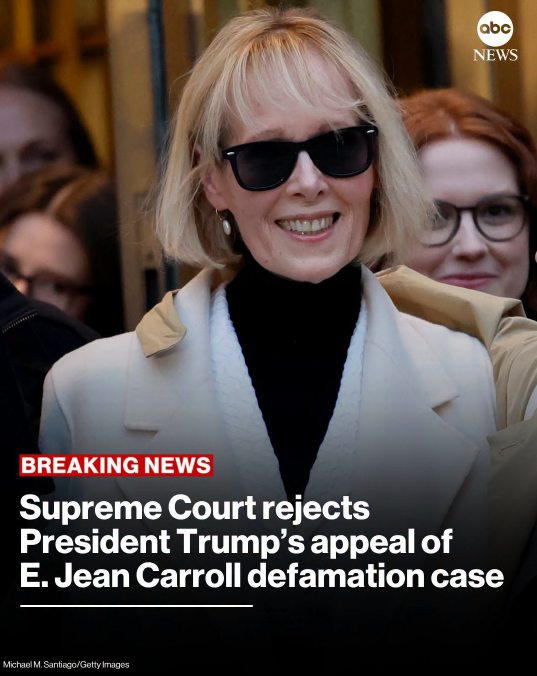
The Supreme Court has declined to hear an appeal from Donald Trump in a long-running defamation lawsuit brought by E. Jean Carroll, allowing a lower court’s decision to stand. The Court’s action marks another significant legal development in one of the most closely watched civil cases involving the former president.
The decision does not represent a ruling on the merits of the case itself. Instead, by declining to grant review, the Supreme Court left intact the judgment of the lower courts. Such denials are common, as the nation’s highest court accepts only a small percentage of the thousands of petitions it receives each year.
The dispute stems from statements Trump made in 2019 after Carroll publicly accused him of sexually assaulting her in a department store dressing room during the mid-1990s. Trump denied the allegation and asserted that he did not know Carroll, while also making comments questioning her credibility and motives.
Carroll filed a defamation lawsuit, arguing that Trump’s statements damaged her reputation and subjected her to public ridicule and harassment. The litigation quickly became one of several high-profile legal battles involving Trump, drawing intense national and international attention.
One of the central legal questions involved whether Trump was acting as a federal employee when he made the disputed statements. The Justice Department, during Trump’s presidency, argued that his comments were made within the scope of his official duties as president. If accepted, that position could have substituted the United States government as the defendant under the Federal Tort Claims Act, potentially ending Carroll’s lawsuit because federal law generally bars defamation claims against the government.
Lower courts, however, allowed Carroll’s lawsuit to proceed, finding that the circumstances did not justify dismissing the case on those grounds. Trump ultimately sought Supreme Court review after unfavorable rulings in the lower courts.
By refusing to hear the appeal, the Supreme Court effectively leaves those lower-court decisions in place. The Court did not explain its reasoning, which is typical when it declines to hear a case. A denial of review should not be interpreted as agreement or disagreement with the lower court’s conclusions; it simply means that fewer than four justices voted to take up the case.
The legal battle between Trump and Carroll has unfolded over several years and has involved multiple lawsuits. In addition to the original defamation case, Carroll later filed another lawsuit after Trump repeated his denials while out of office.
Separately, a federal jury found Trump liable for sexually abusing Carroll and for defaming her through statements he made after leaving the White House. The jury awarded Carroll substantial monetary damages. In another trial concerning Trump’s earlier statements made while he was president, a separate jury also awarded Carroll additional damages after concluding that his remarks had defamed her.
Trump has consistently denied Carroll’s allegations and has maintained that the claims are false. His attorneys have pursued multiple appeals, arguing that legal errors occurred during the proceedings and challenging various aspects of the verdicts and damage awards.
Carroll, meanwhile, has argued that the court system has repeatedly affirmed her claims and that the verdicts demonstrate accountability under the law. Her legal team has characterized the decisions as victories not only for Carroll personally but also for individuals who seek legal remedies after reputational harm.
The Supreme Court’s refusal to hear Trump’s appeal narrows one avenue for challenging the earlier rulings. However, other legal proceedings and appeals involving Trump have continued in different courts, reflecting the broader array of civil and criminal matters that have surrounded the former president in recent years.
Legal experts note that Supreme Court denials of review occur for many reasons unrelated to the underlying merits of a dispute. The Court often focuses on cases presenting unresolved constitutional questions, conflicts among federal appellate courts, or issues of broad national importance requiring clarification. Even cases involving prominent public figures are frequently declined if the justices conclude that further review is unnecessary.
The Carroll litigation has also drawn attention because it touches on broader questions involving presidential immunity, the scope of official duties, and the legal standards governing defamation claims. These issues have implications beyond the specific parties involved, although the Supreme Court chose not to address them in this appeal.
Public reaction to the Court’s decision has reflected the deep political divisions surrounding Trump. Supporters have argued that the former president has been treated unfairly by the legal system, while critics view the ruling as another affirmation that legal accountability applies regardless of political office.
For Carroll, the Supreme Court’s action represents another favorable procedural outcome in a legal battle that has lasted for years. For Trump, it removes one potential avenue for overturning lower-court rulings, though his legal team has continued to contest related judgments through other available processes where applicable.
The case has become one of the most significant civil lawsuits involving a former U.S. president, illustrating how defamation law intersects with public office, media attention, and allegations of personal misconduct. It has also underscored the extensive judicial scrutiny that can accompany statements made by elected officials, particularly when those statements concern private individuals making serious accusations.
As the legal landscape continues to evolve, the Supreme Court’s decision not to intervene closes this particular chapter without establishing new legal precedent. The lower courts’ rulings remain in effect, and the litigation serves as another reminder of the complex legal challenges that have defined much of Trump’s post-presidential years