Debate Erupts Over Faith, Free Expression, and Professional Sports
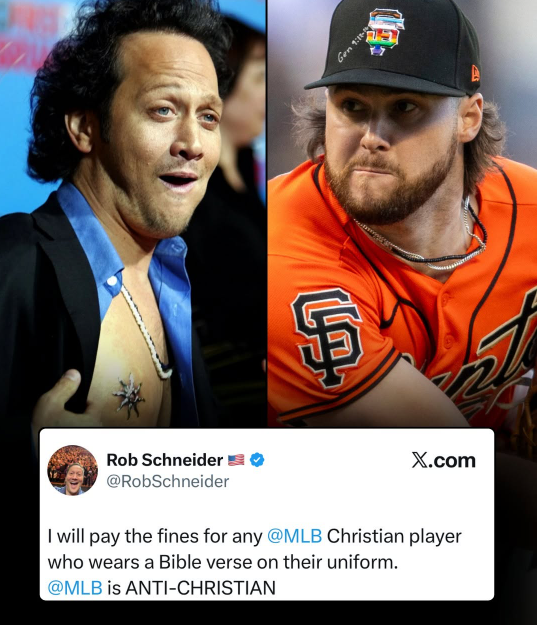
A social media post attributed to comedian and actor Rob Schneider has sparked renewed debate about faith, free expression, and the role of religion in professional sports. The post, which has circulated widely online, claims that Schneider would personally cover fines imposed on any Major League Baseball player who chooses to wear a Bible verse on their uniform. It also accuses Major League Baseball (MLB) of being “anti-Christian,” a statement that has generated strong reactions from supporters and critics alike.
The controversy highlights a broader cultural conversation that extends far beyond baseball. Questions about religious expression in the workplace, freedom of speech, and the responsibilities of professional sports leagues continue to divide public opinion.
For many athletes, faith plays a significant role in both their personal and professional lives. Throughout sports history, players have often spoken openly about their religious beliefs. Some point to heaven after scoring a touchdown, kneel in prayer before games, or thank God during interviews. Others wear jewelry featuring religious symbols or share inspirational Bible verses on social media.
Supporters of Schneider’s position argue that athletes should be free to express their faith without fear of punishment. They believe that displaying a Bible verse is a personal expression of belief and should be treated no differently than other forms of self-expression. From this perspective, restricting religious messages could be viewed as limiting an individual’s constitutional freedoms.
Many fans who share this viewpoint see sports as a reflection of society. They argue that athletes should not have to leave their beliefs behind when they step onto the field. To them, allowing Bible verses or other faith-based messages simply acknowledges the diversity of beliefs held by players.
On the other hand, critics argue that professional sports organizations have long maintained uniform policies designed to ensure consistency and neutrality. Uniform regulations exist in nearly every major sports league and often restrict unauthorized messages, logos, or symbols regardless of their content.
Those who defend MLB’s rules point out that restrictions are typically applied across the board. A league may prohibit political slogans, commercial advertising, personal messages, and religious statements not because it opposes those viewpoints, but because it seeks to maintain standardized uniforms and avoid controversies that could distract from the game itself.
This distinction is important because critics of Schneider’s claim argue that enforcing uniform policies does not necessarily indicate hostility toward Christianity. Instead, they view such regulations as part of broader standards that apply equally to all players and messages.
The discussion also raises questions about where the line should be drawn between personal expression and organizational rules. In many professions, employees must follow dress codes and workplace policies. Sports leagues are no exception. Athletes are often representatives not only of themselves but also of their teams, sponsors, and leagues.
At the same time, professional athletes occupy a unique position in society. Their visibility gives them enormous influence, and many use their platforms to advocate for causes they believe in. Whether discussing social justice, charitable work, political issues, or religious faith, athletes have increasingly become public voices on matters beyond sports.
The intersection of sports and religion is nothing new. Baseball itself has a long history of faith-related traditions. Players have participated in chapel services before games, organized prayer groups, and publicly discussed how faith helps them handle pressure, success, and failure. Some of the sport’s most respected figures have openly credited their religious beliefs for shaping their character and approach to competition.
Because of this history, debates about religious expression in baseball often resonate strongly with fans. For some, faith is inseparable from identity, making any perceived restriction feel deeply personal. Others believe that professional leagues must remain neutral spaces where individuals from many different backgrounds can participate without promoting specific religious viewpoints.
Social media has amplified these discussions significantly. In previous decades, a statement from a celebrity or athlete might have appeared in a newspaper interview or television segment. Today, a single post can reach millions of people within hours, generating widespread reactions and intense debate.
The viral nature of online content often encourages strong opinions and emotional responses. Supporters quickly rally behind messages that align with their beliefs, while opponents challenge claims they consider misleading or unfair. As a result, controversies involving religion, politics, and sports frequently become national conversations.
Rob Schneider himself has become increasingly vocal on various cultural and political issues in recent years. His comments often generate headlines and attract significant attention online. Whether people agree with him or not, his statements tend to spark discussion about larger societal questions.
In this case, the debate extends beyond one celebrity’s opinion. It touches on fundamental issues involving religious liberty, institutional authority, and cultural identity. Americans continue to hold differing views on how religious expression should be accommodated in public and professional settings.
Some argue that society has become less tolerant of public expressions of faith and that stronger protections are needed. Others contend that organizations must maintain clear rules that apply equally to everyone, regardless of religion or ideology.
Ultimately, the controversy reflects the ongoing challenge of balancing individual freedoms with organizational standards. Professional sports leagues must navigate a diverse landscape that includes players, fans, sponsors, and communities with a wide range of beliefs and values.
As conversations about faith and free expression continue, one thing remains clear: sports are about much more than wins and losses. They serve as a stage where broader cultural debates often play out in real time. Whether discussing religion, politics, or social issues, the passions that surround sports frequently mirror the passions found throughout society.
The discussion sparked by Schneider’s post is likely to continue as long as questions about personal expression and institutional rules remain relevant. Regardless of where individuals stand on the issue, the debate demonstrates how deeply people care about both their beliefs and the freedoms they associate with them. In that sense, the conversation is about more than baseball—it is about the ongoing effort to define the relationship between personal conviction and public life in a diverse and evolving society