USA Keep Out: A Political Cartoon on Immigration
Political cartoons have long been a powerful way to communicate ideas, opinions, and criticisms about society. Through simple drawings and clever symbolism, they can spark debate and encourage people to think more deeply about important issues. One cartoon that has generated discussion is the image titled “USA Keep Out,” which addresses the topic of immigration in a provocative and satirical way.
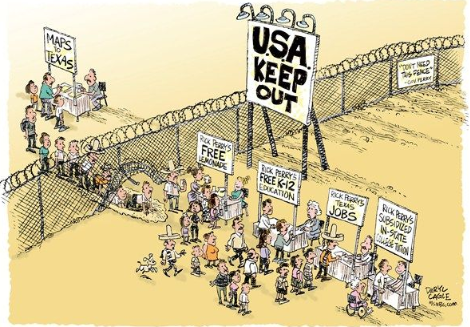
At first glance, the cartoon presents a surprising scene. A large fence topped with barbed wire separates two areas. On one side stands a large sign that reads “USA Keep Out.” Nearby, smaller signs advertise benefits such as free healthcare, free K–12 education, jobs, and subsidized in-state tuition. Crowds of people are shown gathering around the fence, trying to enter the area that offers these opportunities. Meanwhile, on the opposite side, another line of people waits near a sign that says “Maps to Texas.”
The cartoon uses a technique known as role reversal. Traditionally, political discussions about immigration often focus on people seeking entry into the United States. In this illustration, however, the artist imagines a scenario where access to America is restricted, yet people continue to seek ways to enter because of the opportunities and benefits available there. By flipping the usual narrative, the cartoon draws attention to the reasons many migrants choose to move from one country to another.
One of the central themes of the cartoon is economic opportunity. Throughout history, people have migrated in search of better jobs, higher wages, and improved living conditions. The signs advertising employment opportunities suggest that many individuals are motivated by the possibility of building a better future for themselves and their families. Whether someone moves across a city, a state, or an international border, economic advancement is often a major factor in that decision.
Another important theme is access to public services. The signs promoting healthcare and education highlight benefits that can improve quality of life. Education is often viewed as a pathway to success, while healthcare provides security and well-being. The cartoon suggests that these services may act as incentives that attract newcomers. This reflects a common argument in political debates, where some people believe that government programs encourage immigration, while others argue that migrants come primarily for work and safety rather than public benefits.
The fence itself is a significant symbol. Border fences and walls have become highly visible representations of immigration policy in many countries. In the cartoon, the fence serves as both a physical and symbolic barrier. It represents laws, regulations, and national boundaries that determine who can enter a country. Despite the barrier, people are still shown attempting to cross, suggesting that strong motivations can lead individuals to seek entry even when obstacles exist.
The large “USA Keep Out” sign is perhaps the most striking feature of the image. Normally, such signs are associated with keeping people out of a specific area. Here, the sign implies that America has closed its doors. Yet the crowd’s behavior suggests that many still want access to what the country offers. This contrast creates the cartoon’s central message: opportunity remains attractive regardless of barriers.
Political cartoons often rely on exaggeration to make a point, and this image is no exception. The artist is not necessarily claiming that every immigrant comes for free services or that benefits are the sole reason for migration. Instead, the cartoon simplifies a complex issue to highlight a particular viewpoint. By exaggerating certain elements, the artist encourages viewers to consider how policies and incentives may influence migration patterns.
Supporters of the cartoon’s message might argue that generous public benefits create a strong incentive for people to move to countries where those benefits are available. They may believe that governments should carefully balance compassion with concerns about costs, resources, and immigration levels. From this perspective, the cartoon serves as a warning about the unintended consequences of public policies.
Critics, however, may interpret the cartoon differently. They might argue that it oversimplifies immigration and ignores the many reasons people leave their home countries. Around the world, migrants often move because of violence, political instability, economic hardship, family reunification, or the desire for freedom and safety. Critics could contend that reducing migration to a search for benefits does not accurately reflect the experiences of many immigrants.
The cartoon also raises questions about the idea of the American Dream. For generations, the United States has been seen as a land of opportunity where hard work can lead to success. Many immigrants have arrived seeking not government assistance but the chance to build better lives through employment, education, and entrepreneurship. In this sense, the image indirectly acknowledges America’s continuing appeal as a destination for people seeking opportunity.
Another reason the cartoon resonates with audiences is that immigration remains one of the most debated political issues in modern society. Discussions about border security, economic impacts, humanitarian responsibilities, and national identity often generate strong opinions. Political cartoons like this one condense these complex debates into a single visual message, making them accessible and memorable.
Importantly, political cartoons are expressions of opinion rather than objective reporting. Their purpose is not to present balanced analysis but to provoke thought and discussion. Different viewers may interpret the same cartoon in different ways depending on their political beliefs, personal experiences, and understanding of immigration issues.
In conclusion, “USA Keep Out” uses satire, symbolism, and role reversal to comment on immigration and the factors that attract people to the United States. Through images of border fences, public benefits, and crowds seeking entry, the cartoon suggests that opportunity and government services can be powerful motivations for migration. Whether viewers agree or disagree with its message, the cartoon succeeds in encouraging discussion about one of the most important and controversial issues of our time: immigration and the search for a better life.