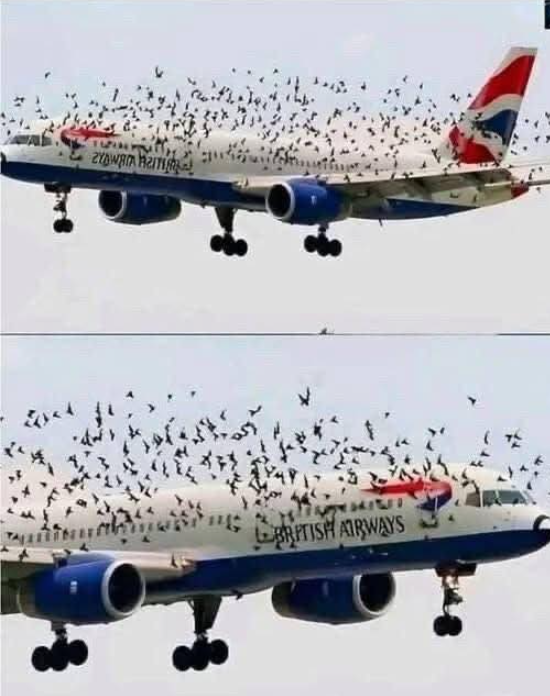
The pilot cried when he understood why the birds wouldn’t leave him alone.
Captain Elias Grant eased the Cessna 172 into a gentle bank over the dense Alaskan wilderness, the engine humming steadily beneath him. At 42, he had logged thousands of hours flying supply runs for remote villages and research stations. Today’s route was routine: drop medical supplies at a tiny outpost near the Yukon border, then return to Anchorage before dusk. The sky was a crisp, endless blue, the kind that made him feel like the last man on Earth.
But something was off.
It started with a single raven. Elias noticed it during his climb out of the outpost airstrip, a black speck keeping pace off his left wingtip. He smiled at first—ravens were clever, curious birds. It dipped and rose with him, almost playful. Then two more joined. By the time he reached cruising altitude, a dozen circled the plane in loose formation. Their caws pierced the cockpit even through the headset.
“Persistent little bastards,” he muttered, adjusting his sunglasses. He’d seen birds escort planes before, mistaking them for hawks or riding thermals. But these didn’t scatter when he banked or descended. They stayed. Always.
The flock grew as the hours passed. Gulls now, and smaller songbirds that had no business this far north. They swarmed the windshield, their wings brushing the glass in frantic bursts. Elias radioed Anchorage.
“Tower, this is November-Three-Four-Sierra. Got an unusual bird situation up here. Flock’s getting thick. Over.”
The reply crackled back. “Roger that. Any damage?”
“Negative. Just… weird.”
He tried climbing higher. The birds followed. He dropped low over the trees, hoping they’d lose interest in the forest canopy. They didn’t. Shadows flickered across his instruments as hundreds now wheeled around the Cessna. Feathers smacked the fuselage with soft thuds. The propeller whined as it sliced through a few stragglers. Elias’s hands tightened on the yoke.
By late afternoon, the sky had darkened with them. Thousands. A living storm cloud of wings and beaks that blotted the sun. The plane shuddered under their weight when some landed on the wings. The stall warning chirped once, twice. Panic clawed at his throat. He was still fifty miles from home base, fuel good, but visibility zero.
“What the hell do you want?” he shouted at the windshield.
A gull slammed into the glass, leaving a bloody smear. Then another. And another. The flock wasn’t attacking randomly—they were trying to slow him, to force him down. Elias fought the controls as the Cessna bucked. He spotted a narrow gravel bar along a winding river below and committed to an emergency landing.
The wheels kissed the stones hard. The plane skidded, fishtailed, and came to a stop inches from the water. Silence fell, broken only by the ticking of the cooling engine and the endless cries outside.
Elias sat there, heart hammering, sweat stinging his eyes. He grabbed his emergency kit, rifle, and stepped out. The birds covered every inch of the plane like a living shroud. They parted as he moved, forming a corridor toward the tree line. Not aggressive. Guiding.
He followed, legs shaky. The forest swallowed him. After twenty minutes of hiking, the birds thinned. In a small clearing stood a weathered cabin, half-hidden by moss and ferns. Abandoned, or so it seemed. Smoke curled from the chimney.
The door creaked open before he reached it.
A woman stepped out. Mid-thirties, dark hair streaked with premature gray, eyes hollow with exhaustion. She wore a faded parka. In her arms, she cradled a small bundle wrapped in blankets.
“You’re late,” she said quietly.
Elias stopped. “Who are you? How did you—”
“The birds told me you’d come. They’ve been waiting for weeks.”
She gestured him inside. The cabin was sparse: a wood stove, a table, two chairs, and a cot. On the table lay charts, weather logs, and a worn pilot’s license. His stomach dropped when he saw the name on it: Captain Daniel Grant.
His father.
Elias hadn’t spoken to the old man in fifteen years. Daniel had walked out when Elias was 27, chasing some half-baked dream of starting a new life in the bush. Letters had stopped after a few years. Elias assumed he was dead.
The woman—her name was Mara—set the bundle down gently. It stirred. A baby, no more than six months old. Tiny fists waved.
“Daniel’s gone,” Mara said. Her voice cracked. “Three weeks ago. Heart attack. He made me promise to get the boy to safety. But I can’t fly. No one comes out here. Except the birds.”
Elias stared at the child. His half-brother.
Mara continued, the story spilling out in exhausted fragments. Daniel had found her years ago, a biologist studying raven intelligence in the region. They fell in love. Built this life together. When the baby—named Finn—arrived, Daniel talked endlessly about his son Elias, the pilot, the one who would understand.
The birds had started gathering the day Daniel died. At first, Mara thought it was coincidence. But they brought her things: shiny keys, bits of colored wire from the plane’s old radio, even a faded photo of Elias as a boy that Daniel had kept. They circled the cabin at dawn and dusk, their calls forming patterns. Mara began to recognize signals—warnings of incoming storms, alerts when wolves drew near.
“They’re not ordinary,” she whispered. “Daniel always said the North changes things. Makes connections. The ravens remember faces. They remember debts. Your father saved a wounded raven years ago. Nursed it back, released it. That bird’s descendants… they never forgot the kindness. The whole ecosystem knows.”
Elias laughed bitterly at first. “Birds don’t plan rescues.”
But as night fell, the flock returned. They didn’t swarm chaotically now. They perched in neat rows along the cabin roof and surrounding trees, silent sentinels. One large raven landed on the windowsill and tapped three times—deliberate, patient.
Mara lifted Finn and placed him in Elias’s arms. The baby looked up with wide, dark eyes so like their father’s.
“I tried hiking out once,” Mara said. “Got lost. The birds led me back. They’ve been waiting for someone who could fly him out safely. They knew you’d come eventually. They’ve been watching the skies for your plane.”
Elias sat by the stove, the weight of the infant heavy and warm against his chest. Memories flooded him: his father teaching him to fly when he was ten, the two of them chasing geese across fields, laughing when the birds outmaneuvered their old Piper. Daniel had always said nature kept score. Kindness returned in ways you couldn’t predict.
Outside, the birds stirred. Not cawing in alarm, but a low, collective murmur. Almost like a lullaby. Elias stepped to the door. In the moonlight, the flock stretched as far as he could see—thousands upon thousands, an ocean of feathers and watchful eyes. They had guided him here through sheer persistence, risking their lives against his propeller, sacrificing their own to slow his plane and force the landing.
They had kept Mara and Finn alive. They had remembered a debt from decades ago and paid it forward across generations.
Tears came without warning. Elias sank to his knees on the porch, cradling his brother, sobbing into the cold night air. The weight of abandonment, the years of resentment toward his father, the miracle of this moment—it all broke inside him. The birds had seen what he couldn’t: family wasn’t just blood. It was the threads woven by time, kindness, and the wild world that bound them.
Mara placed a hand on his shoulder. “He knew you’d understand. That’s why he cried too, at the end. Said the birds would bring his boys together.”
The next morning, Elias prepped the Cessna. The birds helped in their way—clearing debris from the gravel bar, staying clear of the takeoff path. As the plane lifted off, the flock rose with them once more, but this time escorting protectively, not hindering. They flew alongside until the cabin was a speck below, then peeled away in a final, sweeping spiral of farewell.
Elias glanced at Mara in the passenger seat and Finn secured safely behind them. The baby cooed softly.
“Thank you,” Elias whispered to the sky.
He cried again as the plane banked toward Anchorage—quiet tears of grief, gratitude, and the strange, beautiful understanding that some debts in this world are paid not in money or words, but in wings.