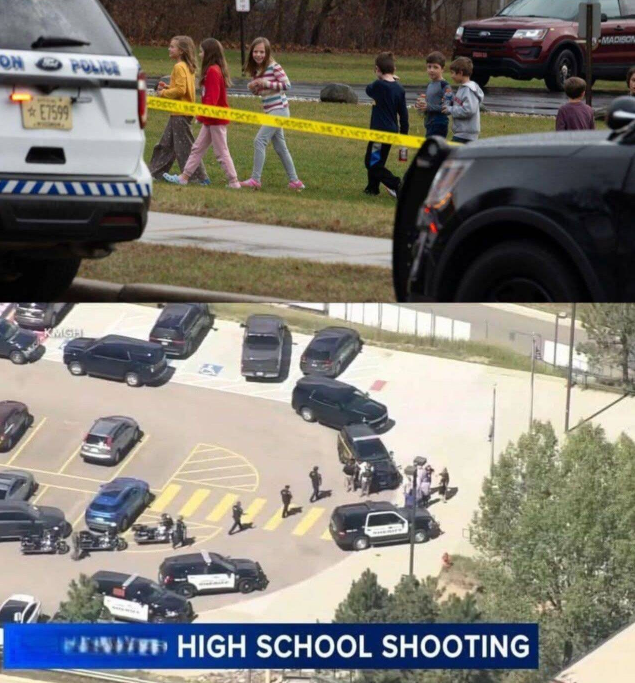
This is textbook Facebook clickbait engagement farming. The post “BREAKING: At least 4 dead, 10 injured after mass sh00ting at schoo…See more” uses censored spelling, urgency, and partial details to lure clicks, comments, and shares. It often links to a real past incident (frequently mislabeled as a school shooting) or redirects to low-quality sites via “first comment.”
Common actual stories behind the bait
- Stockton, California birthday party shooting (Nov 30, 2025): Four dead (including children ages 8, 9, 14) and about 10-11 injured at a family gathering/banquet hall. Believed targeted; children and adults among victims. This matches the numbers closely and gets recycled in “school” posts.
- Apalachee High School, Georgia (2024): Four dead, nine+ injured — a real school shooting by a 14-year-old student. Frequently repurposed in these memes.
- Generic or older school incidents mixed with non-school mass shootings.
In 2026 so far (as of mid-May), school gunfire incidents have occurred, but definitions vary widely (Gun Violence Archive, Everytown, Education Week, CNN track differently: some include any gunfire on grounds, others require casualties). Casualty counts for true mass casualty school events haven’t matched this exact “4 dead, 10 injured” in the most recent days.
The broader reality of U.S. school shootings
School shootings are a serious, tragic American problem, but context and data matter to avoid distortion:
- Frequency: Dozens of “school shootings” per year under broad definitions (any discharge on campus, including suicides, gang-related, or accidental). Narrower counts of indiscriminate mass attacks (multiple victims, public rampage style) are rarer but devastating. Education Week and others logged 13+ casualty incidents in early 2026, with lower totals than peak years.
- Trends: Gun violence is the leading cause of child death in the U.S., but most pediatric gun deaths are homicides in urban areas, suicides, or accidents — not school rampages. School incidents declined somewhat post-COVID peaks but remain elevated historically.
- Perpetrators: Usually young males (teens/early 20s), often current/former students. Warning signs: leakage of plans, grievances, mental health crises, access to firearms (frequently from family). Many are suicidal.
- Locations and victims: Elementary, high schools, colleges. Mix of students, staff, bystanders. Media focuses on suburban/white victim cases; urban school violence gets less national coverage despite higher cumulative toll.
Causes and debates (evidence-based, not partisan slogans)
No single fix. Contributing factors include:
- Firearm access: High gun ownership + legal/illegal circulation. Secure storage failures common in youth shootings. “Assault weapon” bans have mixed evidence; most school attacks use handguns or readily available rifles.
- Mental health and culture: Rise in youth depression, anxiety, social isolation (exacerbated by smartphones/social media per Jonathan Haidt’s The Anxious Generation), family breakdown, fatherlessness, and meaning crises. Many shooters show prior isolation or rage.
- Contagion/copycat effect: Extensive media coverage (name, manifesto, face) correlates with clusters. “No Notoriety” approaches aim to reduce this.
- Security failures: Soft targets. Metal detectors, armed resource officers, locked doors, threat assessment teams show promise in some districts. “Gun-free zone” signage offers no protection.
- Broader violence: U.S. has higher overall homicide rates than peer nations, tied to drugs, gangs, inequality, and cultural factors around honor/retaliation. School subset reflects this.
Solutions with evidence:
- Improved background checks + red flag laws (targeted, due process-protected).
- Better school hardening and rapid response (e.g., ALERRT training).
- Early intervention for at-risk youth.
- Cultural shifts: responsible gun culture, family stability, less glorification of violence.
- Research: Funding for root causes without agenda-driven bias.
Both “guns are the only problem” and “nothing can be done” extremes fail. Countries with strict gun control have fewer such events; the U.S. has cultural, constitutional (2nd Amendment), and scale differences (400M+ guns). Post-Columbine, Parkland, Uvalde reforms yielded mixed results — hardening works better than hope alone.
The clickbait problem
These posts exploit grief for ad revenue or political signaling. They rarely provide context, updates, or solutions. Real prevention requires rejecting fatalism and focusing on high-impact levers: secure guns from prohibited possessors/youth, threat assessment in schools, mental health access, and reducing social contagion. Thoughts and prayers are baseline; sustained policy experimentation across states offers data.
Bottom line: Every child lost to violence is a profound failure. These tragedies demand seriousness — accurate data, multi-factor analysis, and policies balancing rights with safety — not doomscroll outrage. Most schools remain statistically safe; vigilance, not panic, protects kids. Skip the bait; support verified local efforts, evidence-based security, and community resilience. America’s kids deserve better than viral exploitation of their worst days.