Trump Deploys Marine Strike Force to CENTCOM Amid Escalating Tensions in the Strait of Hormuz
In a bold display of military resolve, President Donald Trump has directed additional U.S. Marine forces into U.S. Central Command (CENTCOM)’s area of responsibility to counter Iran’s persistent efforts to disrupt shipping through the Strait of Hormuz. This move comes amid heightened tensions in the Persian Gulf, where Iranian forces have repeatedly attempted to mine waters, harass vessels, and maintain a chokehold on one of the world’s most critical energy arteries.
The Strait of Hormuz, a narrow waterway between Iran and Oman, serves as the passage for roughly 20-30% of global seaborne oil trade. Iran’s Islamic Revolutionary Guard Corps (IRGC) Navy has long threatened to close it during crises, using swarms of fast-attack boats, mines, drones, and anti-ship missiles. In the context of the 2025-2026 regional conflicts involving U.S.-Israeli actions against Iran, Tehran has intensified these tactics, stranding ships, attacking neutral vessels, and driving up global energy prices.
The Deployment: Marines on the Move
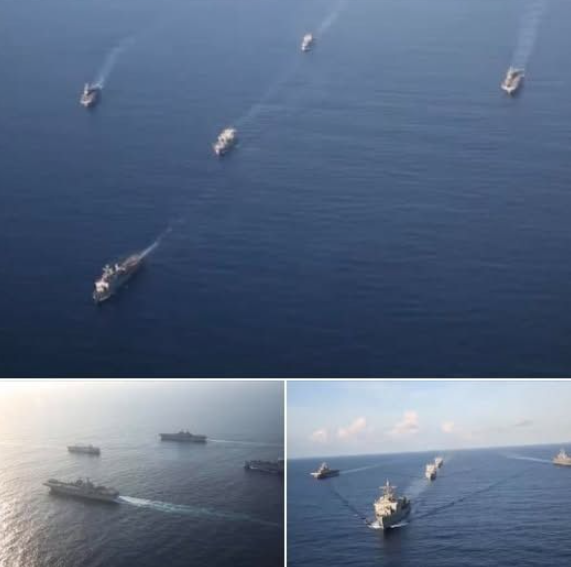
Key assets include amphibious assault ships like the USS Tripoli and USS New Orleans, carrying elements of the 31st Marine Expeditionary Unit (MEU) and approximately 2,200-3,500 Marines. These forces bring significant capabilities: AH-1Z Viper attack helicopters, MV-22 Osprey tiltrotors for rapid insertion, landing craft for amphibious operations, and integrated air-ground teams trained for high-intensity littoral combat.
This is not an isolated reinforcement. It bolsters existing carrier strike groups in the region, part of a broader 2026 U.S. military buildup in the Middle East—the largest since the 2003 Iraq invasion. CENTCOM assets include multiple carrier strike groups, air wings with F-35s and F-15Es, Army units like the 82nd and 101st Airborne, and special operations forces. The Marines provide flexible, expeditionary power projection suited for securing chokepoints, conducting raids, or supporting mine-clearing and escort operations.
Trump’s rhetoric has been characteristically direct. He has ordered the Navy to “shoot and kill” Iranian small boats deploying mines in the strait and announced operations like “Project Freedom” to guide stranded ships through contested waters. U.S. forces have engaged Iranian vessels, drones, and shore-based systems in self-defense, while conducting strikes to degrade Iranian capabilities.
Strategic Context: Why Hormuz Matters
Economically, the strait is irreplaceable in the short term. Alternative pipelines and routes cannot handle the volume. Disruptions spike oil prices, hurt consumers worldwide, and empower adversaries. Iran’s strategy relies on asymmetric warfare: cheap speedboats, naval mines, and proxies to impose costs without direct fleet-on-fleet battle.
Militarily, controlling or neutralizing threats in Hormuz allows freedom of navigation for U.S. and allied forces while denying Iran leverage. Trump has floated ideas like securing Iran’s Kharg Island—the primary oil export terminal handling most of Iran’s crude—as a potential pressure point or long-term guarantee against future disruptions.
This fits a “peace through strength” doctrine. By surging credible combat power, the U.S. aims to deter escalation, protect commerce, and force Tehran back to negotiations on nuclear issues, regional proxies, and ballistic missiles. Ceasefire talks have occurred amid clashes, but fragile truces have been punctuated by incidents.
Operational Realities and Risks
Marine Expeditionary Units excel in rapid response. They can clear mines alongside Navy teams, escort tankers, neutralize boat swarms, or seize key terrain if escalated. Attack helicopters and Ospreys enable over-the-horizon strikes against mobile IRGC threats that hide among civilian traffic or islands.
However, challenges abound. The strait is only about 21 miles wide at its narrowest, with shipping lanes even tighter. Iran’s arsenal includes thousands of mines, coastal missiles, and drone swarms. Urban littoral areas and proximity to Iranian mainland complicate rules of engagement to avoid civilian casualties or broader war.
U.S. forces have already demonstrated effectiveness: destroying small boats, intercepting drones and missiles, and conducting limited strikes on Iranian assets while maintaining that operations are defensive. Minesweepers operate under protection, and “shoot on sight” directives for mine-layers aim to restore deterrence.
Allies and partners play roles too. Gulf states host U.S. bases and provide logistical support. The UK and others contribute assets. Coordinated efforts reduce the burden on American forces.
Broader Implications
This deployment signals U.S. commitment to global commons. Energy security affects allies in Europe and Asia. Unchecked Iranian aggression could embolden China in the South China Sea or Russia elsewhere.
Domestically, it tests public appetite for Middle East engagements post-Afghanistan and Iraq. Supporters see it as necessary leadership; critics worry about mission creep. Trump’s approach emphasizes decisive action over prolonged nation-building, focusing on core interests: open sea lanes, counter-proliferation, and ally protection.
Iran faces internal pressures from protests, economic sanctions, and military losses. The regime’s survival hinges on projecting strength, yet sustained U.S. presence risks further degradation of its conventional and proxy forces.
Looking Ahead
As of mid-2026, the situation remains fluid. Ceasefires are tentative. U.S. Marines and naval forces continue patrols, escorts, and readiness drills. Diplomatic channels probe for de-escalation, potentially tying Hormuz access to Iranian concessions on its nuclear program and ballistic missiles.
The Marine strike force embodies expeditionary ethos: ready to fight tonight, scalable from presence to kinetic action. Whether it leads to breakthrough diplomacy or further clashes depends on Iranian calculations. History shows chokepoint crises often resolve when costs to the aggressor outweigh benefits.
In Trump’s calculus, projecting overwhelming strength—carriers, Marines, precision strikes—restores credibility eroded by years of perceived restraint. The message to Tehran and the world: America will not allow a radical regime to hold global energy hostage. The Hormuz campaign tests whether resolve backed by firepower can secure peace without full-scale war