The Brass Secret
Deep in the dusty drawer of an old oak cabinet, tucked beneath yellowed letters and a broken pocket watch, lay the object. My grandfather, a man whose life spanned continents and wars, had been a passionate collector—of stories as much as things. Coins from fallen empires, fountain pens that once signed treaties, fragments of airplanes from his mechanic days. But this piece felt different. Heavier with mystery.
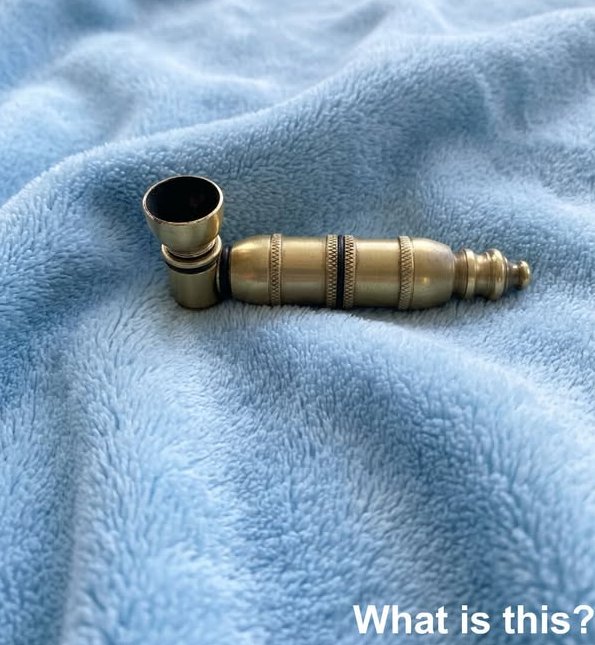
It was solid brass, tarnished to a warm, lived-in glow. About eight inches long, it featured a distinctive L-shaped bowl with a deep, blackened cup that spoke of countless fires. The stem was segmented with ornate bands—some knurled like rope, others smooth and elegant—ending in a rounded mouthpiece with a small decorative finial. Black rings of what looked like Bakelite or hard rubber separated the sections, preventing heat transfer. It had weight, presence, and the unmistakable patina of use. Not mass-produced junk, but something crafted with care.
At first glance, it resembled a classic gentleman’s tobacco pipe. But the proportions and the way the bowl angled suggested something more specific. After gentle cleaning with brass polish and soft cloths, the markings became clearer: faint engravings near the bowl base hinted at Indian or Middle Eastern origins, possibly early 20th century. This was no ordinary briar pipe. It was a brass hookah pipe stem or, more precisely, a portable Indian/Persian-style tobacco pipe often used with a small water base or standalone. Collectors call these “brass chillums” or “portable hookah mouthpieces,” but in grandfather’s world, it was simply “the old smoker.”
I sat on the edge of his worn leather armchair, the pipe resting in my palm, and the memories flooded back. Grandpa Raj was born in 1932 in a small Punjab village before Partition tore the subcontinent apart. He rarely spoke of those early years, but his collection told the story. As a young man he migrated, worked as a mechanic in the Gulf, fixed planes in East Africa, and finally settled in a quiet American suburb where he raised my mother. Between shifts, he collected. Every object had a tale.
I imagined the pipe’s journey.
It likely began in a bustling Lahore or Amritsar bazaar in the 1940s or 50s. A skilled artisan hammering brass sheets by hand, turning raw metal into elegant segments. The knurled grips were designed for sweaty hands in humid monsoon nights. The black rings—heat-resistant and elegant—came from early industrial rubber. Men would gather under banyan trees or on charpoys, passing such pipes after long days. Tobacco mixed with molasses, sometimes subtle spices or, in quieter company, discreet herbs. The water base (long lost) would gurgle softly, cooling the smoke, turning harsh draws into smooth conversation.
Grandpa probably acquired it during his Gulf years. Oil boom times brought merchants from everywhere. A fellow mechanic or a kind shopkeeper in Dubai’s old souk might have sold it to him. “For thinking,” the seller might have said. Grandpa smoked for decades—never heavily, but ritually. He’d sit on the back porch after dinner, pack the bowl with fragrant Cavendish or a pinch of his special “midnight blend,” and let the world slow down. My father remembered the sweet, earthy scent drifting through screen doors on summer evenings.
But the pipe was more than a smoking tool. It became a talisman.
In the 1970s, during one of his roughest patches—layoffs at the airline, marital strain, the weight of immigrant dreams—Grandpa carried it with him on long drives across the American Southwest. He’d pull over in the desert, light it under starlit skies, and talk to himself, to his ancestors, to God. The brass warmed in his hands like a living thing. He claimed it helped him breathe when anxiety tightened his chest. “This pipe has seen worse deserts than this one,” he’d mutter.
I polished it further, revealing tiny dents and scratches—battle scars. One deep scratch near the stem joint looked deliberate, almost like a repaired crack. Perhaps dropped during a hasty packing before a border crossing, or knocked over during a heated card game with fellow expatriates. The bowl’s interior was darkly seasoned, a glossy cake of carbon that serious pipe smokers prize. It told me the object had been loved.
As a boy, I was forbidden from touching “Grandpa’s treasures.” Now, holding it freely, I felt the strange privilege of inheritance. I researched late into the night. Similar pipes appear in antique listings from Rajasthan and Uttar Pradesh. Some were exported to British officers during colonial times as curios. Others were everyday items for locals. This one’s quality—thick brass walls, precise threading between sections—suggested it was made for a discerning user, perhaps a merchant or a minor noble who valued portability. Unlike fragile clay chillums, brass endured travel.
I tried to imagine specific moments. 1962: Grandpa in Kuwait, sharing the pipe with Pakistani engineers under a canvas tent while the call to prayer echoed at dusk. Stories of home flowed with the smoke— Partition horrors, family left behind, the hope of new beginnings. Or 1985: retired early, sitting in his garage workshop in California, pipe clenched between teeth while restoring a vintage motorcycle. The rhythmic puffing synced with the turning of wrenches. My grandmother would scold him gently about the smell, but she knew it calmed the restless man she married.
The pipe survived moves, grandchildren’s curiosity, and even a house fire that damaged half the garage. Grandpa rescued it first, before photo albums.
Now it rests on my desk. I don’t smoke, but I occasionally pack it with a pinch of aromatic tobacco on quiet evenings. The ritual feels like communion. Lighting it, drawing gently, the familiar gurgle absent but the flavor still rich. It connects me to a grandfather I lost too soon. To a life of movement, adaptation, quiet resilience.
Collectors often say objects carry energy. This brass pipe carries Grandpa’s—practical, adventurous, contemplative. It reminds me that some tools outlast their owners. They wait in dusty drawers for the next hand to discover their warmth.
If you listen closely while holding it, you can almost hear faint echoes: distant bazaar calls, the clink of tools on metal, soft laughter between old friends, and the slow exhale of a man finding peace wherever the road took him.
My grandfather’s passionate collecting wasn’t about hoarding. It was about preserving moments. This unassuming brass pipe, with its elegant curves and seasoned soul, is one of his finest legacies. Not valuable in dollars—though similar pieces fetch a few hundred on collector markets—but priceless in story.
I’ll pass it on one day, with its full history written down. Until then, it sits polished on the shelf, catching light, waiting for the next quiet evening when someone needs to slow down, breathe deep, and remember that even the smallest objects can carry entire lives across oceans and decades.