US Blockade Crushes Iran’s Oil Lifeline as China-Bound Tankers Turn Back
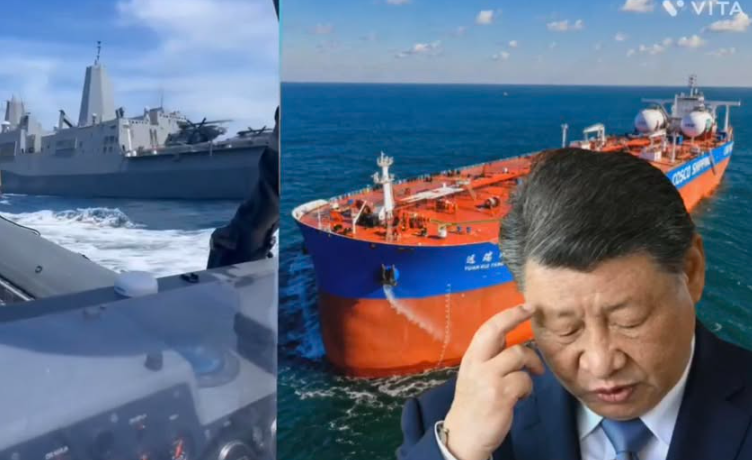
The escalating maritime confrontation in the Persian Gulf and surrounding waters has reached a critical phase, as a sweeping U.S. naval blockade increasingly disrupts Iran’s ability to export oil—its most important source of national revenue. Reports indicate that multiple China-bound tankers have been forced to turn back, reroute, or halt operations entirely, signaling a dramatic shift in the global energy and geopolitical landscape.
A tightening chokehold on Iranian exports
Since the blockade was implemented in April 2026, U.S. forces have significantly expanded their presence across the Gulf of Oman, the Strait of Hormuz, and nearby international waters. According to official military statements, the objective is to prevent vessels from entering or leaving Iranian ports, effectively cutting off the flow of crude oil to global markets.
Early data suggests the operation has already had a severe impact. Shipping analytics show that what was once a corridor of 125–140 daily transits through the Strait of Hormuz has collapsed to a fraction of that volume, with only a handful of ships passing through in recent days—and none carrying Iranian crude destined for export markets.
U.S. Central Command reports that dozens of vessels have been intercepted, redirected, or forced to turn around after approaching Iranian ports. In some cases, tankers have been boarded or disabled after attempting to breach the blockade zone.
China-bound shipments disrupted
One of the most significant developments is the disruption of shipments headed toward China, Iran’s largest oil customer. Several tankers loaded with Iranian crude have reportedly reversed course after encountering U.S. naval patrols enforcing the blockade.
Shipping intelligence data indicates that multiple vessels bound for East Asia were instructed to turn back or divert to alternative destinations in the Gulf region. In at least one documented case, six tankers carrying Iranian oil were forced back to Iranian ports after being intercepted in recent days.
These disruptions are particularly damaging for Tehran, as oil exports to China represent a major financial lifeline. Analysts estimate that billions of dollars in expected revenue are now delayed or lost due to the growing inability to deliver cargoes to buyers.
Military enforcement intensifies
The U.S. enforcement campaign has not been limited to verbal warnings or sanctions. Naval and air assets have been actively involved in stopping vessels suspected of violating blockade conditions. In recent incidents, U.S. forces have disabled tankers attempting to reach Iranian ports, including precision strikes and interdictions in the Gulf of Oman and nearby waters.
According to defense reports, more than 50 commercial vessels have been redirected since the start of the operation, while several others have been disabled or seized outright.
Officials describe the strategy as a layered enforcement system combining surveillance aircraft, destroyers, and carrier strike groups to monitor maritime traffic and prevent sanctioned oil exports from reaching international buyers.
Economic pressure on Iran deepens
The economic consequences for Iran are already becoming visible. Estimates from analysts and government sources suggest that the blockade has cost Tehran billions in lost oil revenue in a matter of weeks. Large volumes of crude are now reportedly stranded in storage tanks at export terminals, with limited capacity to move them out.
Satellite monitoring has also revealed congestion at major export hubs such as Kharg Island, where infrastructure strain and storage overflow risks are increasing. In some cases, environmental issues such as oil leaks and pipeline stress have been reported, adding to operational challenges.
Iran has attempted to mitigate the impact by relying on floating storage and ship-to-ship transfers in international waters. However, these methods are less efficient, more expensive, and increasingly targeted by U.S. sanctions enforcement.
The “shadow fleet” and evasion tactics
Despite the blockade, Iran continues to rely on a network of so-called “shadow fleet” tankers—older vessels operating under opaque ownership structures, often disabling tracking systems to avoid detection. These ships have allowed some continued exports, particularly through covert transfers far from the Persian Gulf.
However, even this system is under pressure. U.S. sanctions targeting intermediary shipping firms, foreign refineries, and oil buyers—especially in Asia—have made it more difficult for Iran to monetize its crude exports.
Some shipments still reach buyers through indirect routes, but analysts report that volumes have declined sharply compared to pre-blockade levels.
Strategic impact on global oil markets
The blockade has introduced significant volatility into global energy markets. With Iran historically supplying a meaningful portion of seaborne crude exports, the disruption has tightened supply conditions and raised concerns about long-term price instability.
The Strait of Hormuz, through which roughly one-fifth of global oil trade normally passes, has become a central flashpoint. Reduced traffic through the strait has not only affected Iranian exports but also created uncertainty for global shipping insurers, energy traders, and import-dependent economies.
At the same time, rerouted shipments and floating storage solutions have partially cushioned the global impact, preventing a total supply shock—for now.
China’s role and geopolitical balancing
China remains a key factor in the unfolding situation. As Iran’s largest oil customer, Beijing has historically relied on discounted Iranian crude delivered through complex shipping arrangements. While China has not officially challenged the blockade, analysts note that Iranian oil continues to reach Chinese markets through indirect and sometimes concealed channels.
However, the increased risk of interception has made these transactions more expensive and logistically difficult. Any escalation involving direct enforcement against China-linked shipments could significantly raise geopolitical tensions.
Risks of escalation remain high
Military analysts warn that the situation remains unstable. The blockade represents one of the most aggressive maritime containment strategies in recent decades, and Iran has not ruled out retaliatory actions, including missile or drone strikes on naval assets in the region.
Meanwhile, U.S. officials have emphasized that enforcement will continue unless Iran agrees to broader negotiations over its nuclear program and regional activities.
Conclusion
The U.S. blockade has already reshaped maritime traffic in and around the Persian Gulf, forcing tankers—especially those carrying Iranian oil toward China—to turn back or reroute. While not yet a complete shutdown of Iranian exports, the operation has significantly reduced flows, increased costs, and placed Iran’s oil-dependent economy under severe strain.
At the same time, the situation remains fluid. Iran’s use of shadow shipping networks, combined with global demand for oil and geopolitical backing from key partners, means that the blockade has not fully severed exports—but it has undeniably tightened the pressure.
The coming weeks will determine whether this maritime standoff stabilizes into a prolonged economic squeeze or escalates into a broader regional confrontation.