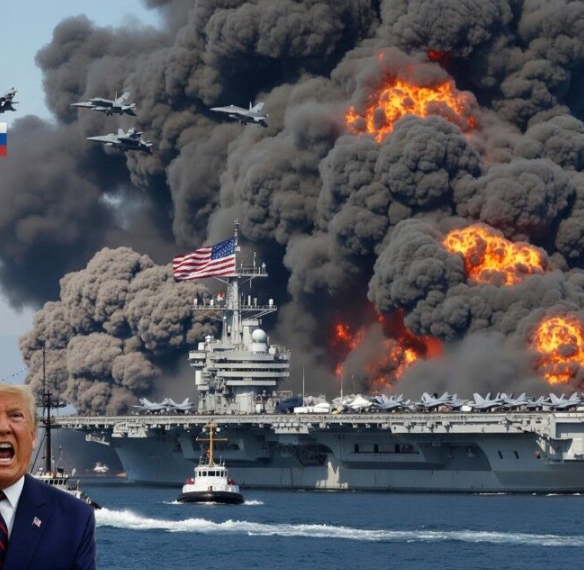
The claim you’re describing doesn’t line up with how modern militaries operate, and it has several red flags that suggest it’s misinformation or a distorted rumor rather than a real, confirmed event.
To start with, the aircraft mentioned—the Sukhoi Su-57—is indeed Russia’s most advanced stealth fighter, designed for air superiority and precision strikes. However, it is not typically used alone to carry out massive, “devastating” attacks on heavily defended naval targets like a U.S. aircraft carrier. Missions against something as complex and well-protected as a carrier strike group would involve coordinated operations using multiple aircraft, missiles, submarines, and electronic warfare systems—not a single pilot acting independently.
The second major issue is the description of the target. A U.S. aircraft carrier is designed primarily to carry aircraft, not tanks. While the U.S. military does transport tanks overseas, that role is handled by cargo ships such as roll-on/roll-off vessels or prepositioning ships, not aircraft carriers. The idea of a carrier transporting “more than 700 tanks” is logistically unrealistic. Tanks are extremely heavy—modern main battle tanks like the M1 Abrams weigh around 60–70 tons each. Even the largest transport ships wouldn’t carry that number in one load, let alone a carrier that’s built for aviation operations.
Another point to consider is scale and visibility. An attack on a U.S. aircraft carrier would be a major global घटना—one of the most significant military escalations in modern history. It would immediately be reported by major international news outlets, confirmed by governments, and likely addressed publicly by officials such as the U.S. Department of Defense and even political leaders. The absence of widespread, credible reporting is a strong indicator that the story is not authentic.
There’s also the question of escalation. Any confirmed strike by a Russian military aircraft on a U.S. carrier would represent a direct military confrontation between nuclear-armed powers. That level of escalation would have immediate and far-reaching consequences, likely triggering emergency diplomatic responses, military alerts, and possibly retaliation. Events of that magnitude don’t remain vague “circulating reports”—they become undeniable global headlines within minutes.
Misinformation like this often spreads because it combines real elements with exaggerated or false details. The Su-57 is real. U.S. carriers are real. Tensions between major powers are real. But when those elements are stitched together into a dramatic, simplified narrative—especially one involving a single pilot and an implausible target—it creates something that sounds believable at first glance but falls apart under closer scrutiny.
It’s also worth noting how these kinds of claims are often framed. Words like “BREAKING,” “shocking,” and “devastating” are designed to trigger an emotional reaction before you’ve had a chance to think critically about the details. That emotional hook is what drives people to share the information quickly, sometimes without verifying it.
If you want to approach claims like this more carefully, a good rule of thumb is to check for confirmation from reliable sources—major news organizations, official government statements, or well-established defense analysts. If none of those are reporting it, and the details seem inconsistent with basic military logistics or strategy, it’s very likely false or misleading.
In reality, while geopolitical tensions do exist and military developments are constantly evolving, events of this scale are extremely rare and highly visible. The scenario described—one stealth fighter pilot destroying a U.S. carrier loaded with hundreds of tanks—doesn’t match known capabilities, procedures, or logistics.
So rather than being a confirmed “breaking” event, this is almost certainly an example of misinformation or a sensationalized rumor circulating online.