There’s something strangely addictive about those “wait… what am I looking at?” images. The kind that make you pause, squint, tilt your head, and sometimes even feel a little embarrassed when the answer finally clicks. A collection like “16 photos that will put your brain to the test” isn’t really about eyesight—it’s about perception, assumptions, and how your brain tries to make sense of incomplete or misleading information.
Let’s walk through the kinds of images you’d typically find in a set like that, and more importantly, why they mess with your head.
The first type is the perfectly timed photo. Imagine a dog mid-jump, but captured at such an angle that its ears line up with a person standing behind it. Suddenly, it looks like the person has giant, fluffy ears. Your brain tries to merge the two subjects into one because it prefers a single, coherent story over multiple overlapping elements. Once you notice the separation, the illusion falls apart instantly.
Then there are forced perspective shots. Picture someone “holding” the sun between their fingers at sunset, or appearing to lean against a distant tower as if it’s right next to them. These work because depth is flattened in a 2D image. Without motion or context, your brain has to guess distances—and sometimes it guesses wrong.
Another classic is the camouflage image. Think of a forest floor covered in leaves, with an owl or a snake hidden almost invisibly in the pattern. At first, it looks like visual noise. But once someone points out the animal, you can’t unsee it. This taps into pattern recognition—your brain is constantly scanning for familiar shapes, but when something blends too well, it slips past your initial filter.
Some photos rely on reflections and mirrors. A building with mirrored windows might reflect the sky so perfectly that it looks like a hole in reality. Or a puddle on the ground might reflect a city skyline, making it seem like you’re looking down into another world. These images confuse your sense of orientation—what’s up, what’s down, and what’s solid.
Then there are optical illusions involving shadows. A shadow might appear to belong to a completely different object than the one casting it. For example, a person holding a small object might cast a shadow that looks like something much larger or entirely different. Your brain expects shadows to match their sources, so when they don’t, it creates a moment of cognitive dissonance.
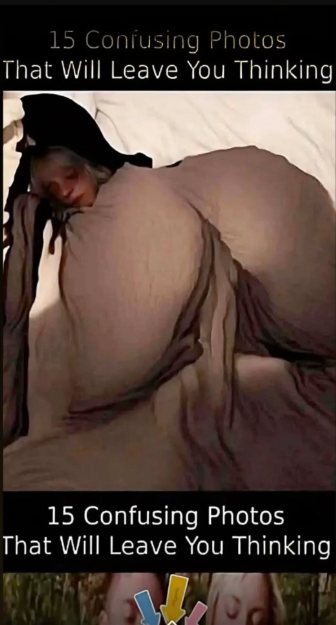
You’ll also find partial obstruction images. A cat sitting behind a glass table might look like it has no body—just a floating head and paws. Or a person lying on a couch might appear to be missing part of their torso because of how the cushions line up. These illusions happen because your brain fills in gaps based on what it expects to see, even when the visual data is incomplete.
Another favorite is the double-take composition. For instance, a photo where someone’s legs blend perfectly with another person’s body, making it look like a single, oddly proportioned figure. These are especially confusing because they involve real objects arranged in just the right way to create something impossible.
There are also scale illusions. A toy car photographed up close can look like a real vehicle, while a real mountain in the background might seem tiny compared to something in the foreground. Without familiar reference points, your brain struggles to judge size accurately.
Some images play with color and lighting. A dress that appears blue and black to some people but white and gold to others is a famous example of how lighting assumptions affect perception. Your brain tries to “correct” for lighting conditions, but different people make different assumptions, leading to completely different interpretations of the same image.
Then you have motion illusions in still images. Certain patterns—like repeating lines or spirals—can create the sensation that something is moving, even though it’s completely static. This happens because of how your visual system processes contrast and edges.
What makes all these images so compelling is that they expose the shortcuts your brain takes. You don’t consciously analyze every pixel of what you see—that would be exhausting. Instead, your brain uses heuristics: quick rules of thumb that usually work but can be fooled under the right conditions.
That’s why the “aha” moment feels so satisfying. It’s the instant your brain updates its interpretation and everything suddenly makes sense. It’s also why you might feel a little tricked—because, in a way, you were.
If you want to get better at spotting what’s really going on in these photos, there are a few tricks you can use. Slow down and scan the entire image instead of focusing on the most obvious subject. Look at edges and boundaries—where one object ends and another begins. Pay attention to shadows and reflections, since they often reveal the truth. And don’t be afraid to question your first impression.
At the end of the day, these “brain test” photos aren’t about how smart you are. They’re about how your perception works—and how easily it can be nudged in the wrong direction. That’s what makes them fun. They remind you that seeing isn’t always believing, and sometimes the most ordinary image can become extraordinary with just the right angle, timing, or trick of the light.