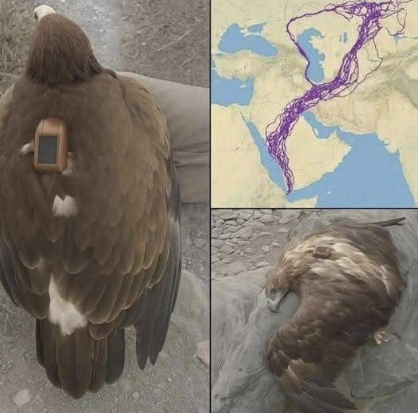
For nearly two decades, a single tagged eagle seemed to defy everything scientists thought they knew about migration. The story began in the early 2000s, when researchers working with the Smithsonian Migratory Bird Center fitted a young Golden Eagle with a GPS tracking device. The goal was straightforward: gather long-term data about migration routes, nesting habits, and survival patterns.
At first, the data came in exactly as expected. The eagle followed a recognizable seasonal rhythm, moving between northern breeding grounds and southern wintering areas. Its path traced mountain ridges and thermal currents, the invisible highways that large birds rely on to conserve energy. For the first few years, there was nothing unusual—just a steady stream of coordinates that helped confirm existing theories.
Then, something changed.
Around year five, researchers began to notice irregularities. The eagle started deviating from its established route. Instead of following predictable corridors, it veered into unfamiliar territory—sometimes flying hundreds of miles off course. At first, scientists assumed it was a temporary anomaly. Weather patterns, food scarcity, or minor GPS errors could explain short-term deviations.
But the pattern didn’t correct itself.
Year after year, the eagle continued to chart an increasingly erratic course. One season it would appear in regions where golden eagles were rarely documented. Another year, it would linger for weeks in a single remote location before suddenly resuming long-distance travel. The data points, when plotted on a map, looked less like a migration route and more like a tangled web of unpredictable decisions.
The mystery deepened when researchers noticed something even stranger: the eagle wasn’t just wandering—it seemed to be returning to specific, obscure locations with uncanny precision. These places weren’t known nesting grounds or feeding hotspots. Some were isolated mountain valleys, others barren stretches of land far from typical prey sources.
Speculation spread quickly within the scientific community.
Some researchers proposed that the eagle had discovered previously unknown ecological niches—hidden pockets of food or favorable conditions that hadn’t been documented. Others suggested that environmental changes, such as shifting climate patterns, were altering migration instincts in ways scientists didn’t yet understand.
There were also more unusual theories. A few scientists wondered whether the bird had experienced a neurological change, altering its navigational behavior. Birds rely on a combination of visual cues, magnetic fields, and learned experience to find their way. If any of those systems were disrupted, it could lead to unpredictable movement.
As the years passed, the eagle became something of a legend among researchers. It was no longer just a data point—it was a case study in uncertainty. Graduate students wrote papers analyzing its movements. Conferences featured debates about its behavior. The bird had, in a sense, become famous.
Then came the breakthrough.
After nearly 20 years of data collection, a team of researchers decided to overlay the eagle’s GPS path with a completely different dataset: historical land use and wildlife population records. What they discovered changed everything.
The eagle’s “erratic” movements weren’t random at all.
Instead, they aligned closely with long-forgotten migration routes—paths that had been used decades earlier by prey species that had since declined or shifted their ranges. In essence, the eagle appeared to be following an inherited map, one that no longer matched the modern landscape.
This realization reframed the entire mystery. Rather than behaving unpredictably, the eagle was demonstrating a kind of ecological memory—a persistence of instinct that outlived the conditions it evolved for. Its repeated visits to obscure locations weren’t mistakes; they were echoes of a past ecosystem.
The implications were profound.
If one eagle could retain and act on such deep-rooted patterns, what did that mean for other species? How many animals were navigating based on outdated environmental cues? And how might rapid changes—like urban development or climate shifts—be disrupting these ancient behaviors?
The case also highlighted the importance of long-term tracking. Without two decades of continuous data, the pattern might never have been recognized. Short-term studies could have dismissed the eagle’s behavior as random or anomalous, missing the deeper story entirely.
In the end, the eagle didn’t just puzzle scientists—it expanded their understanding of how animals interact with a changing world. It showed that behavior that looks irrational on the surface can have hidden logic rooted in history.
Even now, the story continues to circulate in scientific circles, often cited as a reminder: nature doesn’t always operate on timelines we easily understand. Sometimes, the answers only emerge when we’re willing to watch, question, and wait—no matter how long it takes